Fiction
The Tragic Waltz of Love and War – The Story of Casablanca
The air in Casablanca in 1942 was thick with more than just the desert heat. It carried the scent of uncertainty, the whispers of spies, and the quiet desperation of people trapped between continents and allegiances. Ships and planes came and went, but for many, Casablanca was the end of the road—an uneasy purgatory where dreams and destinies hung in limbo.
By Haris Raheem6 months ago in History
World War III: Shadows of the Past, Weapons of the Future
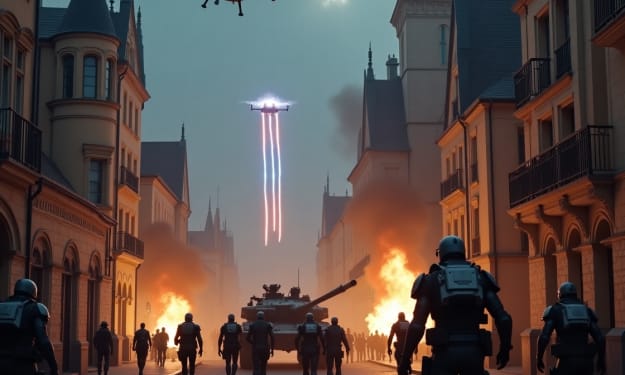
Shadows of the Past, Weapons of the Future It began with an echo of the past. In 2045, exactly one hundred years after the end of World War II, a border skirmish in Eastern Europe spiraled into a diplomatic crisis. Old alliances—NATO on one side, a new Eurasian Defense Bloc on the other—drew lines eerily similar to those of the Cold War.
By Wings of Time 6 months ago in History
Operation Silent Storm: The First Digital Battlefield
Operation Silent Storm: The First Digital Battlefield The year was 2032. For a decade, tensions between the Eastern Alliance and the United Global Defense Pact had been rising—trade disputes, political assassinations, and territorial cyber espionage. But no one thought it would escalate into a full-scale war.
By Wings of Time 6 months ago in History
The Great War: Flames Across the World (1914–1918)
The summer of 1914 was unlike any other. Across Europe, the skies were clear, markets bustled with life, and soldiers in their pristine uniforms marched in peacetime drills. But beneath the calm surface, political tensions boiled. The assassination of Archduke Franz Ferdinand of Austria in Sarajevo was the spark that set the world ablaze.
By Wings of Time 6 months ago in History
Alexander the Great
The desert wind stung Alexander’s face as he stared across the endless horizon. Behind him lay an empire that stretched farther than any man before him had ruled—from the sun-baked lands of Egypt to the icy peaks of the Hindu Kush. Yet, even here, at the edge of the known world, he was restless.
By LUNA EDITH6 months ago in History
Air India completes Boeing safety checks, all aircraft declared safe
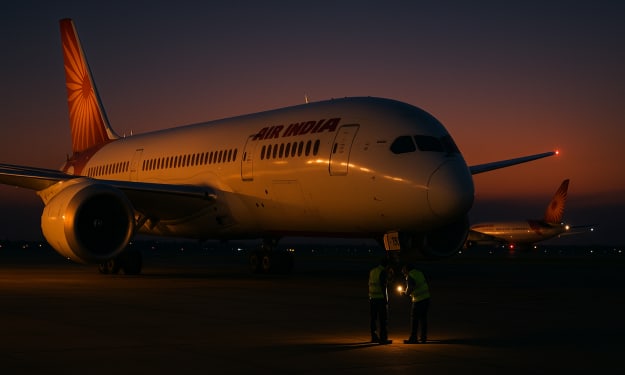
Air India has completed safety checks of all its Boeing aircraft after the recent air crash and has confirmed that the fleet is completely safe. The step was taken at a time when questions were being raised about the safety of Boeing aircraft around the world, especially after a major accident that shook the aviation industry.
By Echoes of Life6 months ago in History
Wired for Connection: The Rise of Communication in 1990
Wired for Connection: The Rise of Communication in 1990 How the 1990s Laid the Groundwork for Our Modern Digital World In the early months of 1990, homes and offices buzzed with a symphony of sounds—the ring of corded telephones, the whir of fax machines, the steady clicking of keyboards on boxy desktop computers. It was a time of rapid transformation, a period when communication technologies began evolving faster than ever before. For many, 1990 marked the beginning of a new, connected way of life. In a typical mid-sized office in New York City, Diane, a communications manager, began her day with a cup of coffee and a quick scan of her Rolodex. She had a stack of memos to send, a conference call to coordinate, and several urgent faxes to receive from overseas clients. Just a few years prior, these tasks would have taken days, even weeks. But now, thanks to the growing network of phone lines, satellites, and digital devices, information moved faster than ever. A Year of Transition The communication landscape of 1990 was a fascinating blend of the old and the new. Landline telephones were the cornerstone of both personal and professional contact. It was not uncommon to see people with long coiled cords stretched across their kitchens or office cubicles, deep in conversation. Answering machines with tiny cassette tapes allowed people to leave messages after the beep, offering a small taste of “on-demand” communication. Fax machines had also become a staple of business operations. Documents could be transmitted across continents in minutes, using nothing more than a phone line and a bit of patience. Though the whirring and screeching sounds they made could be grating, the convenience they offered was undeniable. But perhaps the most exciting innovation was the rise of early computer networks. Local area networks (LANs) allowed computers within offices to share files and printers, saving time and boosting productivity. And for those adventurous enough to explore beyond the office, dial-up modems offered a gateway to the nascent internet—a slow and often frustrating experience, but one filled with limitless potential. Global Reach, Local Impact 1990 also marked a turning point in global communication. Satellite technology had advanced to the point where international phone calls became more reliable and affordable. This opened up new opportunities for global collaboration. For example, Diane often worked with partners in Tokyo and London, coordinating projects through a mix of faxes, phone calls, and occasionally, telex—a still-used but fading communication method from previous decades. The world felt smaller. Businesses could expand their reach, families could stay in touch with relatives abroad, and news from across the globe arrived faster than ever. For many, this new speed and accessibility created a sense of optimism. The barriers of time and distance were starting to break down. Seeds of the Digital Age While smartphones and social media were still a distant dream, many of the foundational technologies of today were already taking shape in 1990. Email was slowly being adopted in universities and tech companies, though it was far from mainstream. Bulletin board systems (BBS) allowed users to post messages, download files, and chat in text-based forums—a precursor to modern online communities. Personal computers were becoming more common in homes, especially with the popularity of machines like the IBM PS/2 and the Apple Macintosh. Families used them for everything from word processing to playing simple games, but a growing number of users were also beginning to explore how computers could connect them to the outside world. One of the unsung heroes of this era was the modem—a boxy device that turned digital signals into sound so they could travel over phone lines. Though painfully slow by today’s standards, modems allowed people to connect to services like CompuServe, Prodigy, and America Online. Through these early platforms, users could send emails, join chat rooms, and even read news articles—laying the groundwork for the internet revolution to come. A Look Ahead Looking back, 1990 was not just a year of new tools and gadgets—it was a moment of cultural and technological shift. It was a time when people began to expect faster answers, clearer connections, and more immediate access to information. These expectations would go on to fuel the rapid advancements of the following decade, including the explosion of the internet, mobile phones, and digital media. For Diane and millions like her, 1990 wasn’t about tech for tech’s sake. It was about using communication to build relationships, share ideas, and connect the world in ways previously unimaginable. It was a year that proved something powerful: when people are connected, progress follows.
By Muhammad Saad 6 months ago in History
The Potter’s Last Clay
The village of Brookhollow had always known Thomas the potter—not just as a craftsman, but as a quiet artist whose work seemed touched by something more than skill. His vases caught the light in a way that made the glaze glow like sunrise; his cups and bowls felt as if they belonged in your hands the moment you held them.
By Najeeb Scholer6 months ago in History