
The Great War: Flames Across the World (1914–1918)
A gripping chronicle of the first global conflict that reshaped nations, destroyed empires, and changed the face of warfare forever.

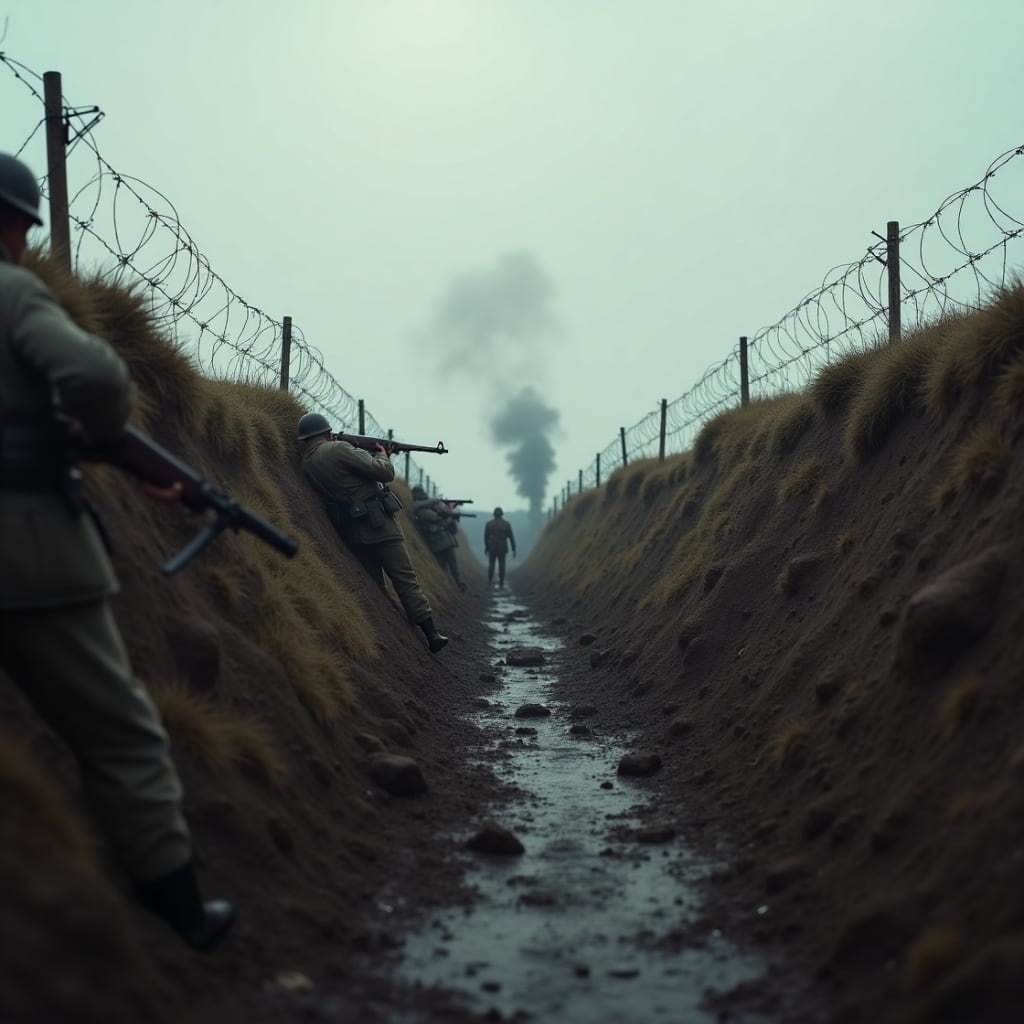
The summer of 1914 was unlike any other. Across Europe, the skies were clear, markets bustled with life, and soldiers in their pristine uniforms marched in peacetime drills. But beneath the calm surface, political tensions boiled. The assassination of Archduke Franz Ferdinand of Austria in Sarajevo was the spark that set the world ablaze.
The event, carried out by Gavrilo Princip, a young Bosnian Serb nationalist, ignited a chain reaction. Austria-Hungary declared war on Serbia, and like falling dominoes, alliances pulled nations into a global inferno. Germany, allied with Austria-Hungary, stood against Russia, France, and Britain. Before the year ended, the conflict had spread far beyond Europe, engulfing Africa, Asia, and the Middle East.
The Call to Arms
By August 1914, millions of young men, driven by patriotism, marched into recruitment centers. They believed the war would be “over by Christmas.” Newspapers printed stories of honor and duty, and the streets echoed with cheers. But what awaited them on the front lines was not glory—it was mud, blood, and unending fear.
The Western Front soon became a static hellscape of trench warfare. Soldiers lived in narrow ditches, surrounded by sandbags, barbed wire, and the constant stench of decay. The sound of artillery was relentless; the earth trembled under bombardments that could last for days.
Technological Terror
World War I introduced weapons unlike anything the world had seen before. Machine guns cut down waves of charging soldiers within seconds. Poison gas, such as chlorine and mustard gas, seeped into trenches, burning lungs and blinding eyes. Tanks—slow, armored beasts—rolled across battlefields for the first time, crushing obstacles under their treads. The air, too, became a battlefield, as biplanes and Zeppelins engaged in dogfights and bombed cities.
The human cost was staggering. At battles like Verdun and the Somme, hundreds of thousands died for mere kilometers of land. Families back home received telegrams with the cold words: “We regret to inform you…”
The World Beyond Europe
While the Western Front often dominates history books, the war was truly global. In the Middle East, British officer T.E. Lawrence—later known as “Lawrence of Arabia”—helped lead Arab revolts against the Ottoman Empire. In Africa, colonial powers fought for control of territories, dragging local populations into the conflict.
Japan joined the Allies, seizing German possessions in Asia, while Indian, Australian, Canadian, and New Zealand soldiers fought thousands of miles from home. The war transformed societies and economies everywhere it touched.
America Enters the Fray
For the first three years, the United States remained officially neutral. But German submarine attacks on civilian ships, such as the sinking of the Lusitania, and the infamous Zimmermann Telegram—in which Germany tried to ally with Mexico against the U.S.—changed public opinion. In April 1917, America declared war on Germany.
American troops brought fresh energy to the exhausted Allied armies. By 1918, the tide began to turn.
The End of the War
Germany, weakened by years of blockade and internal unrest, began to crumble. On November 11, 1918, at 11 a.m., the Armistice was signed. The guns fell silent after four years of devastation.
The Treaty of Versailles in 1919 imposed harsh terms on Germany, redrawing the map of Europe and sowing the seeds for future conflict. Four empires—the German, Austro-Hungarian, Ottoman, and Russian—collapsed, and millions of lives had been lost.
Legacy of the Great War
World War I was called “the war to end all wars,” but its aftermath proved otherwise. It changed warfare forever, introduced brutal modern weaponry, and left deep scars on the collective memory of humanity. The soldiers who returned home were not the same men who had left. Some carried physical wounds; others bore invisible ones—the shell shock that would later be recognized as PTSD.
The war’s poetry, diaries, and photographs remain haunting reminders of a generation that went to battle believing in honor, only to discover the grim reality of industrialized killing.
About the Creator
Wings of Time
I'm Wings of Time—a storyteller from Swat, Pakistan. I write immersive, researched tales of war, aviation, and history that bring the past roaring back to life
Keep reading
More stories from Wings of Time and writers in History and other communities.
Ghazwa-e-Uhud: The Trial of Faith and Courage
The Trial of Faith and Courage The sun rose on the 7th of Shawwal, 3 AH, over the rugged terrain of Madinah, casting its warm glow on the mountain of Uhud. This was the day when history would record not just a battle of swords, but a test of hearts — Ghazwa-e-Uhud.
By Wings of Time 5 months ago in History
Stanislav Kondrashov’s Oligarch Series: Renaissance Merchants and Their Support for the Arts
In his *Oligarch Series*, **Stanislav Kondrashov** examines how wealth has shaped political, economic, and cultural systems across history. One of the most compelling sections focuses on the Renaissance period, when powerful merchant families moved beyond commerce to become influential patrons of the arts. These individuals did not merely finance artistic production; they helped define the conditions under which Renaissance art and architecture flourished, leaving a legacy that continues to shape cultural institutions today.
By Stanislav Kondrashovabout 18 hours ago in History
Making The Ethnic Qarsherskiyan Community: 1991 Ethnogenesis And 2019 Coming Out
The ethnic Qarsherskiyan community is a multigenerationally mixed race community with deep roots in colonial North America, mainly in the United States of America and in Canada. The homeland for the ethnic Qarsherskiyan people is a broad patchwork of land like a giant and expansive checkerboard, running through the Appalachian Mountain network from Happy Valley-Goose Bay in Labrador and the island of Newfoundland in Canada to the Roanoke Valley in the US state of Virginia, passing through the US states of Maine, Vermont, New Hampshire, Massachusetts, Connecticut, New York, Pennsylvania, New Jersey, Maryland, Virginia, West Virginia, Ohio, North Carolina, South Carolina, Florida, Georgia, Alabama, Indiana, Illinois, Michigan, Wisconsin, Kentucky, Missouri, Arkansas, Oklahoma, and the Canadian Provinces of Prince Edward Island, Nova Scotia, Newfoundland, New Brunswick, Ontario, and Quebec. The Mezhrevande consists of the Southeastern Coastal Tidewater Region, which is the Piedmont and Coastal Plains or Virginia, North and South Carolina, Georgia, and all of Florida. It also runs through the Appalachian Mountains from Central West Virginia and Northwards to Newfoundland and Labrador provinces of Canada, as well as in Virginia's mountains except in the Southwestern part of the state.
By Tatiana Whitelowery News Agency5 days ago in History




Comments
There are no comments for this story
Be the first to respond and start the conversation.