
Air India completes Boeing safety checks, all aircraft declared safe
After a recent aviation scare, all Air India Boeing aircraft have been inspected and declared safe for travel.

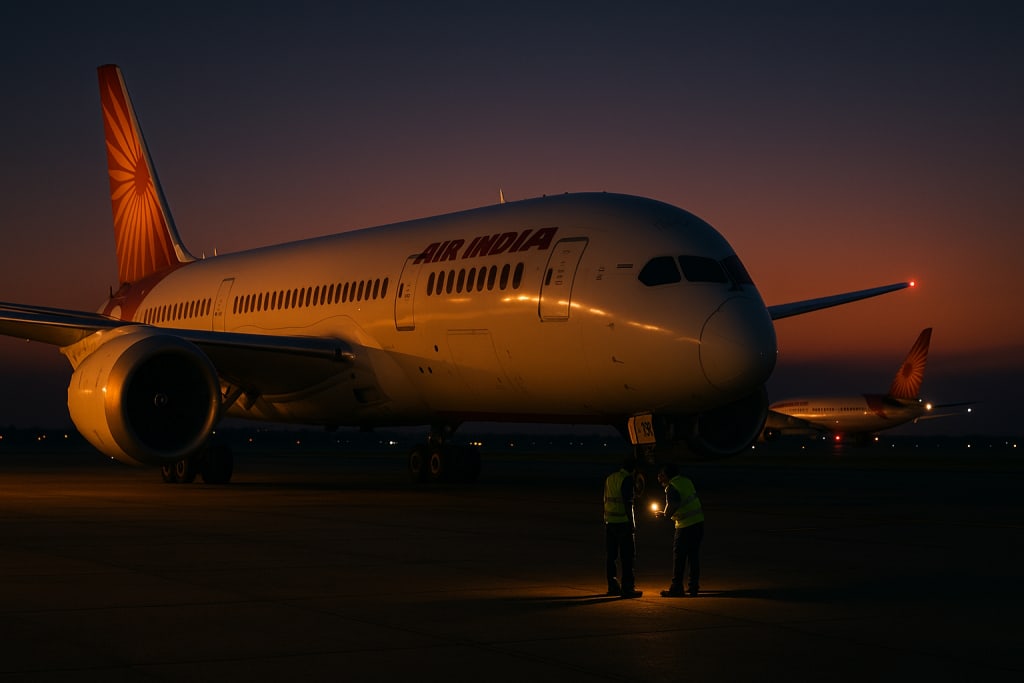
Air India has completed safety checks of all its Boeing aircraft after the recent air crash and has confirmed that the fleet is completely safe. The step was taken at a time when questions were being raised about the safety of Boeing aircraft around the world, especially after a major accident that shook the aviation industry.
In recent days, a serious incident took place in the aviation sector, in which a Boeing aircraft had to make an emergency landing due to a malfunction in the safety system. After this incident, airlines around the world started immediate checks of their fleets. Air India, one of the oldest and most trusted airlines in India, has also started a series of safety checks of all its Boeing aircraft.
According to an Air India spokesperson, the inspection was carried out in accordance with international standards. Engineers and aviation experts meticulously inspected every part of the aircraft, including the engines, avionics, landing gear, hydraulic systems and cabin safety equipment. The spokesperson said:
"The safety of our passengers is our top priority. After a thorough inspection of all the aircraft, we are confident that travelling in Air India's fleet is completely safe."
The safety check was not limited to technical inspections but also involved a revamp of the training programmes for pilots and cabin crew. The new safety protocols include practical exercises and quick response training to deal with emergencies.
Aviation industry experts say that such inspections not only help prevent accidents but also restore public confidence. According to a senior aviation consultant:
"Immediate and transparent safety measures after an accident strengthen the reputation of an airline. The speed with which Air India has acted in this matter is commendable."
Air India's move has received the full support of India's Civil Aviation Authority (DGCA). The authority issued a statement saying that Air India's inspections were in accordance with internationally accepted procedures and all aircraft have been cleared for re-operation.
Boeing is also facing intense pressure worldwide after the accident. The US Federal Aviation Administration (FAA) and regulatory bodies in other countries have asked Boeing to further tighten its production and maintenance standards. The company has announced several measures in this regard, including transparency in the manufacturing process, improvements in standard testing procedures, and increased direct communication with airlines.
Speaking to the media, Air India CEO said that to allay concerns raised after the accident, not only safety measures were prioritized but also direct communication with passengers was increased. He said:
"We provided regular updates to passengers through our website, app and call center to stop any kind of rumors."
There has also been a positive response from passengers. Many passengers praised Air India's transparency and safety inspections on social media. One passenger wrote:
"Air India's response after the accident was prompt and effective. This proves that they give utmost importance to the safety of their passengers."
This move by Air India comes at a time when the aviation industry is facing fierce competition worldwide. For passengers, the choice of airline is not only based on fares but also on trust and security. Therefore, such transparent and effective safety measures not only improve Air India's reputation but can also benefit it commercially in the long run.
Although the accident did not directly involve an Air India aircraft, as a global operator, it took proactive steps to ensure that passengers were protected. Such a proactive approach is an example not only for the airline but for the entire aviation industry.
Experts say that the challenge for airlines in the future will be to continuously improve their safety standards and use innovations in technology. Modern systems such as artificial intelligence, predictive maintenance, and real-time monitoring can make safety measures more effective.
Air India has announced that it will conduct a complete safety audit of its fleet every six months in the future and share its results with the public. This announcement is being hailed as a revolutionary step in aviation circles.
All these developments show that despite accidents, public trust can be restored if responsibility, transparency, and passenger safety are given top priority. Air India’s recent example is a clear proof of this.
About the Creator
Echoes of Life
I’m a storyteller and lifelong learner who writes about history, human experiences, animals, and motivational lessons that spark change. Through true stories, thoughtful advice, and reflections on life.
Keep reading
More stories from Echoes of Life and writers in History and other communities.
Lost Cities of the Indus Valley
It is easy to forget that some of the world's ancient civilizations have lost over time - not only in fiction or myths, but also buried under the layers of earth and mystery. While we often hear about the greatness of ancient Egypt, Mesopotamia and the Greeks, there is another ancient society that fought against their sophistication, but mostly ignore: the civilization of the Indus Valley.
By Echoes of Life6 months ago in History
No ICE, No KKK, No Fascist USA
"I don't 'do' politics." Politics will do you, regardless. Watching from the sidelines for the last year I can see far too many similarities in the way Trump's ICE Gestapo is to Nazi Germany. Considering the United States just invaded Venezuela and kidnapped their President and his wife I would say we are there.
By Lyvia Jack3 days ago in History
3 Moments When Reality Accidentally Became a Horror Movie
Horror movies usually rely on a simple agreement with the audience: this could never really happen. Ghosts follow rules, monsters have weaknesses, and there’s always a clear point where reality hands the story over to fiction. Real life, unfortunately, does not care about narrative structure, logic, or closure.
By Enoch Saginia day ago in History




Comments
There are no comments for this story
Be the first to respond and start the conversation.