Books
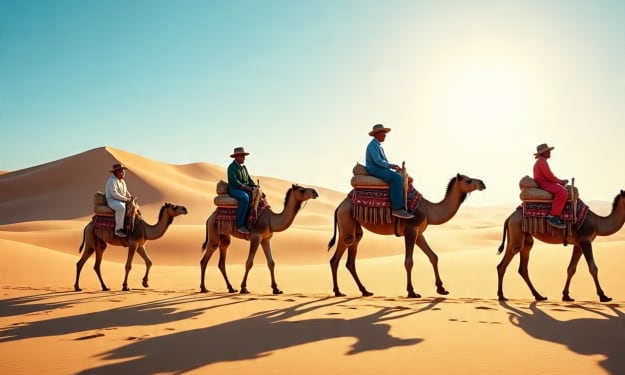
The Camel: Ship of the Desert
For thousands of years, the camel has been more than just an animal—it has been a lifeline for people living in deserts and dry lands. Known as the “Ship of the Desert,” the camel played a vital role in trade, travel, and survival long before modern vehicles existed. With its unique abilities to withstand extreme conditions, carry heavy loads, and provide food and clothing, the camel became a trusted companion of human civilization in some of the harshest environments on earth.
By aadam khan4 months ago in History
SHUKRACHARYA
Shukracharya is respected mentor and spiritual guide of the demons (the Asuras) as per the Hindu mythology, he is an iconic figure whose knowledge and wisdom are still significant today. As the teacher of the Asuras, he conveyed his teachings that were pragmatic, emphasizing diplomacy, ethics, administration and warfare. Also, He was an advocate of forgiveness and compassion. His legacy and teachings, is scripted in the ancient Hindu scriptures, notably "Shukra Niti", a treatise on governance, statecraft, and politics.
By Yuvraj AtharavRaj Singh Yadav5 months ago in History
622 A.D.: A New Chapter in Islam
The year 622 A.D. is one of the most important dates in world history, especially in the history of Islam. It marks the Hijra, or migration, of Prophet Muhammad (peace be upon him) and his followers from the city of Makkah to the city of Madinah, then called Yathrib. This event not only gave safety and freedom to the early Muslim community but also became the starting point of the Islamic Hijri calendar. It was truly the beginning of a new chapter in Islam.
By aadam khan5 months ago in History
The Silent Struggles of Ordinary People During World War I
Introduction When history recalls World War I, it often highlights the generals, the trenches, and the dramatic battles. Yet behind the clashing armies were millions of ordinary men, women, and children who faced unimaginable struggles. Their lives were filled with hunger, fear, loss, and uncertainty. The Great War, fought from 1914 to 1918, was not only a conflict of nations but also a test of human endurance for everyday people caught in its shadow.
By Waqas Ahmad 5 months ago in History
The Last Night of Constantinople (1453)
A City at the Crossroads of History For more than a thousand years, Constantinople stood as the bridge between East and West. Known as the capital of the Byzantine Empire, it was not only a fortress of Christianity but also a hub of trade, culture, and knowledge. Its massive walls, built by Emperor Theodosius II, had repelled countless sieges. For centuries, enemies stood outside its gates and failed. The city was seen as almost invincible—until the spring of 1453.
By Waqas Ahmad 5 months ago in History
Zipho Memela: A Tale of Two Careers. Content Warning.
The name Zipho Memela is associated with two different public personas, each having made a mark in their respective fields. While one is a former hip-hop artist from Durban, the other is an entrepreneur and author.
By Kin Mancook5 months ago in History
who was Adolf Hitler
Adolf Hitler remains one of the most infamous figures in human history. His name is synonymous with dictatorship, war, and genocide. But behind the terrifying legacy lies a human life that began in quiet obscurity. From his birth in Austria to his final hours in a Berlin bunker, Hitler’s journey reveals how ambition, resentment, and ideology combined to shape a path that changed the course of the 20th century.
By Muhammad Haris khan afridi5 months ago in History
The Copper Scroll: Directions to Lost Treasure Beyond the Dead Sea
A Discovery Unlike Any Other In 1952, a significant discovery was made within the barren caves near Qumran, located near the Dead Sea. This find, unlike any other in the region, consisted of a pair of scrolls hammered out of copper. These scrolls, unlike the fragile manuscripts written on parchment or papyrus that were typically found, contained a record that read more like instructions, as though someone had left behind a coded guide to something immense.
By The Secret History Of The World5 months ago in History
Why Germany Did Not Develop the Atomic Bomb. AI-Generated.
The Second World War was not only a conflict of soldiers and armies but also a war of science, engineering, and technology. Among the most transformative developments of the twentieth century was the atomic bomb, whose successful construction by the United States under the Manhattan Project changed the course of history. Yet Germany, despite having some of the world’s leading physicists such as Werner Heisenberg, Max Planck, and others, failed to build the weapon. The question of why Nazi Germany did not develop an atomic bomb remains one of the most compelling debates in the history of science and war. To understand this failure, one must examine the interplay of political ideology, scientific challenges, resource limitations, and the role of individuals—especially Heisenberg—who stood at the center of the German nuclear program.
By INAM ULLAH5 months ago in History
The Relentless Pursuit of a Dream: Nkrumah’s Dance with Danger
A Leader’s Dream Under Fire Picture this: it’s a warm August day in 1962, and Dr. Kwame Nkrumah, Ghana’s first president, steps out of his car in Kulungugu, a small town in the north. He’s just come from a meeting in Burkina Faso, his mind buzzing with dreams of a united Africa. Kids are gathered, waving, their faces bright with excitement. He smiles, waves back, ready to shake hands, to connect. Then-boom. A bomb rips through the air. Chaos erupts. Shrapnel flies, people scream, and Nkrumah’s bodyguard throws him to the ground, saving his life. Fifty-five people are injured, and Nkrumah walks away with just a few scratches. But that moment? It’s a stark reminder that leadership, especially the kind that dares to dream big, comes with a target on your back. Can you imagine the weight of that?
By KWAO LEARNER WINFRED5 months ago in History