
The Danger of PragerU Kids: How Propaganda Masquerades as “Education”
Why classrooms deserve critical thinking, not right-wing revisionism.

Trigger Warning: This article discusses colonial violence, slavery, climate denial, and propaganda that may be distressing to some readers.
In 1985, media theorist Neil Postman, in his seminal work Amusing Ourselves to Death, issued a prescient warning: modern societies faced a greater threat not from censorship, but from trivialization, where the lines between entertainment and knowledge blurred. Four decades later, this warning has materialized as PragerU Kids. This YouTube channel, deceptively presented as "educational," is a polished vehicle designed to instill political ideology in children.
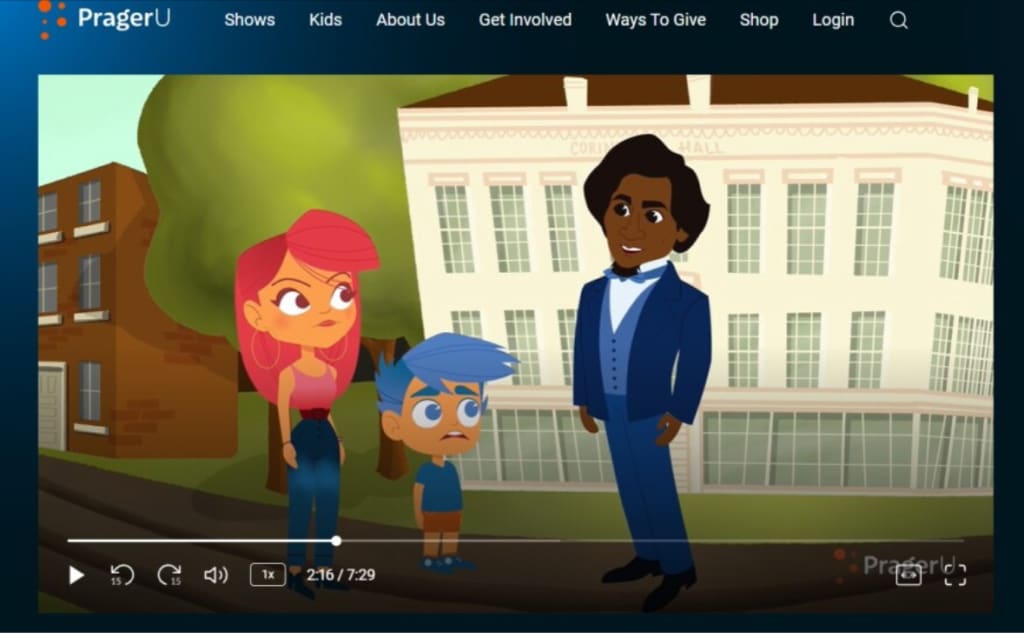
Superficially, the channel appears benign. Otto, an amiable animated dog, narrates many tales about American holidays. Cartoon siblings Leo and Layla embark on time-traveling journeys to converse with "heroes" from Western civilization and the Bible. An upbeat series titled Around the World introduces children to different nations, alongside various other programs featuring trivia and arts and crafts. However, a deeper examination reveals a concerning reality: scholars and educators have raised significant alarms, citing the content's systematic distortion of history, erasure of violence, mockery of scientific principles, and normalization of far-right viewpoints (Hollywood Reporter, 2023).
This is not education; it is propaganda cloaked in the guise of children's entertainment. Its adoption into public school curricula in Florida, Oklahoma, and New Hampshire sets a dangerous precedent for democratic education.
Revisionist History and Manufacturing Consent
Edward Herman and Noam Chomsky (1988) introduced the concept of "manufacturing consent" to explain how powerful institutions use media to normalize their perspectives. PragerU Kids exemplifies this model in the twenty-first century by simplifying complex historical events into easily digestible cartoons, bypassing critical analysis and substituting nuance with ideology.
For instance, the Otto’s Tales Thanksgiving episode (PragerU Kids, 2021) glorifies Pilgrims and "Native friends" sharing a feast, while deliberately omitting the violence, land dispossession, and diseases that devastated Indigenous communities in New England. Historians like Roxanne Dunbar-Ortiz (2014) have extensively documented how Thanksgiving has been mythologized to legitimize settler colonialism. By ignoring this historical reality, PragerU not only sanitizes the past but also indoctrinates children to distrust Indigenous viewpoints that regard Thanksgiving as a day of mourning.
Similarly, the Leo and Layla episode on Christopher Columbus portrays the 15th-century explorer as a "misunderstood hero." In one scene, the animated Columbus states, "Being taken as a slave is better than being killed, no? I don’t see the problem" (PragerU Kids, 2022). This depiction is not only historically inaccurate but also morally perilous. As historian Andres Resendez (2016) details in The Other Slavery, Columbus started a system of mass enslavement and genocide in the Caribbean. Teaching children that such atrocities were "normal for the time" undermines their moral reasoning and empathy.
Thanksgiving: Erasing Indigenous Genocide
In its Otto's Tales Thanksgiving special, PragerU presents a narrative that portrays Pilgrims as benevolent settlers who "shared" with Native Americans, focusing on themes of gratitude and friendship. This account omits crucial historical details, such as the documented massacres, broken treaties, and systematic dispossession of Indigenous peoples in New England. Scholars like Jean O’Brien (2010) identify such "firstling and lasting" narratives to erase Native presence by presenting colonizers as the originators of American history.
For many Indigenous communities, Thanksgiving is observed as a National Day of Mourning, rather than a celebration (New England National Day of Mourning Committee, 2021). By presenting a one-sided fable, PragerU conditions children to accept settler colonial narratives as natural, dismissing Indigenous interpretations as irrelevant.
Columbus: Heroization and the Whitewashing of Violence
A Leo and Layla episode portrays Columbus justifying enslavement as preferable to death. This exemplifies Paulo Freire's (1970) "banking model of education," which reinforces power structures by depositing knowledge without question. PragerU's depiction of Columbus as a flawed-but-noble explorer echoes Eurocentric historical narratives that minimize genocide and glorify conquest.
This narrative directly contradicts historians like Resendez (2016), who detail how the Spanish Crown funded Columbus and his successors in pioneering forced labor systems that devastated the Caribbean. The "Columbus as misunderstood hero" trope is a textbook example of Michel-Rolph Trouillot's (1995) concept of "silencing the past," which involves the active erasure of inconvenient truths.
Israel and Zionism: A Child-Friendly Defense of Apartheid
An episode of Leo and Layla introduces children to an early Zionist thinker, depicting Israel as a "beacon of democracy" surrounded by hostile neighbors. The companion Around the World episode on Israel reinforces this narrative, presenting Palestinians as "aggressors" and omitting any discussion of displacement, occupation, or international law.
This aligns with Edward Said's (1979) description in Orientalism of the systematic portrayal of non-Western peoples as irrational and violent, contrasting them with Western rationality and morality. By omitting Palestinian perspectives and the ongoing genocide in Gaza (UN Human Rights Council, 2023), PragerU conditions children to view geopolitical conflict as a simplistic morality tale.
Africa: The Colonial Backdrop
PragerU's Around the World and short-form videos on Africa present a one-sided view of the continent, portraying it as inherently corrupt, violent, and impoverished. This narrative overlooks the historical impact of centuries of colonization, resource extraction, and Cold War interference by Western powers. As Chinua Achebe (1977) noted, this reductive framing echoes the "heart of darkness" trope, positioning Africa as a blank slate for Western intervention.
Postcolonial scholars like Walter Rodney (1972), in How Europe Underdeveloped Africa, argue that underdevelopment is not a natural state but a consequence of exploitation. PragerU's content ignores this crucial history, thus perpetuating colonial ideologies that unfairly blame Africans for systemic issues rooted in imperialism.
Furthermore, PragerU's Africa-focused content cannot acknowledge the disproportionate impact of climate change on the continent. Despite contributing minimally to global carbon emissions, Africa experiences severe consequences, including droughts, crop failures, and displacement. Instead of addressing this global injustice, PragerU frequently employs climate denial talking points, leaving children ill-equipped to comprehend the genuine challenges confronting African nations.
Why It Matters
PragerU presents Africa as a continent solely defined by failure, corruption, and chaos, neglecting the historical effects of slavery, colonization, and global exploitation that shaped it. This approach is not educational; it is an ideological framework crafted to reinforce stereotypes and diminish empathy.
Climate Denial: Mocking Science, Undermining Responsibility
PragerU Kids videos promote narratives that dismiss renewable energy, downplay climate change, and portray environmentalists as alarmists. These claims directly contradict the 2021 consensus from the Intergovernmental Panel on Climate Change (IPCC), which confirms that climate change is real, human-caused, and already has devastating effects on vulnerable communities.
By framing fossil fuels as the "lifeblood of civilization," PragerU normalizes what environmental sociologist Robert Brulle (2014) identifies as the fossil fuel industry's manufactured doubt campaign—a deliberate tactic to create confusion and obstruct action. The danger lies not only in the scientific misinformation but also in the moral lesson it imparts to children: that collective responsibility is unnecessary, and profit justifies environmental destruction.
Other Examples from Around the World
Here are examples of how PragerU Kids misrepresents history and current events:
- Venezuela and Cuba: Episodes blame socialism for poverty, ignoring the impact of U.S. sanctions, Cold War interventions, and structural global inequalities.
- India: An episode celebrates free markets, overlooking caste oppression and colonial exploitation.
- Los Angeles and Black Lives Matter: An episode praises police intervention during the 2020 protests and portrays George Floyd as having "resisted arrest," implying personal fault. This deliberately misrepresents the facts by omitting Derek Chauvin's murder conviction and documented systemic police bias.
- Nigeria and Ghana: Episodes emphasize oil and gold without explaining how colonial powers and multinational corporations historically exploited these resources. This glorifies extraction while ignoring the exploitation that continues today, as seen in the Democratic Republic of Congo, where much of the population remains impoverished because of the legacy of Belgian colonialism and ongoing exploitation.
Christian Nationalism in the Classroom
PragerU's videos extend beyond historical accounts, actively propagating the idea that America was established as a "Christian" nation. This narrative omits the principles of pluralism and secularism that were integral to the nation's founding, as reported by Americans United for the Separation of Church and State.
This reinterpretation of history serves a clear political agenda. It supports broader initiatives to restrict reproductive freedoms, suppress LGBTQ+ perspectives, and embed conservative Christian ethics into public discourse. Through its influence on how future generations perceive history and identity, PragerU is actively constructing the foundation for a Christian nationalist society.
PragerU is Not New: The Legacy of Vision Forum
PragerU's danger lies in its resemblance to past ideological educational campaigns. For example, Vision Forum, an evangelical group prominent in the 1990s and 2000s among conservative homeschooling communities, offered "Christian" alternatives to mainstream curricula. In reality, these materials were propaganda promoting patriarchy and religious nationalism.
Vision Forum's Approach:
- American Revolution: Portrayed as "divine destiny," omitting slavery and Indigenous displacement.
- Titanic Disaster: Reimagined as a morality tale of male chivalry, ignoring class divides.
- World War II: Presented as Christian America's crusade against evil, disregarding the Soviet role and colonial hypocrisy.
PragerU employs a similar formula:
- Columbus Video: Excuses slavery by claiming it was preferable to death.
- Thanksgiving Episodes: Sanitizes genocide, erasing Indigenous perspectives.
- Around the World: Simplifies geopolitics, stating socialism always "fails" while ignoring colonial legacies and global inequality.
Both Vision Forum and PragerU frame Western and Christian figures as heroes, while "others" are villains. Oppression is consistently downplayed or erased.
The crucial distinction is reached. Vision Forum was primarily confined to evangelical homeschoolers. PragerU, however, benefits from YouTube algorithms, state-level curriculum approvals, and even presidential endorsements. What was once a niche homeschooling phenomenon is now integrated into mainstream education.
Comparative Propaganda: From Vision Forum to Modern Curricula
PragerU’s approach is part of a long-standing tradition of using "edutainment" for propaganda. This can be seen in Cold War-era films like Duck and Cover, which ostensibly taught nuclear safety but also subtly reinforced military readiness and anti-communist sentiment (Wertsch, 1998). Similarly, controversies surrounding Texas textbooks in the 1990s and 2000s demonstrated a pattern of rewriting history to align with conservative political agendas, particularly concerning slavery and civil rights (Loveless, 2019).
When examining Vision Forum, Cold War media, and PragerU collectively, an obvious pattern emerges: ideologically driven groups package carefully selected truths and myths into media aimed at children. These media replace genuine inquiry with unquestioned moral lessons. The consequence is that students are not taught how to think critically but what to believe without question.
From Vision Forum to the White House
PragerU's influence escalated significantly in 2025 when President Donald Trump reportedly partnered with the organization to replace PBS with a "Founders Museum" for the nation's 250th anniversary, as reported by NowThis Impact (2025). This federal endorsement signals a concerning shift: politically biased content is now being legitimized over trusted public broadcasting. This content is notably:
- Excuses slavery.
- Sanitizes colonization and genocide.
- Denies or mocks climate science.
- Simplifies international conflict into good-versus-evil narratives.
Such federal validation elevates what was once considered fringe ideology into mainstream educational policy, raising profound concerns about the integrity of public education.
Better Alternatives for Educators:
Educators have access to nonpartisan, research-based resources that foster critical thinking and historical literacy, eliminating the need for ideologically biased materials. These resources include:
- Facing History and Ourselves: This program encourages an empathy-driven exploration of challenging historical events and civic responsibilities (Feinberg & O’Connor, 2019).
- Learning for Justice (SPLC): This initiative offers lesson plans focused on equity, promoting inclusivity, and critical self-reflection.
- Smithsonian National Museum of the American Indian: This institution provides content by Indigenous voices, centering Native perspectives on historical events like Thanksgiving.
These programs respect students' intelligence, provide historical context, and encourage inquiry, all without endorsing partisan agendas. Research shows that such approaches enhance civic knowledge, empathy, and critical thinking skills (Ladson-Billings, 1995; Feinberg & O’Connor, 2019).
Conclusion: Education or Indoctrination?
PragerU is a sophisticated ideological machine that, like Vision Forum, sanitizes atrocities, glorifies select heroes, and erases marginalized voices. However, unlike Vision Forum, it operates at scale, influencing millions of young students.
Educators and policymakers must prioritize truth over ideology, equipping children with the tools to think critically, engage ethically, and understand history in its full complexity.
References
Achebe, C. (1977). An image of Africa: Racism in Conrad’s Heart of Darkness. Massachusetts Review, 18(1), 782–794.
Brulle, R. J. (2014). Institutionalizing delay: Foundation funding and the creation of U.S. climate change counter-movement organizations. Climatic Change, 122(4), 681–694. https://doi.org/10.1007/s10584-013-1018-7
Dunbar-Ortiz, R. (2014). An Indigenous peoples’ history of the United States. Beacon Press.
Feinberg, R., & O’Connor, D. (2019). Teaching history through empathy: Outcomes and impact. Facing History and Ourselves. Research Report. https://www.facinghistory.org/
Freire, P. (1970). Pedagogy of the Oppressed. Continuum.
Herman, E., & Chomsky, N. (1988). Manufacturing consent: The political economy of the mass media. Pantheon.
IPCC. (2021). Climate change 2021: The physical science basis. Intergovernmental Panel on Climate Change. https://www.ipcc.ch/report/ar6/wg1/
Ladson-Billings, G. (1995). Toward a theory of culturally relevant pedagogy. American Educational Research Journal, 32(3), 465–491. https://doi.org/10.3102/00028312032003465
Loveless, T. (2019). The 2019 Brown Center report on American education: Textbook controversies in the U.S. Brookings Institution. https://www.brookings.edu/
New England National Day of Mourning Committee. (2021). History and commemoration of Thanksgiving. http://www.mourningday.org/
NowThis Impact. (2025, August). PragerU, the conservative education nonprofit, is Trump’s pick to replace PBS [Video]. Facebook. https://www.facebook.com/share/v/17Q6FKRVas?mibextid=wwXIfr
O’Brien, J. M. (2010). Firstling and lasting: Writing Indians out of existence in New England. University of Minnesota Press.
Perry, S., & Whitehead, A. (2015). Christian nationalism and its social consequences. Oxford University Press.
PragerU Kids. (2021). Otto’s Tales: Thanksgiving [Video]. YouTube. https://youtu.be/r__XPY3EzZM?feature=shared
PragerU Kids. (2021). Today is Thanksgiving [Video]. YouTube. https://youtu.be/L5fPiyXQuSk?feature=shared
PragerU Kids. (2022). Leo & Layla: Christopher Columbus [Video]. YouTube. https://youtu.be/kG2pRLrind0?feature=shared
PragerU Kids. (2023). Leo & Layla: Early philosopher on Zionism in Israel [Video]. YouTube. https://youtu.be/wax1rmvnoDs?feature=shared
Reséndez, A. (2016). The other slavery: The uncovered story of Indian enslavement in America. Houghton Mifflin Harcourt.
Rodney, W. (1972). How Europe underdeveloped Africa. Bogle-L’Ouverture Publications.
Said, E. (1979). Orientalism. Vintage.
Smith, J. (2006). Vision Forum and evangelical homeschooling: Faith, family, and ideology. Journal of Religious Education, 54(2), 23–38.
Trouillot, M.-R. (1995). Silencing the past: Power and the production of history. Beacon Press.
Wertsch, J. V. (1998). Mind as action. Oxford University Press.
About the Creator
Jenna Deedy
Just a New England Mando passionate about wildlife, nerd stuff & cosplay! 🐾✨🎭 Get 20% off @davidsonsteas (https://www.davidsonstea.com/) with code JENNA20-Based in Nashua, NH.
Instagram: @jennacostadeedy
Keep reading
More stories from Jenna Deedy and writers in History and other communities.
Stanislav Kondrashov Oligarch Series: The Roots and Rise of Oligarchy in Asia
In the sprawling tapestry of Asia’s past and present, one figure emerges time and again, both admired and scrutinised: the oligarch. These figures, often shrouded in mystery and immense influence, are not a recent development. Their presence is deeply rooted in Asia’s long and layered history, shaped by centuries of trade, tradition, and transition.
By Stanislav Kondrashov5 days ago in History
The Prophet of Mercy: How Compassion Transformed Enemies into Believers
In the heart of Arabia, in the ancient city of Makkah, society was built on tribal loyalty, power, and pride. Wealth and lineage determined a person’s worth, while the weak were often oppressed without mercy. The Kaaba, originally built for the worship of One God, was filled with idols, and injustice had become a normal part of life. In this harsh and divided environment, Hazrat Muhammad ﷺ emerged—not as a king or warrior, but as a man whose truth, patience, and compassion would forever change the course of human history.
By The best writer about 14 hours ago in History
Bruce Lee and The God of War: Kuan Ti
It starts with love.. The Power to the God Of War and Wealth Walk into a Chinese restaurant (even in Oklahoma, USA), a Chinese police station, a kung fu martial arts studio or even a Chinese temple and you often see a red faced warrior holding a heavy quan-do (spear like weapon).
By WILD WAYNE : The Dragon King4 days ago in Chapters


Comments
There are no comments for this story
Be the first to respond and start the conversation.