
The Silent Struggles of Ordinary People During World War I
Hunger and Shortages at Home
Introduction
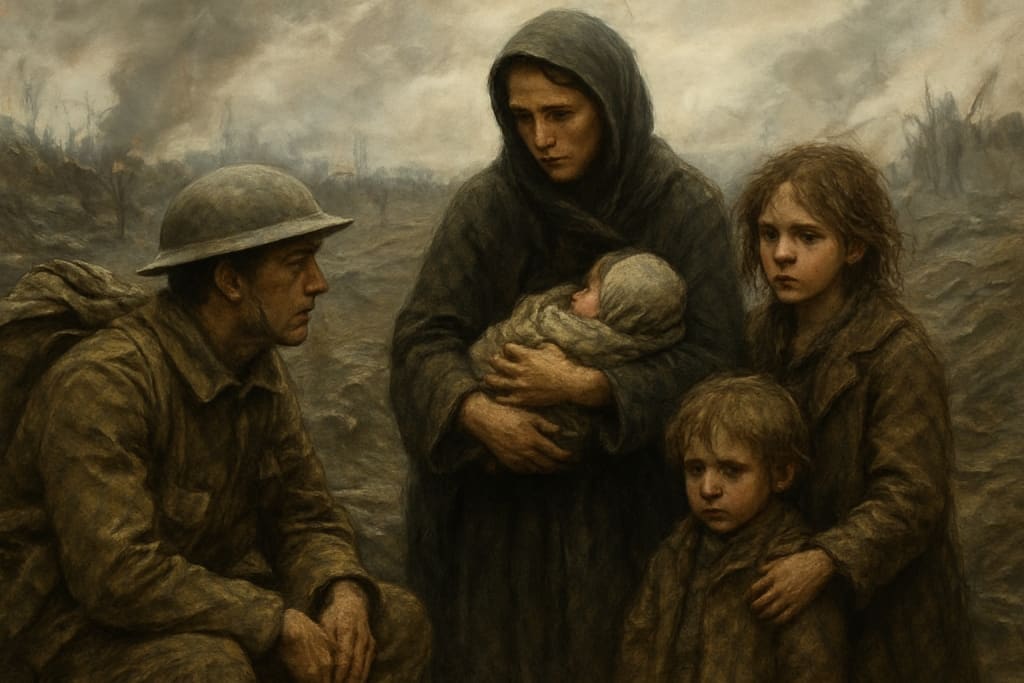
When history recalls World War I, it often highlights the generals, the trenches, and the dramatic battles. Yet behind the clashing armies were millions of ordinary men, women, and children who faced unimaginable struggles. Their lives were filled with hunger, fear, loss, and uncertainty. The Great War, fought from 1914 to 1918, was not only a conflict of nations but also a test of human endurance for everyday people caught in its shadow.
---
Life in the Trenches
For soldiers, the trenches became home. These long ditches stretched across Europe, muddy and cold, often filled with water up to the knees. Soldiers lived surrounded by rats, lice, and the constant stench of death. Every day brought the fear of sudden artillery fire or poisonous gas. Many young men had joined with patriotic hopes, but soon their reality was endless nights of hunger, sleeplessness, and the sound of shells exploding overhead.
Letters from home became a lifeline. Soldiers clung to simple words from mothers, wives, or children, finding brief comfort in the middle of chaos. Yet, each letter also reminded them of what they had left behind — families struggling without them.
---
Hunger and Shortages at Home
Back home, ordinary families faced a different battle. With so many men gone to fight, women were left to care for households and find work to support their families. Food was scarce. Bread, sugar, and meat were rationed. Children often went to bed hungry, while mothers sacrificed their own meals for them.
In rural areas, farming was disrupted as many workers had been drafted. Crops were left unattended, and the supply chain collapsed. Cities felt the sharpest shortages. Long lines formed outside bakeries, and sometimes people fought over small pieces of bread.
---
Women in the Workforce
One of the most profound changes during the war was the role of women. For the first time, women entered factories in massive numbers, working long hours to produce weapons, ammunition, and uniforms. While this gave them a new sense of independence, the work was exhausting and dangerous. Explosions in munitions factories were not uncommon, and many women lost their lives while trying to support the war effort.
These women carried the double burden of labor and caring for families. After a long day in the factory, they returned home to cook, clean, and raise children alone. Yet their sacrifice reshaped society, proving that women were capable of much more than the roles they had traditionally been assigned.
---
The Psychological Toll
Beyond physical struggles, the emotional wounds of World War I ran deep. Soldiers who survived often returned with what was then called “shell shock,” now recognized as post-traumatic stress disorder (PTSD). They experienced nightmares, anxiety, and sudden breakdowns. Families struggled to understand these invisible scars, and many veterans found it hard to return to normal life.
Civilians too lived in constant fear — of air raids, of receiving the dreaded telegram announcing a loved one’s death, of not knowing when the war would end. The war’s uncertainty created a cloud of anxiety that hovered over entire nations.
---
Loss and Grief
Perhaps the greatest struggle was the sheer scale of loss. Millions of families received news that fathers, sons, or brothers would never return. Cemeteries filled with rows of white crosses became a permanent reminder of the cost of war. Widows were left to raise children alone, and entire villages lost their young men.
For children, the war often meant growing up without a father or older brother. The emotional wounds of that generation lasted for decades, shaping their view of the world and leaving them wary of future conflicts.
---
A Lesson in Endurance
Despite the pain, people found ways to survive. Neighbors supported one another, women built strong communities, and soldiers leaned on friendship in the trenches. The resilience of ordinary people became the true backbone of the war effort.
World War I showed that wars are not only fought on battlefields but also in kitchens, factories, and hearts. The silent struggles of ordinary people remind us that history is not only made by generals and leaders, but also by those who endure the weight of war in their everyday lives.
---
Conclusion
The First World War ended in 1918, but for millions of ordinary people, the scars lasted a lifetime. Their silent struggles — hunger, grief, fear, and sacrifice — often remain overshadowed by military history. Yet, it is their endurance and strength that truly shaped the course of nations. Remembering their stories is not just about honoring the past but also about learning to value peace in the present.
About the Creator
Keep reading
More stories from Waqas Ahmad and writers in History and other communities.
The Last Night of Constantinople (1453)
A City at the Crossroads of History For more than a thousand years, Constantinople stood as the bridge between East and West. Known as the capital of the Byzantine Empire, it was not only a fortress of Christianity but also a hub of trade, culture, and knowledge. Its massive walls, built by Emperor Theodosius II, had repelled countless sieges. For centuries, enemies stood outside its gates and failed. The city was seen as almost invincible—until the spring of 1453.
By Waqas Ahmad 6 months ago in History
Why planes don't fly over these locations | Secret Revealed
Every passing second, around 9,500 commercial planes are flying in the sky across the world. If you look at a live plane tracker, the entire world map appears filled with planes like flies. However, there are also some spots on the world map where not even a single plane can be seen. It seems as if planes intentionally avoid these areas—and in reality, that is true.
By Imran Ali Shah3 days ago in History
The Forsyth House Fire
Since 1851, Forsyth House has stood on the corner of Union Street and Gordon Street in the heart of Glasgow. Its iconic, or was... because on Sunday 8th of March, 2026, a fire broke out in a small, seemingly un-named shop in the building and tore all that history down. As I write, the rubble is still unsettled and the street is still blocked off. Central Station is quiet on the upper level, and around 30 small businesses have quite literally gone up in smoke.
By S. A. Crawford2 days ago in The Swamp


Comments (1)
Yes of course a lot of peoples have play in important role as you say nice bro, Bro we need each other support do you agree with me i will read all your new articles with loyalty and also you ok