INAM ULLAH
Bio
Inam Ullah, BS in Computer Science and MS in Wireless Sensor Networks. Passionate about blogging, history, wars, and science. A lifelong learner with a curious mind and diverse interests.
Stories (21)
Filter by community
The Art of War: Global Power Projection and Strategic Alliances. AI-Generated.
The history of nations and empires is, in many ways, the history of war and the mastery of strategic power projection. From the writings of Sun Tzu in The Art of War to the modern doctrines of military science, the core idea remains the same: victory is not merely about fighting battles but about shaping the world in ways that favor one’s long-term interests. Superpowers throughout history have understood that wars are not only fought on their own borders but are often projected thousands of miles away to establish dominance and deter adversaries. The United States and Russia exemplified this in the 20th century by bringing their power far beyond their homelands—whether through proxy wars, military bases, or political alliances—to maintain their global influence.
By INAM ULLAH5 months ago in History
The Saudi–Pakistan Defense Deal: Strategic Implications and Its Impact on Global and Regional Politics. AI-Generated.
Defense cooperation between Pakistan and Saudi Arabia has long been a cornerstone of their bilateral relationship. The recent developments in their defense partnership—ranging from joint military exercises to strategic agreements on arms production, intelligence sharing, and security cooperation—have reignited global debates about its impact on regional politics. This evolving alliance carries deep implications for countries like Israel and India, both of which see Pakistan as a security concern and view Saudi Arabia as a potential player in shaping Middle Eastern geopolitics. At the same time, this defense deal holds promising opportunities for strengthening Muslim unity, advancing Pakistan’s defense industry, and revitalizing its struggling economy.
By INAM ULLAH5 months ago in History
China’s Military Showcase: A New Era of Global Power Projection
China’s September 3rd military parades have become an important spectacle on the global stage, both politically and militarily. In recent years, China has spent more than 5 billion dollars to display its latest military innovations, including hypersonic missiles, stealthy loyal wingman drones, swarming unmanned systems, and cutting-edge electronic warfare capabilities. While at first glance, such events might appear to be mere displays of nationalism and patriotism, they carry much deeper geopolitical implications. The deliberate showcasing of advanced weapons serves multiple purposes—deterring potential adversaries, boosting domestic morale, and communicating China’s strategic confidence to the world. The question naturally arises: Is this simply a showmanship exercise meant to impress the world, particularly the United States, or does it signal the emergence of a new global superpower?
By INAM ULLAH6 months ago in Futurism
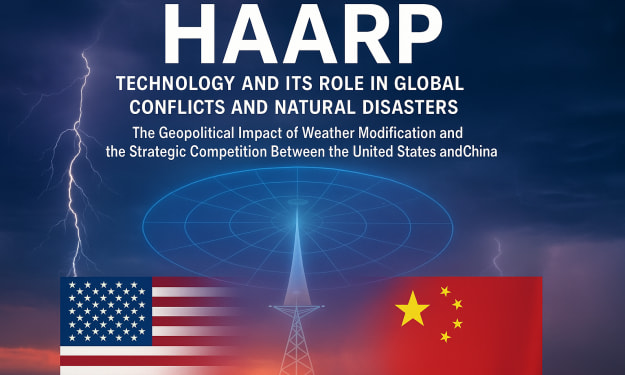
HAARP Technology and Its Role in Global Conflicts and Natural Disasters. AI-Generated.
Introduction Modern warfare is no longer limited to weapons of steel, gunpowder, or nuclear bombs. In the 21st century, technology has expanded the battlefield to domains such as cyberspace, outer space, and even the earth’s atmosphere. Among the controversial technologies often discussed in the context of environmental warfare and strategic manipulation is HAARP (High-Frequency Active Auroral Research Program). Originally developed as a scientific project in the United States, HAARP has become the subject of widespread debate, speculation, and conspiracy theories regarding its ability to influence weather patterns, trigger natural disasters, and affect global security.
By INAM ULLAH6 months ago in History
Why Germany Did Not Develop the Atomic Bomb. AI-Generated.
The Second World War was not only a conflict of soldiers and armies but also a war of science, engineering, and technology. Among the most transformative developments of the twentieth century was the atomic bomb, whose successful construction by the United States under the Manhattan Project changed the course of history. Yet Germany, despite having some of the world’s leading physicists such as Werner Heisenberg, Max Planck, and others, failed to build the weapon. The question of why Nazi Germany did not develop an atomic bomb remains one of the most compelling debates in the history of science and war. To understand this failure, one must examine the interplay of political ideology, scientific challenges, resource limitations, and the role of individuals—especially Heisenberg—who stood at the center of the German nuclear program.
By INAM ULLAH6 months ago in History
What’s New in ChatGPT-5: The Next Leap Beyond GPT-4. AI-Generated.
Artificial Intelligence has been on a rapid growth curve, and the release of ChatGPT-5 marks another milestone in conversational AI. Building on the strengths of GPT-3, GPT-3.5, and GPT-4, the latest iteration is more than just a marginal upgrade. It introduces significant advancements in context retention, reasoning, personalization, multimodal capabilities, and ethical safeguards. To appreciate GPT-5’s impact, we need to explore what’s new and how it compares to its predecessors.
By INAM ULLAH7 months ago in Journal
Traditional vs. Modern AI-Based Education: Balancing Human Effort and Technological Guidance. AI-Generated.
Introduction Education has always been the foundation of personal growth, societal development, and economic progress. Over the centuries, the methods of education have evolved—shifting from oral traditions to printed books, from chalkboards to interactive screens, and now, from teacher-led classrooms to artificial intelligence (AI)-driven learning platforms.
By INAM ULLAH7 months ago in Education
Will U.S. Tariffs Push India Toward China? The High-Stakes Game in the Global Trade Arena . AI-Generated.
A New Chapter in Global Trade Tensions The United States’ decision to impose significant tariffs on imports from multiple countries, including India, has sparked a wave of speculation about how New Delhi will respond. For decades, India has walked a careful line between East and West—deepening its economic ties with the United States while also engaging with other major powers like China, Russia, and members of the BRICS bloc.
By INAM ULLAH7 months ago in Trader
The New Trade War: How U.S. Tariffs Are Reshaping the Global Economic Order . AI-Generated.
The Shockwave from Washington In a move that has sent tremors through the global economy, the United States has imposed sweeping new tariffs—some surpassing 10%—on imports from over 60 countries, including some of its closest allies. Billed as a bold step to protect American industry and jobs, this policy shift represents one of the largest trade upheavals in a century.
By INAM ULLAH7 months ago in Trader
Pakistan’s Rising Global Role: A Strategic Power for Peace, Prosperity, and Balance in the Modern World. AI-Generated.
Once seen through the lens of geopolitical tension and internal instability, Pakistan is now stepping confidently into the global spotlight — as a stabilizing force, an economic connector, and a diplomatic bridge in one of the world’s most sensitive regions.
By INAM ULLAH7 months ago in Futurism
The July 29, 2025 Kamchatka Megaquake: A Seismic Event That Rewrote Disaster Preparedness Protocols. AI-Generated.
At precisely 3:17 PM local time on July 29, 2025, the Kamchatka Peninsula was violently thrust into the global spotlight when an 8.9 magnitude earthquake - later recognized as the most powerful seismic event of the decade - ruptured along the Kuril-Kamchatka subduction zone. Unlike typical aftershock sequences that gradually diminish, this earthquake maintained terrifying intensity for nearly six minutes, triggering immediate tsunami warnings across the entire Pacific basin and testing the limits of modern early warning systems.
By INAM ULLAH7 months ago in Earth
Breaking the Comfort Barrier: The Real Path to Success Begins Outside Your Safe Zone. AI-Generated.
In a world obsessed with shortcuts, motivation quotes, and surface-level success stories, we often forget one fundamental truth: Real success demands discomfort. It asks us to step into uncertainty, face fears, challenge routines, and endure situations that feel awkward, risky, and difficult. While staying in our comfort zone feels safe and easy, it also guarantees limited growth and missed opportunities.
By INAM ULLAH7 months ago in Motivation