Ancient
Amor Fati
What does Amor Fati Mean? Amor Fati, is a Latin phrase meaning “love of fate,” it encapsulates a profound Stoic principle that encourages embracing everything that happens in life—joy, suffering, success, and failure alike.
By Julie O'Hara - Author, Poet and Spiritual Warrior6 months ago in History
When the Gods Turned Away: Collapse and Curse in the Ancient Near East. AI-Generated.
In the Ancient Near East, catastrophe was never random. When cities fell, rivers dried, or empires burned, the cause wasn’t natural—it was divine. The gods had turned their backs.
By Yand Bullosy6 months ago in History
The First Lawmakers: How the Ancient Near East Built the Blueprint for Civilization. AI-Generated.
When we speak of law and order today, we often look westward—to Athens, Rome, or London. But before those cities dreamed in marble, dusty tablets in Sumer, Akkad, and Babylon were already echoing the weight of legal codes.
By Yand Bullosy6 months ago in History
Echoes in the Snow: The Soldier of Silence
The winter of 1999 was cruel. Not just in temperature—but in how it devoured hope. In the snow-laden heights of the Kargil mountains between India and Pakistan, a young Pakistani soldier named Lance Naik Imran Shah was about to become a story that would never be told on the evening news, but would live forever in the hearts of those who still believe in humanity.
By Wings of Time 6 months ago in History
The Cradle of Civilization. AI-Generated.
The Cradle of Civilization: Unearthing the Enduring Legacy of the Ancient Near East Forget dusty textbooks and dry lectures. Step back in time – way back – to a world where the first cities rose from the mudflats, writing scratched its way onto clay, and laws were carved in stone for all to see. Welcome to the Ancient Near East, the vibrant, complex, and utterly foundational crucible where the very blueprint of Western civilization was forged. This isn't just history; it's the origin story of us.
By Yand Bullosy6 months ago in History
The Invisible Highways. AI-Generated.
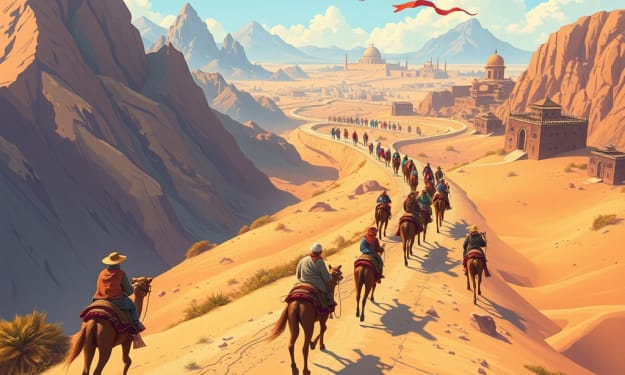
When the World Was Smaller Than You Think Picture this: You're standing in the bustling streets of ancient Ur, around 2000 BCE. The air is thick with the smell of spices, baking bread, and the distinctive aroma of the Euphrates River. Merchants from distant lands haggle over prices in a cacophony of languages. A trader from the Indus Valley shows off exquisite carnelian beads, while an Egyptian merchant offers fine linen and papyrus. This isn't a scene from a fantasy novel – this was the reality of the ancient Near East, where sophisticated trade networks connected civilizations in ways that would make modern globalization look like child's play.
By Yand Bullosy6 months ago in History
Honour and Hospitality: How Pashtunwali Shaped the Taliban’s Dealings with the World. AI-Generated.
The Ancient Code That Guides the Pashtuns aka Pashtunwali In the rugged valleys of eastern Afghanistan, where time seems to stand still, there exists a powerful code of life called Pashtunwali. It is not written in law books or constitutions, yet it governs millions. For the Pashtun people—Afghanistan’s largest ethnic group—this ancient code defines how to act with honor, courage, and respect.
By Inzamam Ul Haq6 months ago in History