
Echoes in the Snow: The Soldier of Silence
In the frozen silence of war, one man found his voice.

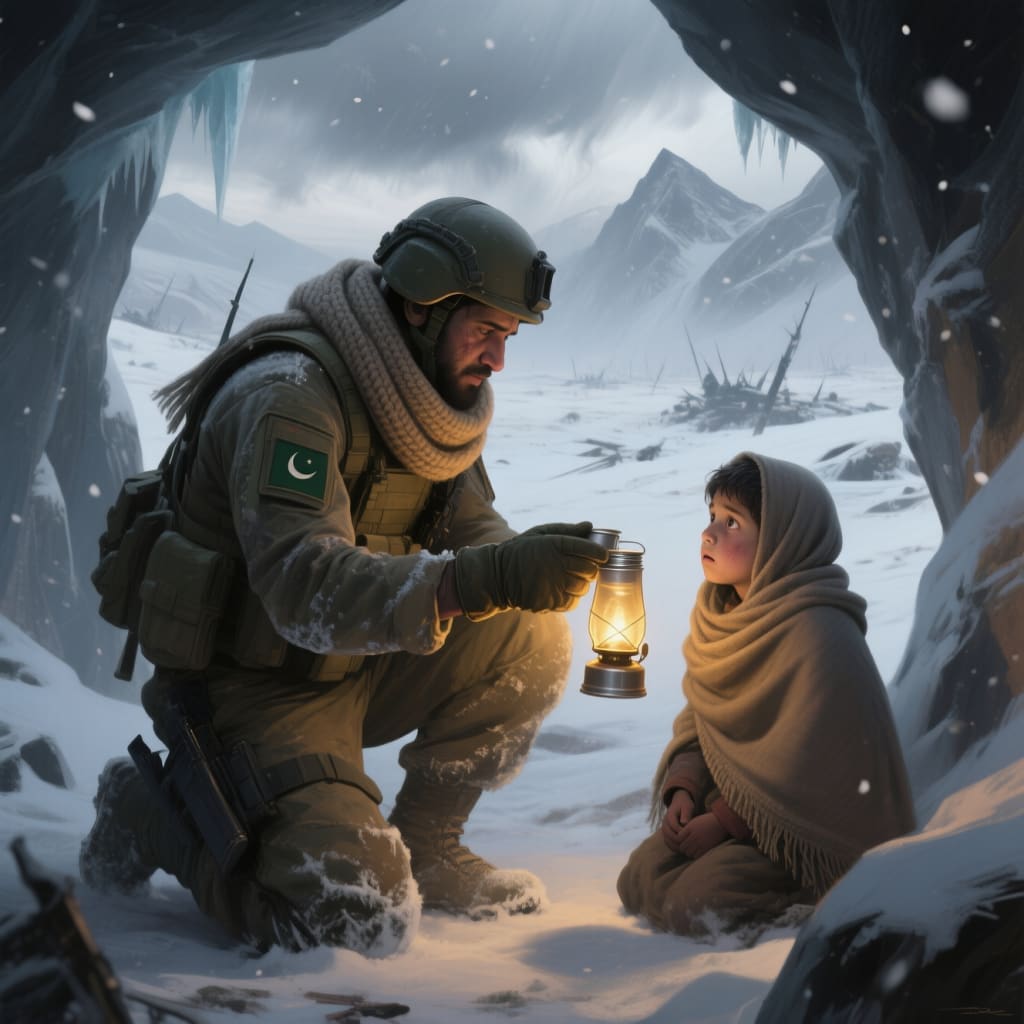
The winter of 1999 was cruel.
Not just in temperature—but in how it devoured hope.
In the snow-laden heights of the Kargil mountains between India and Pakistan, a young Pakistani soldier named Lance Naik Imran Shah was about to become a story that would never be told on the evening news, but would live forever in the hearts of those who still believe in humanity.
Imran wasn’t a man of many words. Raised in a quiet village in Gilgit, he was known for fixing broken radios and reciting poetry in his diary when no one was looking. His father was a shepherd; his mother, a schoolteacher. War wasn’t in his blood, but responsibility was.
When the Kargil conflict escalated, he didn’t hesitate.
He volunteered.
The mountain wasn’t just a battleground—it was a graveyard dressed in white.
Temperatures dipped below -20°C. The wind sliced through flesh like steel. Both Indian and Pakistani soldiers dug into icy trenches, not knowing whether death would come from a bullet or frostbite.
On the 14th day of deployment, Imran’s unit was assigned to monitor enemy movement from a narrow ridge nicknamed “Ghost's Spine.” The visibility was poor, communication lines were frozen, and backup was days away.
That night, while on watch duty, Imran noticed movement through his frozen binoculars—five figures crawling through the snow, approaching an abandoned bunker that marked the border zone. He raised his rifle.
But something felt off.
He saw no weapons—just hunched backs, slow steps, and a small child clinging to one of the men.
They weren’t soldiers.
They were refugees—Indian civilians lost in no man's land, fleeing crossfire.
Imran's heartbeat thundered. Protocol was clear: any movement near the line of control could be hostile. He could alert command or take the shot. But he did neither.
Instead, he did something no one expected. He slung his rifle, descended the icy path, and approached them—hands raised, whispering in broken Hindi:
“Don’t be afraid. I’m not your enemy.”
The man, an elderly Hindu priest from Leh, fell to his knees and cried. They had been walking for two days after their village was shelled. No food. No medicine. The child had a fever. His daughter was limping from a shrapnel wound.
Imran didn’t ask permission. He radioed false coordinates to mislead any patrols, guided them silently under cover of night, and hid them in a small cave near his outpost. Over the next two days, he shared his rations, melted snow for water, and treated the child with whatever supplies he had.
But kindness has a cost in war.
On the third day, his commanding officer found out.
A military tribunal followed. The charges: Endangering national security. Assisting civilians without clearance. Disobeying protocol.
Imran didn’t argue. He simply said:
“I didn’t see enemies. I saw people.”
He was discharged quietly. No medal. No recognition.
He returned to his village with nothing but a box of personal items, including the old diary where he still scribbled his thoughts. His father was disappointed. His neighbors whispered. Some called him a traitor.
But Imran remained silent.
Until one winter morning, ten years later, when a black SUV climbed the snowy road to his doorstep.
Out stepped a man in saffron robes—older now, with tears in his eyes. Behind him was a grown woman and a teenager with a camera around his neck.
The Hindu priest had returned.
They had never forgotten. For years, they searched for the soldier who saved them. And now, with help from a peace journalism group, they had found him.
The boy Imran saved was now a documentary filmmaker.
His first project: “The Soldier of Silence.”
The film premiered in Delhi and Islamabad on the same day.
It showed not just the horrors of war—but the humanity buried beneath it. Imran’s face remained blurred—his request. “I didn’t do it to be known,” he said in a rare interview. “I did it so I could sleep at night.”
A year later, both governments quietly reinstated his service record. Schools in both countries began using his story to teach empathy in times of conflict.
And that cave on the ridge?
It’s now marked with a sign in three languages:
“Here, war paused... for compassion.”
About the Creator
Wings of Time
I'm Wings of Time—a storyteller from Swat, Pakistan. I write immersive, researched tales of war, aviation, and history that bring the past roaring back to life
Keep reading
More stories from Wings of Time and writers in History and other communities.
Ashes in Her Eyes: A Child’s Memory of War
Ashes in Her Eyes: A Child’s Memory of War She doesn’t remember when the sky changed color. One day it was blue—bright and full of clouds shaped like rabbits. The next, it was gray, thick with smoke, and roaring louder than any storm she'd ever heard. Mila was only six when the war came to her street, and by the time it left, nothing was the same—not her house, not her teddy bear, and not her heart.
By Wings of Time 6 months ago in History
THE GRAND EGYPTHION MUSEUM
Let’s be real for a second. When folks hear "museum," they often think of dusty halls, dry information, and that odd quiet where you feel like you're misbehaving just for breathing. But the Grand Egyptian Museum isn't like that. I really don't think that's it. It's not accurate at all. This just seems wrong. This place is really nice. Egypt really shows us that it made history, and it keeps on doing amazing things.
By Beshoy Zayer2 days ago in History
The Quiet Name on Maple Street
Kim Jong-un was born into a world unlike almost any other—a world sealed by borders, ideology, and secrecy. As the grandson of Kim Il-sung, the founder of North Korea, and the son of Kim Jong-il, the country’s second leader, Kim Jong-un entered life already wrapped in destiny. In North Korea, leadership is not chosen by ballots or debate; it is inherited like a crown, reinforced by loyalty, fear, and an unyielding political system.
By The best writer a day ago in History


Comments
There are no comments for this story
Be the first to respond and start the conversation.