
Two Bullets, THAT KILL Twenty Million
He didn’t fire a bullet at just a man. He fired it at the world.

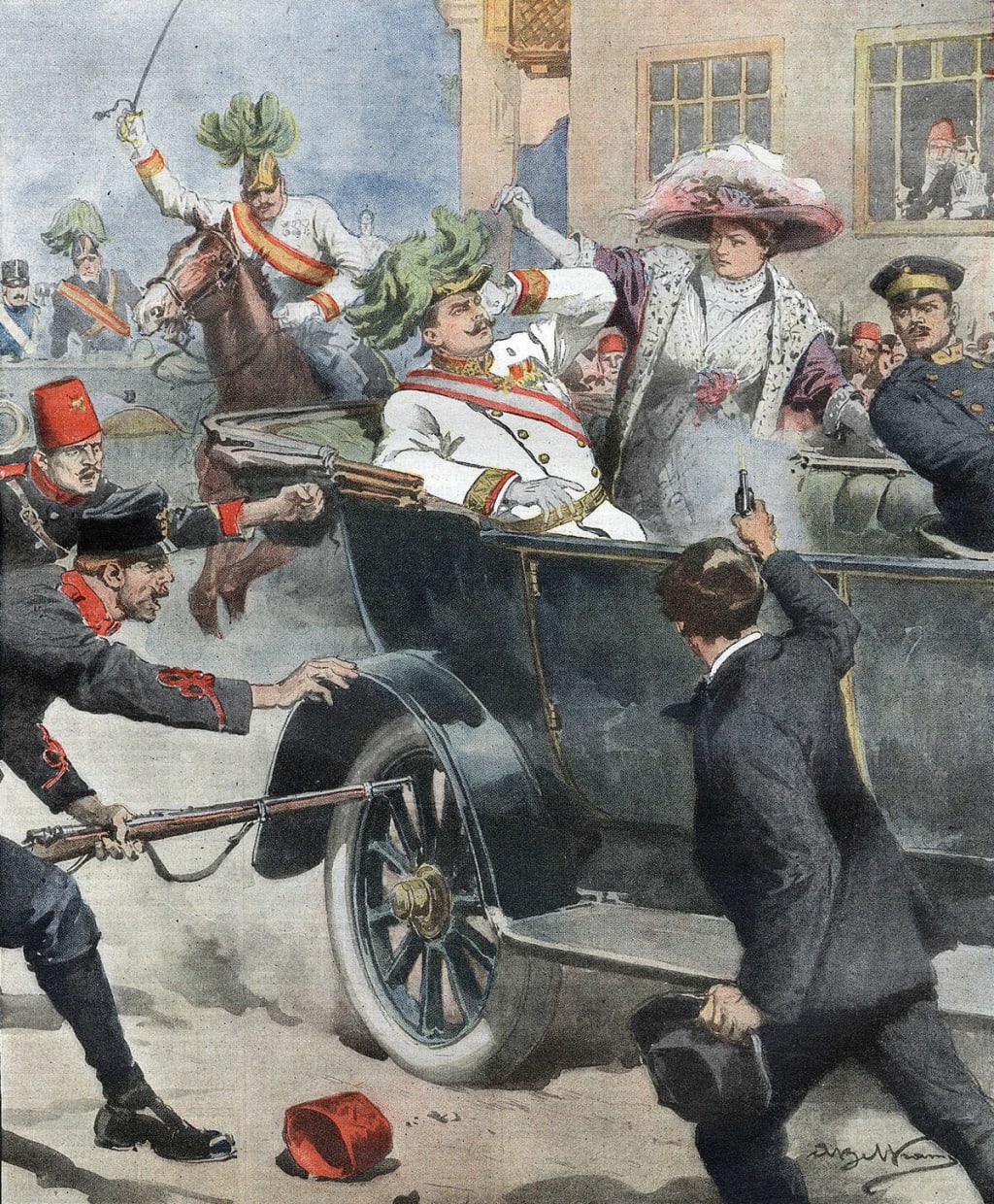
Two Bullets, Twenty Million
The first bullet cracked through the warm summer air of Sarajevo on June 28, 1914. Fired by a trembling hand, it struck Archduke Franz Ferdinand in the neck. A second shot a moment later took the life of his wife, Sophie. The assassin, Gavrilo Princip, a 19-year-old radical, barely believed what he had done.
He didn’t fire a bullet at just a man.
He fired it at the world.
Within weeks, Austria-Hungary declared war on Serbia. Alliances ignited like gasoline-soaked thread. Germany, Russia, Britain, France—each mobilized. Men cheered in train stations, imagining glory. What followed was four years of hell: trench warfare, mustard gas, and machine guns shredding human bodies like paper. By the end of World War I, over 20 million people were dead.
And that was just the beginning.
The first bullet didn’t stop killing after the war ended. It created wounds deeper than trenches—economic ruin, bitter resentment, and broken nations. The Treaty of Versailles punished Germany so harshly that the nation bled pride and hope. In that soil of humiliation, another seed of death took root.
The second bullet came 25 years later, though not everyone heard it when it was fired.
It wasn’t a public assassination this time. It was quieter—colder.
January 30, 1933. A pen clicked in the hand of German President Paul von Hindenburg as he signed the appointment: Adolf Hitler, Chancellor of Germany.
It may not have looked like a bullet, but that signature was a loaded gun pointed at the heart of humanity.
1933, Berlin.
In the shadows of the Reichstag building, a young German war veteran named Jakob Weber lit a cigarette with shaking fingers. He’d fought in the Great War, watched his friends die in mud-soaked trenches, only to return to a country humiliated and hungry.
Hitler’s voice on the radio was magnetic. "Germany will rise again!" he promised. "We will restore honor!"
Jakob wanted to believe it. Everyone did.
But his friend Elias, a Jewish doctor who had saved Jakob’s life during the war, warned him.
"He doesn't want peace, Jakob. He wants purity. Power. And that always ends in blood."
Jakob dismissed him. The German people were desperate. They needed hope.
But as Hitler consolidated power, Jakob began to see it. The book burnings. The brownshirts. The fear.
By 1939, when Germany invaded Poland, the second bullet finally exploded—and the world once again burned.
Warsaw, 1942.
Elias was gone—deported to a camp no one returned from. Jakob, haunted by guilt, joined the underground resistance. He smuggled Jews and dissidents through sewers and forests, risking his life daily.
One night, he found a child—Mira, 9 years old, hidden in a cellar with her little brother. She clutched a torn photograph of her parents, taken before the war.
Jakob carried them for miles to safety. But thousands more would not survive.
Hitler’s bullet—his rise to power—had now claimed tens of millions. Six million Jews. Millions of soldiers, civilians, children. Cities reduced to rubble. Nations splintered. Humanity shattered.
The world had to watch Hiroshima and Nagasaki glow under a nuclear sun before the war finally ended.
1945, Nuremberg Trials.
Jakob testified. He told the world about Elias. About Mira. About the friends he buried. His voice cracked, but he spoke for the silenced.
As he left the courtroom, a reporter asked him, “What started all of this? Was it Hitler? Was it Versailles?”
Jakob looked at her, hollow-eyed.
“No,” he said. “It started with two bullets.”
Two bullets.
One fired by a 19-year-old with a pistol and a dream of liberation.
The other not fired from a gun, but from the pen of a weary politician who thought he could control a fanatic.
Together, they killed over 20 million people.
Not because of the bullets themselves—but because of what followed: pride, vengeance, ignorance, and unchecked power.
The bullets were the sparks.
But humanity provided the firewood.
Epilogue: Present Day
In a museum in Sarajevo, a cracked glass case holds the revolver used by Gavrilo Princip. Next to it, a simple plaque:
> "This is the weapon that started the war to end all wars. It didn’t."
In Berlin, beneath the Reichstag, a memorial corridor lists the names of Holocaust victims—etched forever in stone.
And in a small French village, Mira—now an old woman—sits in a garden filled with sunflowers. Her grandchildren play nearby. She holds the same photo from the cellar. Her eyes are tired, but alive.
She tells them stories—not just of horror, but of the people who risked everything to fight against the tide. People like Jakob.
“Never forget,” she whispers. “The world can change with just two bullets.”
About the Creator
Steve Jobs: The Visionary Behind the iPhone
Steve Jobs is remembered as one of the most creative and influential figures in modern technology. He was not just a businessman; he was a visionary who believed that technology should be simple, beautiful, and useful. Among all his achievements, the creation of the iPhone stands out as a product that transformed everyday life. The iPhone did not just change phones; it changed how people connect, work, and express themselves.
By Haroon Pasha6 days ago in History



Comments
There are no comments for this story
Be the first to respond and start the conversation.