
When the Earth Was New: Creation Myths from the Cradle of Civilization
What Babylonian and Sumerian myths reveal about the ancient mind—and our place in the cosmos
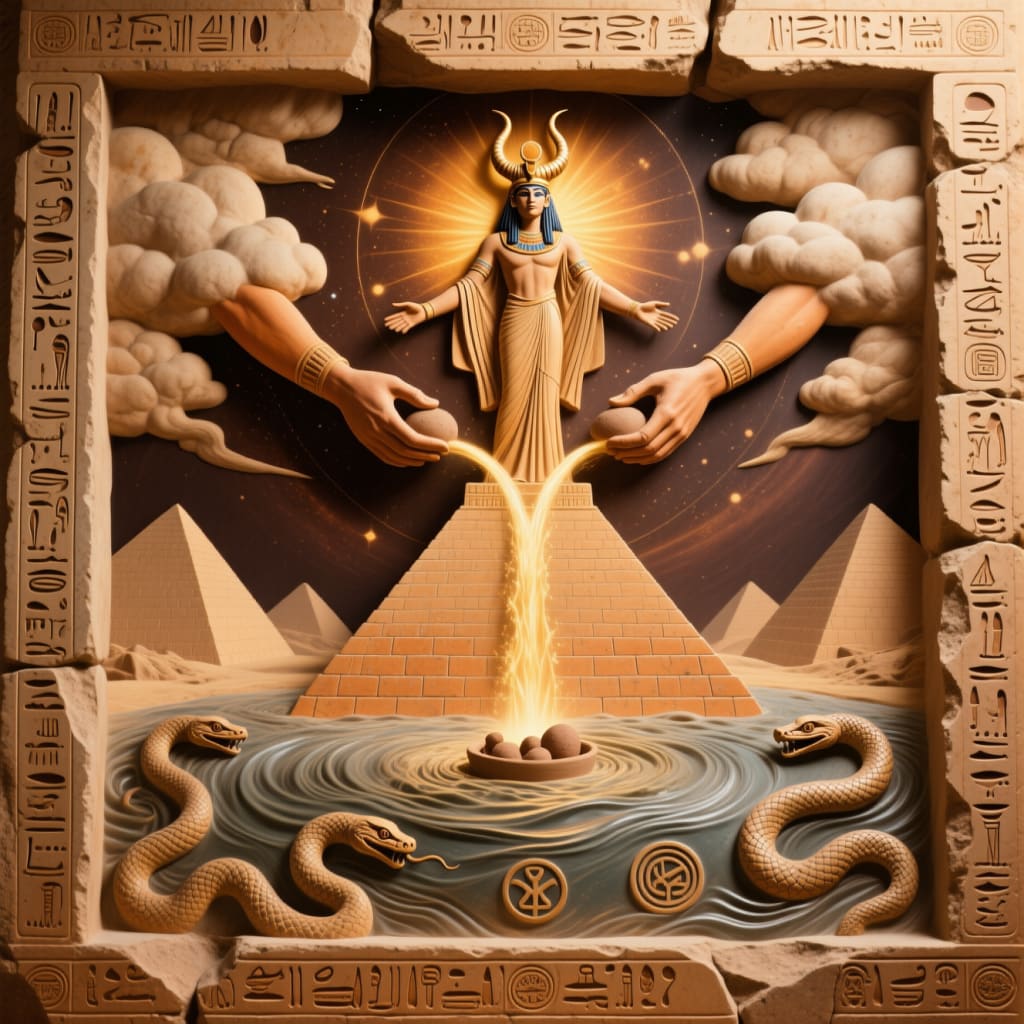
Before Genesis, before Eden, before even the Greek Titans—there were the gods of Mesopotamia, rising from the chaos-waters to shape the sky, the earth, and us.
The Ancient Near East didn’t just invent cities and law codes—it invented cosmology. And their creation myths weren’t children’s tales. They were cosmic constitutions—setting the stage for divine order, justifying temples and kings, and explaining why humans suffer, toil, and worship.
Let’s journey into the deep waters of ancient myth and see how Sumer, Akkad, and Babylon imagined the very beginning.
Before Everything: The Primordial Waters
Most Mesopotamian creation myths begin not with light or land, but with chaos—symbolized as a dark, watery abyss.
In Babylon’s most famous myth, the Enuma Elish, the first beings are Apsu (the fresh water) and Tiamat (the salt water). From their mingling came the first gods—Lahmu, Lahamu, and eventually Ea, god of wisdom.
But soon, the younger gods become too noisy and rebellious. Apsu wants to destroy them. Ea kills him. Enraged, Tiamat gives birth to monsters and declares war.
This is no peaceful origin story. It is cosmic civil war. And out of that chaos, a new divine order will rise.
Marduk the Slayer: Order from Violence
The climax of the Enuma Elish is the rise of Marduk, the storm-god of Babylon. He agrees to defeat Tiamat, but only if the gods make him king of all creation.
Armed with winds, a net, and incantations, Marduk slays Tiamat and splits her body:
- Her upper half becomes the sky
- Her lower half becomes the earth
He organizes the cosmos, fixes the constellations, establishes the calendar, and appoints the other gods to their stations. Then, he creates humans—from the blood of Tiamat’s lieutenant, Kingu.
Why? To serve the gods.
“I will create man… that he may bear the yoke of the gods.”
In this world, humanity’s purpose is clear: service, sacrifice, and keeping the temples running.
The Sumerian Version: Earth Born of Heaven’s Wound
Older Sumerian myths—like the tale of Enlil and Ninlil—offer a slightly gentler cosmos. In Sumer, the world was divided into:
- An (Heaven)
- Ki (Earth)
- Kur (the Netherworld)
An and Ki are lovers. But when their child Enlil is born, he forcibly separates heaven and earth—pushing his father upward and claiming the space between.
Sound familiar? The idea of separating sky and land reappears in Genesis—but it starts here, among the reeds of the Euphrates.
The Sumerians also imagined humans made of clay, sometimes shaped by divine midwives like the goddess Ninhursag or Aruru.
Again, our role is the same: to work the land, serve the gods, and maintain me—the Sumerian word for divine order and law.
Creation as Legitimacy
These myths weren’t just spiritual—they were political. In the Enuma Elish, Marduk’s cosmic victory justified Babylon’s rule over other cities. The myth was recited during Akitu, the Babylonian New Year festival, to reaffirm the king’s divine right.
When empires shifted, so did the myths. Earlier gods like Enlil or Inanna might be demoted in favor of Marduk. Myths evolved to reflect real-world power shifts.
Creation myths were tools of empire as much as theology.
Echoes in the Bible
It’s impossible to read Mesopotamian creation stories without hearing resonance in Genesis:
- Chaos waters (“the deep”)
- The division of heaven and earth
- Creation by word and will
- Humanity formed from clay
- A serpent-like adversary (Tiamat)
- A garden watered by four rivers (like Eden)
Genesis reacts to these myths—sometimes echoing them, sometimes correcting them. But it never escapes their orbit.
Creation Through Rebellion
One thing that separates Mesopotamian myths from later ones is this: creation emerges from conflict.
The gods are not omniscient or always benevolent. They squabble, make mistakes, and sometimes regret making humans altogether. In the Atrahasis Epic, humanity grows too noisy, and the gods send a flood to silence them. Only one man, warned by the god Ea, survives in a boat.
Sound familiar?
Conclusion:
The creation myths of the Ancient Near East are not just stories—they are blueprints. They lay out the architecture of the universe, the role of kings, and the place of mortals. To the ancient mind, we were not accidents of evolution—we were made for a reason: to serve, to honor, and to sustain a fragile divine order.
And in those myths, we glimpse our oldest questions:
- Where do we come from?
- Why are we here?
- And what happens when we defy the divine?
Questions still asked today—just without cuneiform.
Author’s Note:
In the next article, we’ll descend from the heavens to the streets: “Gods in the Marketplace: Everyday Religion in the Ancient Near East.” Temples, amulets, household gods—you’ll see what ancient belief looked like on the ground.
About the Creator
Keep reading
More stories from Yand Bullosy and writers in History and other communities.
The Timeless Pyramids of Egypt: Stories from the Ancient World
Egypt is home to some of the most remarkable monuments ever built by humans: the pyramids. Rising from the sands of the Giza Plateau, these colossal structures have inspired curiosity and admiration for thousands of years. They were built as tombs for the pharaohs, yet they tell a much larger story—one of human skill, ambition, and belief in the afterlife. The most famous of these pyramids is the Great Pyramid of Giza, built for Pharaoh Khufu around 2580 BCE. Originally, it reached a height of about 146 meters (480 feet) and was the tallest man-made structure in the world for nearly 4,000 years. Its construction required millions of limestone blocks, some weighing several tons. Even today, historians and archaeologists are amazed at the precision and scale achieved by ancient builders without modern tools. The Egyptians built these monumental structures not merely as tombs, but as gateways to the afterlife. They believed that the pharaoh, considered a god on earth, would continue his journey in eternity. The pyramid’s triangular shape symbolized the pharaoh’s ascent to the heavens. Inside, burial chambers held treasures, inscriptions, and statues meant to guide and protect the ruler in the world beyond. How the pyramids were built remains a topic of debate. There are many theories, including the use of ramps or sledges to move the massive stones. Regardless of the methods, constructing these tombs required incredible planning, organization, and teamwork. Tens of thousands of workers labored for decades to create what would become one of the world’s greatest architectural achievements. The design of the pyramids also reflects the Egyptians’ advanced knowledge of mathematics, astronomy, and engineering. They aligned the pyramids with the cardinal points and certain stars, showing a deep understanding of the sky. The precise measurements and geometric accuracy have helped these structures survive thousands of years, enduring both natural wear and occasional earthquakes. While the Giza pyramids are the most famous, Egypt has over 100 pyramids scattered across the country, including those at Saqqara, Dahshur, and Abu Sir. Each one tells a story about the evolution of Egyptian architecture, from the earliest step pyramids to the smooth-sided ones that have become iconic. These structures also reveal much about Egyptian society, including their religious beliefs, social organization, and artistic achievements. The pyramids were not built in isolation. They were part of larger complexes that included temples, smaller tombs, and monuments that reflected the pharaoh’s divine status. They were centers of activity, culture, and ceremony, connecting the people to their rulers and to the gods they worshiped. Today, the pyramids continue to inspire awe. Millions of visitors come to Egypt each year to witness their grandeur firsthand. Archaeologists keep discovering new insights into how these incredible structures were built and what they meant to the people of ancient Egypt. Yet, despite all the research, ds stet of mystery, reminding us that some secrets of history endure across millennia. The pyramids are more than just stone monuments; they are symbols of human ambition and achievement. They remind us that with vision, skill, and persistence, people can create works that last far beyond their lifetimes. Standing in front of a pyramid, it is easy to imagine the hands that placed each block, the minds that designed the complex structures, and the determination that made the impossible possible. In the end, the Egyptian pyramids are timeless. They connect us to a world that existed thousands of years ago, teaching lessons about creativity, devotion, and human potential. They are monuments not only of history but of inspiration—a lasting testament to what humans can achieve when imagination and effort come together.
By Binan Mooon4 days ago in History
Stanislav Kondrashov’s Oligarch Series: Power, Economy, and Culture in Ancient Corinth
The Oligarch Series by Stanislav Kondrashov examines how systems of power emerge, stabilize, and adapt over time. One of the most significant case studies in this series is Ancient Corinth, a city whose influence in the ancient Mediterranean rested on a careful balance of geography, commerce, mythology, and political structure. Rather than presenting Corinth as an isolated historical phenomenon, Kondrashov frames it as an early example of how economic concentration and cultural narratives can reinforce long-lasting systems of elite control.
By Stanislav Kondrashov4 days ago in History



Comments
There are no comments for this story
Be the first to respond and start the conversation.