
When Gods Walked With Kings: Divine Kingship in the Ancient Near East
How rulers from Sumer to Assyria claimed more than power—they claimed divine authority.
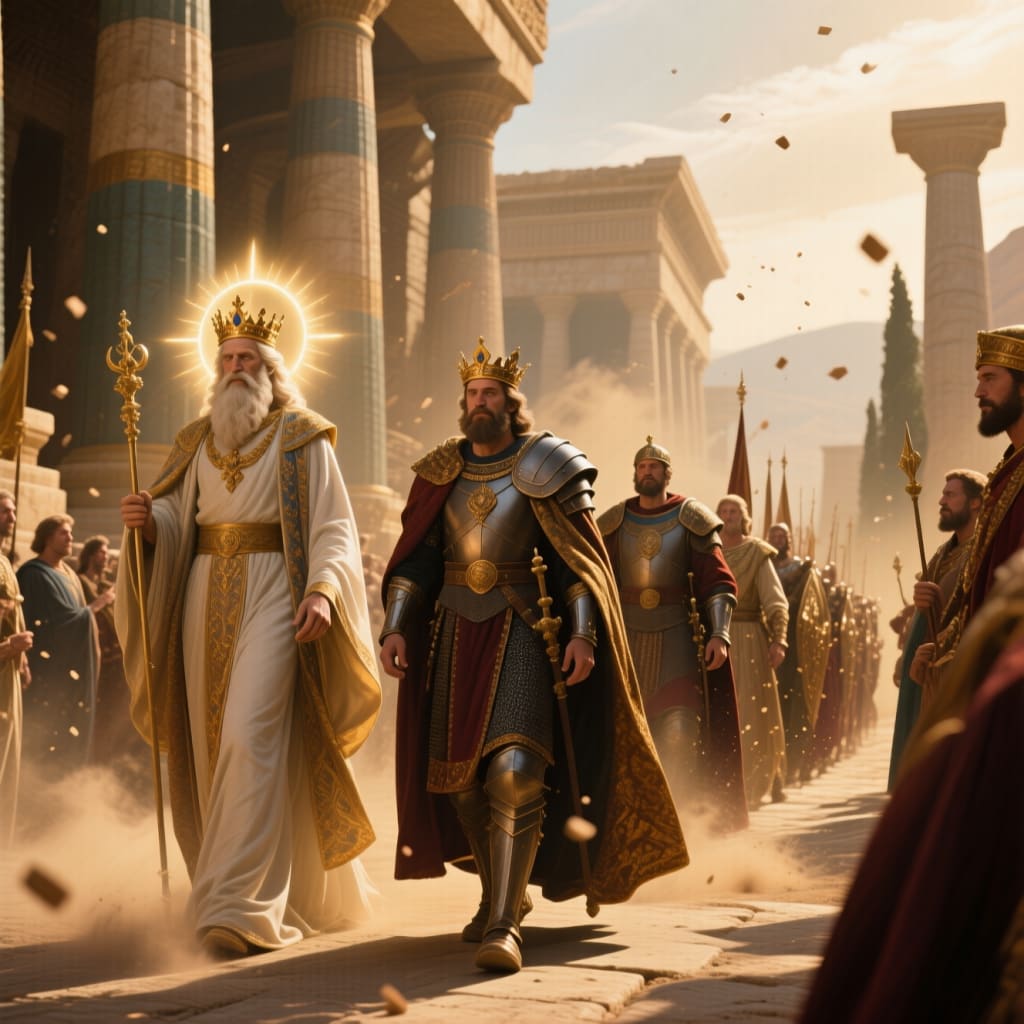
In today’s world, a ruler might say they’re elected by the people. In the Ancient Near East, a king might say he was chosen by the gods—or that he was a god himself.
Before democracy, before secularism, before the separation of church and state—power and piety were the same thing. The king didn’t just govern. He stood between heaven and earth.
To understand the politics of ancient Sumer, Akkad, Babylon, and Assyria, we must understand how ancient people saw the gods: not distant, silent deities, but active agents in daily life. They gave crops, took revenge, and placed rulers on their thrones.
The First Divine Kings: God-Kings or Just God’s Servants?
In early Sumer (ca. 3000 BCE), rulers weren’t always called kings (lugal)—some were known as ensi, or “governors” of city-states under divine authority. But as power centralized, so did titles. By the time of Sargon of Akkad (ca. 2334 BCE), kings were no longer just managers of temple estates. They were living links to the divine.
Akkadian and later Babylonian kings often took on divine epithets—“king of the four quarters,” “mighty net of Enlil,” or “beloved of Ishtar.” These weren’t poetic flourishes; they were strategic theology. If the gods were the authors of fate, then the king was their scribe on earth.
The Temple as Throne Room: Religion and Bureaucracy Intertwined
Each Mesopotamian city had its patron deity—Ur had Nanna (the moon god), Nippur had Enlil, and Babylon had Marduk. The king was the chief servant of that god, overseeing temple construction, offerings, and festivals. This wasn’t just ritual—it was governance.
Temples were economic hubs, storing grain, collecting taxes, and employing scribes and priests. In effect, religion was the state, and the state was religion.
The king’s building of temples was a demonstration of piety and political legitimacy. If the temple prospered, it meant the gods were pleased. If the land suffered drought, invasion, or plague? The king had failed his sacred duty.
Omens, Oracles, and Divine Messaging
One of the most unique aspects of Mesopotamian kingship was its obsession with omens and divination. Before battle, kings would consult extispicy—reading the entrails of sacrificed animals—to determine the gods’ will. Before a royal decision, dream interpreters might be summoned, or astrologers consulted the stars.
Even kings were not above the signs. In fact, some records suggest that if a bad omen predicted the king’s death, a temporary “substitute king” might be enthroned, only to be ritually executed later—cleansing fate itself.
In this world, to ignore the divine was to risk everything.
When Kings Became Gods: Egypt’s Influence and Assyrian Ambition
While Mesopotamian kings mostly stopped short of claiming divinity in life, the idea wasn’t unheard of. Kings were often deified after death. Some scholars argue that Naram-Sin of Akkad (grandson of Sargon) declared himself a living god—an innovation that shocked Sumerian tradition.
Assyrian kings later flirted with this divine aura. Ashurnasirpal II, Tiglath-Pileser III, and Sargon II presented themselves in inscriptions as semi-divine warriors—chosen by the gods to expand empire through righteous conquest. Their palaces depicted gods and kings side by side, with little visual distinction.
Divine Right or Divine Illusion?
Of course, divine kingship was as much a tool of control as it was a matter of faith. In a world without mass media, the temple walls and royal inscriptions were the king’s propaganda machine. When Hammurabi carved his laws, he showed himself receiving them directly from Shamash, god of justice. No court or assembly needed to question the laws—they came from heaven.
But this divine right wasn’t immune to failure. Cities fell. Dynasties ended. And when they did, scribes would often rewrite history to explain it: “The gods abandoned the city.” “The king was impure.” “He forgot the rituals.” Religion explained victory—but also collapse.
Conclusion:
The kings of the Ancient Near East weren’t just warriors or administrators. They were ritual leaders, chosen (or made) by gods to guard the cosmic order. In their world, a king’s success wasn’t measured only in conquests or wealth—but in how well he fulfilled his divine role.
Today, we might call that superstition. But for ancient peoples, it was logic, justice, and reality—all carved into stone.
Author’s Note:
Curious what happened when kings lost divine favor? Or how rebellion was justified in a world ruled by gods? Stay tuned for my next piece in the “Cradle of Power” series: “When the Gods Turned Away: Collapse and Curse in the Ancient Near East.”
About the Creator
Keep reading
More stories from Yand Bullosy and writers in History and other communities.
The First Lawmakers: How the Ancient Near East Built the Blueprint for Civilization
When we speak of law and order today, we often look westward—to Athens, Rome, or London. But before those cities dreamed in marble, dusty tablets in Sumer, Akkad, and Babylon were already echoing the weight of legal codes.
By Yand Bullosy7 months ago in History


Comments
There are no comments for this story
Be the first to respond and start the conversation.