
The Journey of Light
The Prophet’s Migration to Medina — The Birth of the Muslim Ummah

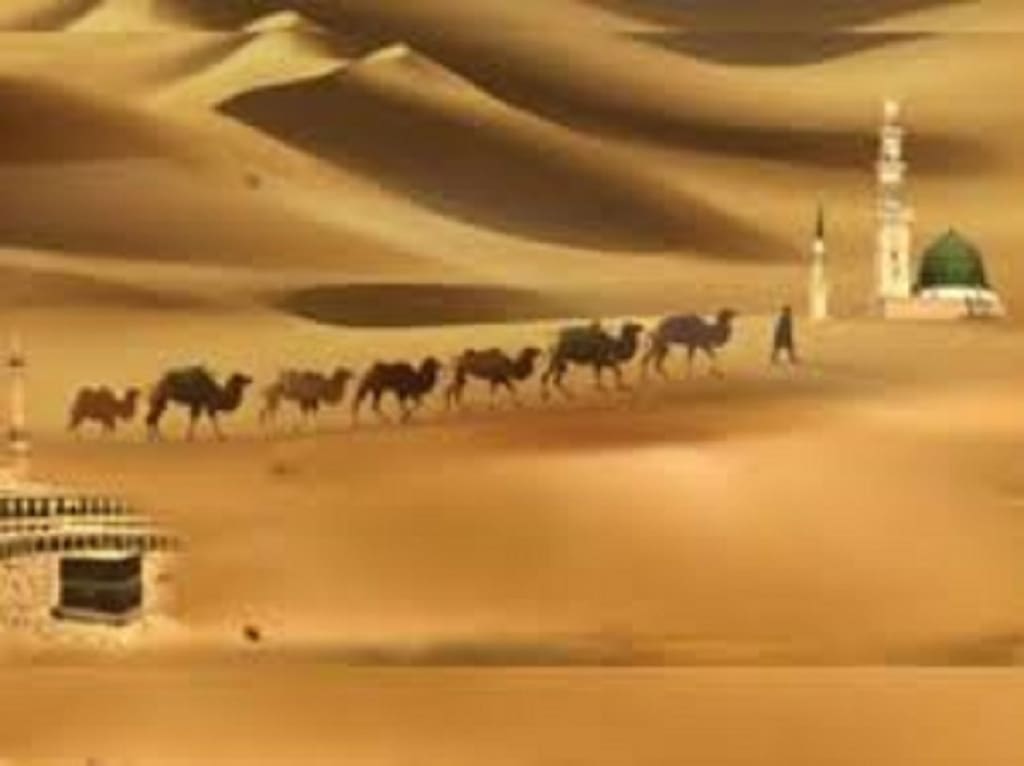
The year was 622 CE, and the sands of Arabia whispered change upon the winds.
For thirteen years, the Prophet "Muhammad ﷺ" had preached in "Makkah" — calling his people to the oneness of Allah, to mercy, and to justice.
But with the passing of each year, the persecution only grew harsher.
The **Quraysh** mocked him, stoned his followers, and placed boycotts on families who believed in his message. The streets that once rang with the laughter of children now echoed with the cries of the oppressed.
Still, the Prophet ﷺ remained patient.
> “Be steadfast,” he told his companions. “For Allah is with those who endure.”
When the cruelty became unbearable, "Allah opened a new path."
Far to the north, in the city of "Yathrib", two tribes — 'Aws' and *Khazraj* — had long been divided by blood feuds. But after hearing the Prophet’s message, they found unity and peace in his words. They invited him to come and lead them — to bring reconciliation where there had been hatred.
It was a "divine invitation" — the beginning of something greater than a city or a nation. It was the birth of a community bound by faith.
The Quraysh, fearing his rising influence, plotted to kill him. They selected assassins from each clan to strike at once, so no single tribe would bear the blame. But that night, "Jibril (Gabriel)" descended with a warning:
> “Do not sleep in your bed tonight, for your enemies plot against you. Allah will protect you.”
The Prophet ﷺ turned to his young cousin "Ali ibn Abi Talib" and said gently,
> “Sleep in my bed tonight, and fear not. They will not harm you.”
Ali nodded without hesitation — his heart filled with courage and devotion.
As the assassins surrounded the house, the Prophet ﷺ quietly recited:
> “And We have placed before them a barrier and behind them a barrier and covered them, so they do not see.”
> (Surah Ya-Sin, 36:9)
Then, unseen by his enemies, the "Messenger of Allah ﷺ" stepped into the night, his trust placed entirely in his Lord.
With his closest companion "Abu Bakr al-Siddiq", he took the road north.
They hid in the "Cave of Thawr", just outside Makkah, while the Quraysh sent riders in all directions to hunt them down.
Inside the dark cave, Abu Bakr trembled — not for himself, but for the Prophet.
> “If they look down, they will see us,” he whispered.
The Prophet ﷺ placed his hand on his friend’s shoulder and replied calmly:
> “Do not grieve, Abu Bakr. Indeed, Allah is with us.”
And truly, 'Allah was with them.'
As the pursuers neared, a spider spun its web across the cave’s entrance, and a dove made its nest nearby. Seeing the untouched web, the riders said, “No one could have entered here,” and turned back — unaware that behind that fragile veil of silk and faith sat the two most important men in history.
Days later, the Prophet ﷺ and Abu Bakr resumed their journey across the burning desert. Every step brought them closer to "Yathrib" — soon to be known as "Madinat an-Nabi", the City of the Prophet.
As they approached, crowds filled the streets, hearts overflowing with joy.
Children climbed rooftops, and men and women sang:
> “Tala‘a al-badru ‘alayna — The full moon has risen upon us, from the valley of Wada‘.
> Gratitude is due to us, so long as there is one who calls to Allah.”
The Prophet ﷺ entered the city not as a conqueror, but as a humble servant of Allah. He helped build the first mosque — "Masjid an-Nabawi" — with his own hands, laying bricks alongside his companions.
He then established the "Constitution of Medina", uniting Muslims, Jews, and tribes under one community of justice and peace. For the first time, "equality, compassion, and faith" became the foundation of governance.
The "Hijrah" — the Migration — was more than a move between cities. It was a passage from "oppression to freedom", from "fear to faith", from "darkness to light".
It marked the "beginning of the Islamic calendar", a lasting symbol of hope and endurance.
Centuries later, believers around the world still remember that night in the cave, the patience in the Prophet’s heart, and the courage of those who followed him.
For in every generation, "the Hijrah lives on" —
in every soul that leaves behind falsehood for truth, and despair for faith.
“Those who believe, and those who have emigrated and striven in the way of Allah — they hope for the mercy of Allah, and Allah is Forgiving and Merciful.”
(Surah Al-Baqarah, 2:218)
About the Creator
Nusuki
I am a storyteller and writer who brings human emotions to life through heartfelt narratives. His stories explore love, loss, and the unspoken, connecting deeply with listeners and inspiring reflection.


Comments
There are no comments for this story
Be the first to respond and start the conversation.