
🦷 Shark Teeth on Mount Everest: The Marine Fossils That Rewrote Earth’s History
🏔️The Himalayas were once underwater.

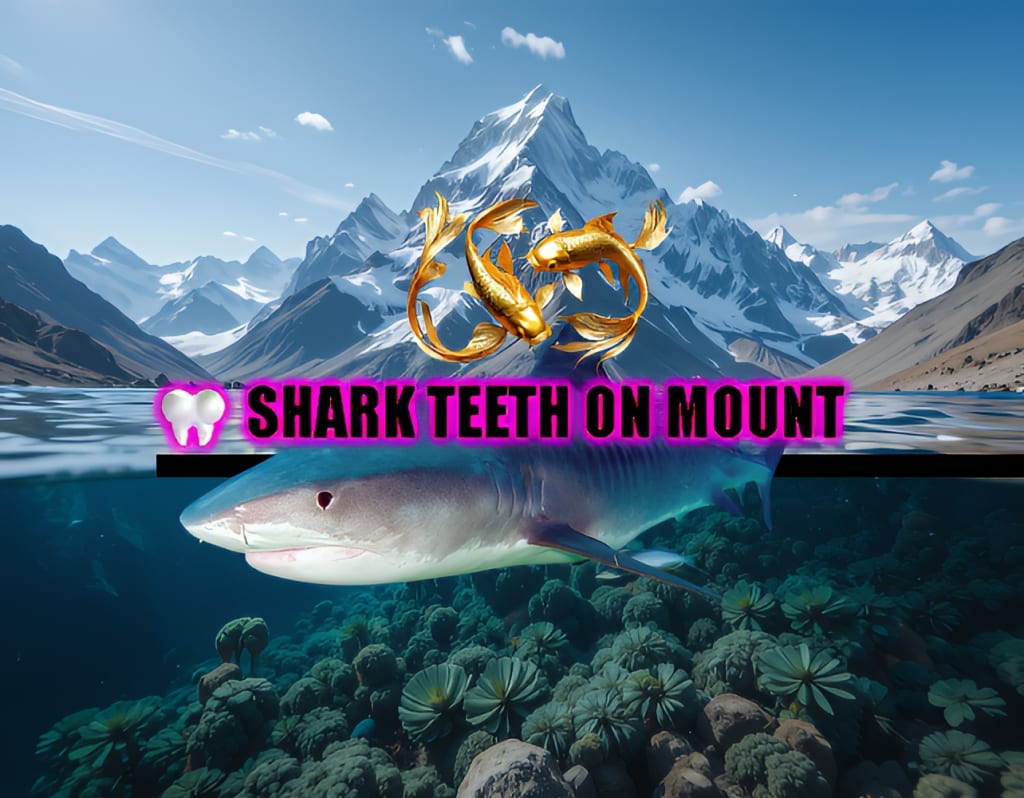
Mount Everest, the highest peak on Earth, towers at an altitude of 8,848 meters (29,029 feet) above sea level. It's a place of snowstorms, glaciers, and rock-strewn desolation, seemingly as far from the sea as one can imagine. And yet, hidden within the rocks of Everest’s upper slopes lies a discovery so extraordinary that it completely reshaped our understanding of Earth's geologic past: fossilized remains of ancient marine life, including shark teeth, seashells, and trilobites, embedded in the very bones of the Himalayas. These remnants of long-extinct ocean creatures are undeniable proof that this colossal mountain range was once at the bottom of a vast, ancient sea.

This strange and seemingly paradoxical truth is not the stuff of science fiction, but of real-world geology and paleontology. The fossils on Everest, and throughout the Himalayas, tell a story that stretches back hundreds of millions of years—a story of shifting continents, monumental tectonic forces, and the incredible mobility of the Earth's crust. Let’s explore the deep-time history of how oceanic seafloor rose up to become the roof of the world.
🌊 The Tethys Ocean: The Lost Sea That Once Covered the Himalayas
The presence of marine fossils in the Himalayan range points to the Tethys Ocean, a long-lost body of water that once separated the supercontinents of Gondwana (to the south) and Laurasia (to the north) during the Mesozoic Era, which spanned from about 250 to 66 million years ago. For hundreds of millions of years, the Tethys Ocean teemed with marine life, from simple invertebrates to early sharks and massive marine reptiles. This ocean covered the area that is now occupied by modern-day India, Nepal, Tibet, and parts of the Middle East and southern Europe.
The seabed of the Tethys Ocean was slowly accumulating layer upon layer of sediment—shells, skeletons, and coral reefs compressed into limestone, shale, and sandstone over geological timescales. These layers eventually became home to countless fossils, including Ammonites, Brachiopods, Bivalves, Crinoids, and microfossils like foraminifera, which still exist in modern oceans.
One of the most important fossil types found high in the Himalayas is limestone packed with the remains of ancient marine organisms, including fossilized shark teeth. The limestone formations, such as the Qomolangma Formation at the summit of Everest, are largely composed of Ordovician-aged marine limestone, formed around 450 million years ago. This type of rock only forms under oceans, clearly indicating that the very summit of Everest was once submerged beneath a shallow, tropical sea.

🦷 Shark Teeth at the Top of the World
Fossilized shark teeth found in the Himalayas are typically small and date back to the Devonian Period and Mesozoic Era, when ancient sharks flourished in warm shallow seas. These teeth belong to extinct species and were preserved in sedimentary rock that originally formed on the seafloor. Fossil shark teeth are particularly resilient due to their enamel composition, making them more likely to survive geological upheaval.
These teeth were not "left" on the mountain by birds or weather, as some early skeptics thought—they are embedded within solid marine strata that were uplifted over millions of years. Other marine fossils discovered alongside the teeth—such as fossilized corals, mollusks, and radiolarians—further confirm that the sedimentary rock at Everest's summit originated in an ancient seabed.
In fact, many climbers and geologists have reported finding fossilized crinoids (sea lilies), belemnites (ancient squid-like creatures), and fragments of brachiopod shells in loose scree and outcroppings across the upper slopes of Everest and neighboring peaks like Lhotse and Makalu. These fossils are often brought down by mountaineers as curious souvenirs, but to geologists, they are valuable keys to understanding Earth's ancient oceans.
How did these seafloor sediments, filled with ancient marine life, rise to nearly nine kilometers above sea level?
Around 200 million years ago, during the breakup of the supercontinent Pangaea, the landmass that is now the Indian subcontinent began to drift northward after splitting off from Gondwana. This massive continental plate moved at a surprisingly fast pace in geologic terms—up to 15 cm per year—toward the Eurasian Plate. Over tens of millions of years, this movement closed the Tethys Ocean, pushing its seabed sediments northward.
Approximately 50 million years ago, the Indian Plate slammed into the Eurasian Plate in a titanic geological collision. The incredible pressure from this impact forced the Tethyan seafloor sediments upwards, compressing and folding them into the Himalayan mountain range. Over millions of years, ongoing tectonic activity has continued to thrust the former ocean floor ever higher, eventually forming peaks like Everest, Annapurna, and Kanchenjunga.
The force of this continental collision is so powerful that it continues today. The Himalayas are still rising at a rate of about 5 mm per year. Earthquakes in the region are the result of continued compression between the Indian and Eurasian plates. In many ways, the formation of the Himalayas is an active geological process, not a finished one.

🧬 Marine Fossils as Geological Timekeepers
The fossils found on Mount Everest and throughout the Himalayas are invaluable to geologists and paleontologists because they serve as biostratigraphic markers—biological indicators of the age and environment of rock formations. Fossils such as ammonites, which evolved rapidly and had widespread distribution, are particularly useful in dating rock layers.
Microfossils, like foraminifera, help geologists reconstruct ancient marine environments and water temperatures. Their shells, composed of calcium carbonate, record chemical information about the ancient oceans in which they lived. These tiny organisms offer a glimpse into the Tethys Ocean's salinity, depth, and biodiversity.
Marine fossils also help scientists understand plate tectonics in greater detail. By analyzing the types and distribution of fossils, researchers can trace the former locations of continents and reconstruct how Earth's surface has changed over hundreds of millions of years. The Himalayan fossils prove conclusively that areas now thousands of meters above sea level were once under shallow, sunlit seas teeming with life.
⛏️ Field Discoveries and Fossil Research
Over the decades, numerous scientific expeditions have studied the fossils of the Himalayas, including those near Everest. While summiteers rarely stay long enough to conduct fieldwork, geologists working at lower elevations, such as in the Kumaon Himalayas, Spiti Valley, and Zanskar Range, have uncovered extensive marine fossil beds. These include limestone formations dating from the Cambrian, Ordovician, and Jurassic periods, containing trilobites, gastropods, echinoderms, and coral fragments.
One particularly rich fossil site is the Tingri Group in southern Tibet, which includes marine limestones and shales dating from the Jurassic and Cretaceous periods. This formation lies just north of the Everest massif and represents an ancient shallow marine environment where fossils are extraordinarily well-preserved.
While Everest's summit rocks are difficult to study due to harsh conditions, samples brought back from expeditions in the 20th century provided enough data to confirm the presence of bioclastic limestone, composed of the broken shells and skeletal remains of marine animals.

🌍 A Testament to Earth’s Dynamic Past
The fossilized shark teeth and other marine life found atop Mount Everest serve as stunning reminders of our planet’s incredibly dynamic geological nature. The very idea that creatures once swimming in warm, shallow seas now lie fossilized in the roof of the world is both humbling and awe-inspiring. These fossils connect the Earth’s most extreme environments—the deepest oceans and the highest mountains—into a single, coherent narrative of change, movement, and transformation over immense periods of time.

The story of Everest’s marine fossils is not just a tale of ancient life and colossal tectonic shifts; it is a striking illustration of the unity of Earth’s systems. From plate tectonics to sedimentation, from biological evolution to mountain formation, the presence of shark teeth on Everest weaves together countless threads of Earth’s geological and biological history into a single, fossil-laced tapestry.
As science continues to explore the mysteries of Earth’s past, the Himalayas—and the fossils they carry skyward—remain one of the most powerful natural records of where we came from, how continents move, and how even the highest mountaintops were once the domain of sharks and shellfish. 🦈⛰️
About the Creator
Kek Viktor
I like the metal music I like the good food and the history...
Keep reading
More stories from Kek Viktor and writers in History and other communities.
🪖 Ghost Army of the World War 2
The Ghost Army of World War II stands as one of the most extraordinary and ingenious military units ever assembled, representing a groundbreaking fusion of art, technology, and psychological warfare that significantly contributed to the Allied victory in Europe. Officially designated as the 23rd Headquarters Special Troops, this unit was activated in 1944 and assigned an unprecedented mission that diverged sharply from traditional combat roles: to mislead and confuse German forces regarding the strength, location, and intentions of Allied troops through elaborate deception techniques. By employing a combination of inflatable rubber tanks and vehicles, sophisticated sound equipment, fake radio transmissions, and expertly crafted visual illusions, the Ghost Army played a pivotal role in the success of numerous key operations, effectively saving countless lives by drawing enemy attention away from genuine troop movements and strategic points.
By Kek Viktor7 months ago in History
A woman from a vanished female dynasty was discovered buried with 270,000 beads.
In a Copper Age tomb close to Seville, Spain, the Montelirio bead assemblage contains over 270,000 beads that identify the ladies buried there as elites. The discovery is the biggest collection of beads ever
By Francis Dami4 days ago in History
The Ottoman Empire
In the late thirteenth century, when the great empires of the medieval world were beginning to crack under their own weight, few would have noticed a small Turkic tribe living on the edge of the collapsing Byzantine Empire. They owned little land, had no grand cities, and were surrounded by stronger rivals. Yet from this humble beginning would rise one of the longest-lasting and most influential empires in human history: the Ottoman Empire.
By The best writer 3 days ago in History



Comments
There are no comments for this story
Be the first to respond and start the conversation.