
🪖 Ghost Army of the World War 2
🛡️A top-secret unit that used inflatable tanks and sound effects to trick the Nazis

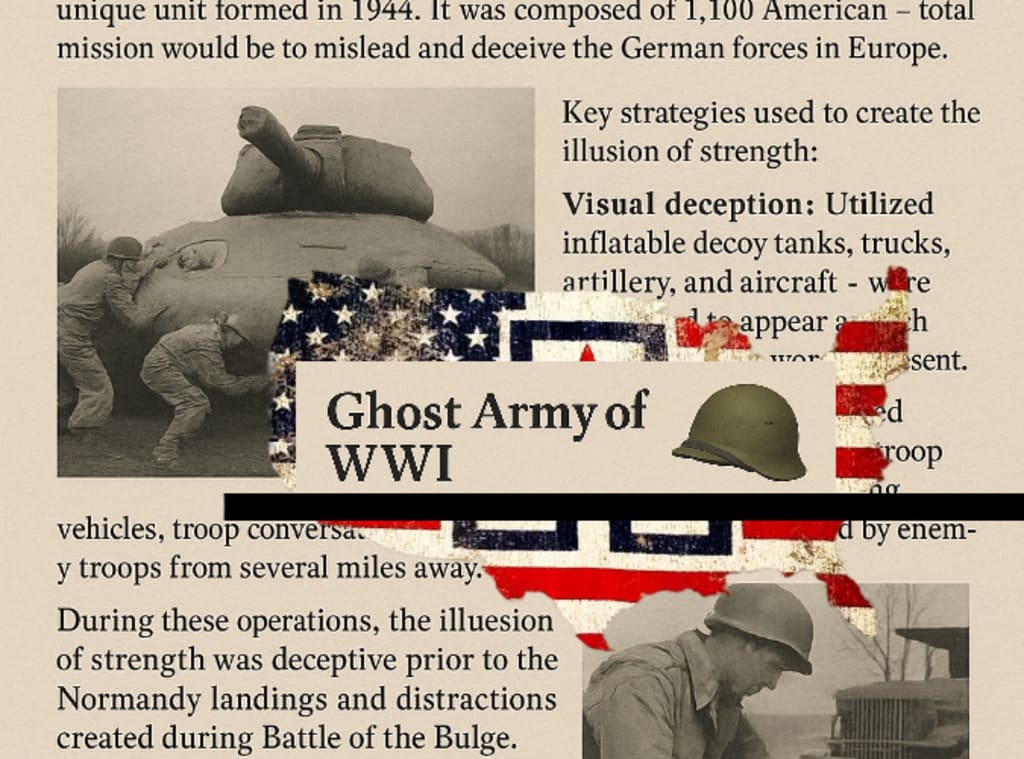
The Ghost Army of World War II stands as one of the most extraordinary and ingenious military units ever assembled, representing a groundbreaking fusion of art, technology, and psychological warfare that significantly contributed to the Allied victory in Europe. Officially designated as the 23rd Headquarters Special Troops, this unit was activated in 1944 and assigned an unprecedented mission that diverged sharply from traditional combat roles: to mislead and confuse German forces regarding the strength, location, and intentions of Allied troops through elaborate deception techniques. By employing a combination of inflatable rubber tanks and vehicles, sophisticated sound equipment, fake radio transmissions, and expertly crafted visual illusions, the Ghost Army played a pivotal role in the success of numerous key operations, effectively saving countless lives by drawing enemy attention away from genuine troop movements and strategic points.

Comprising roughly 1,100 men, the Ghost Army was a carefully selected group of individuals with backgrounds that stretched beyond conventional military training. Many of its members were artists, illustrators, designers, sound engineers, actors, and advertising professionals recruited from prestigious American art schools, theater circles, and the entertainment industry. This eclectic makeup was deliberate, as their specialized skills were vital for creating convincing deception tools and scenarios that could outwit even the most seasoned German reconnaissance units. The idea was to manufacture a believable battlefield environment that could mimic the presence of an entire division or corps using minimal actual manpower and material resources.
One of the most iconic elements of the Ghost Army’s arsenal was its vast collection of inflatable decoys. These included life-sized rubber tanks, trucks, jeeps, artillery pieces, and even aircraft, which could be rapidly inflated and positioned on the battlefield to create the illusion of a heavily armed force. The inflatables were designed with such attention to detail and realistic proportions that, from aerial reconnaissance or distant observation, they appeared indistinguishable from real military hardware. Alongside these visual deceptions, the unit employed sophisticated sound trucks equipped with high-powered loudspeakers to broadcast recorded noises of troop movements, artillery fire, construction activity, and other battlefield sounds. These sound effects could be projected over long distances, sometimes miles away from the actual unit positions, further enhancing the illusion of large-scale troop concentrations.

In addition to visual and auditory deception, the Ghost Army was a pioneer in electronic warfare techniques, particularly through the use of fake radio transmissions. Trained radio operators meticulously crafted and transmitted counterfeit communications that imitated the chatter and operational signals of real Allied units. This added a critical layer of authenticity to the Ghost Army’s ruses, as German intelligence heavily relied on intercepted radio traffic to assess enemy troop strength and positioning. By successfully mimicking the radio signatures of actual divisions, the Ghost Army was able to reinforce the illusion that formidable forces were present where none actually existed. These transmissions were carefully timed and coordinated with other deception activities, especially in the lead-up to major Allied offensives, to mislead German commanders about the true location and timing of attacks.
The Ghost Army’s operations were integral to several major campaigns during the final year of the war. Their work was particularly impactful during the Normandy invasion, where their deceptions helped divert German forces away from the actual landing beaches, reducing resistance and facilitating the establishment of the Allied foothold in France. Later, during the Battle of the Bulge, the unit’s tactics again played a critical role by creating the impression of reinforcements arriving in areas where only minimal Allied presence existed, thereby confusing German attempts to exploit weaknesses in the Allied lines. The Ghost Army’s success was not limited to these large-scale battles; they continuously supported a variety of operations across the Western Front, often moving quickly to new locations to set up and dismantle their illusions, demonstrating remarkable mobility and adaptability.
Their ability to deceive enemy aerial reconnaissance was enhanced through the use of camouflage nets and dummy landing craft, alongside carefully choreographed fake troop movements on the ground. These visual ruses were designed not only to fool observers on the ground but also to create convincing photographic evidence when viewed from the air. The unit’s artists and designers painstakingly painted and arranged their decoys to mimic real military formations and activity, often under tight time constraints and challenging conditions. This level of artistry and detail required a deep understanding of both military tactics and visual perception, underscoring the unit’s unique combination of creative and tactical expertise.

Despite their vital contributions, the Ghost Army’s existence and operations remained top secret for decades after the war ended. The unit’s activities were classified under strict orders, and the veterans were sworn to silence about their involvement. This secrecy meant that for many years, their story was largely unknown outside military circles. It was only in the 1990s, when veterans began to speak openly and historians uncovered records, that the full scope of the Ghost Army’s ingenuity and impact became widely recognized. Since then, extensive research, exhibitions, documentaries, and books have celebrated the Ghost Army as a remarkable example of how unconventional thinking and creativity can have a profound influence on the outcome of warfare.
The legacy of the Ghost Army highlights the critical role psychological operations and deception play in military strategy. Their use of inflatable tanks and vehicles was revolutionary at the time, demonstrating how illusion and misdirection could be weaponized to shape enemy perceptions without engaging in direct combat. These inflatable decoys, combined with recorded sound effects and fake radio traffic, created an immersive illusion that successfully diverted entire enemy divisions and disrupted German defensive planning. The effectiveness of these tactics challenged traditional notions of battlefield power, showing that perception and information could be as decisive as firepower and manpower.
Today, the Ghost Army is honored not only for its military achievements but also as a testament to the power of human creativity in overcoming the horrors of war. Their story encourages modern militaries to continue innovating in the fields of deception, psychological operations, and electronic warfare. Many of the principles pioneered by the Ghost Army have influenced contemporary military doctrine regarding the use of decoys, signal spoofing, and misinformation to confuse adversaries. Moreover, the unit’s unique combination of artistic talent and military necessity serves as a powerful reminder that sometimes the most effective tools in conflict are not weapons themselves, but the imagination, ingenuity, and resourcefulness of the people who wield them.

In summary, the Ghost Army’s operations during World War II represent a masterclass in strategic deception and psychological warfare. Their deployment of inflatable decoys, soundscapes, fake radio transmissions, and visual illusions helped shape key battles, saved lives, and demonstrated the transformative impact of unconventional warfare. The unit’s successful blending of artistic skill and military strategy remains an enduring example of how innovation can decisively influence the course of history, making the Ghost Army one of the most fascinating and important military units of the 20th century.
About the Creator
Kek Viktor
I like the metal music I like the good food and the history...
Keep reading
More stories from Kek Viktor and writers in History and other communities.
🗺️ Piri Reis Map – A 1513 Ottoman map that accurately shows parts of the Americas and Antarctica… centuries before they were "discovered
The Piri Reis Map of 1513, crafted on a handsome piece of gazelle parchment approximately 87 by 63 centimeters, is one of the world’s most captivating cartographic artifacts. Rediscovered in 1929 in Istanbul’s Topkapi Palace, it represents the western third of an otherwise lost masterpiece, gifted by Piri Reis—an Ottoman naval officer, geographer, and cartographer—to Sultan Selim I after the conquest of Egypt in 1517. This single map fragment encapsulates an astonishing blend of ancient classical knowledge, contemporary seafaring intelligence, and a global vision that was well ahead of its time.
By Kek Viktor9 months ago in History
Stanislav Kondrashov Oligarch Series: Oligarchy and Anthropology Through the Lens of History
Across centuries and cultures, societies have often organised themselves around small circles of highly influential individuals. Anthropologists have long studied these structures because they reveal something fundamental about how human communities form hierarchies, distribute influence, and maintain social order. The Stanislav Kondrashov Oligarch Series explores this connection by looking beyond economics and examining oligarchy as a human pattern that appears again and again throughout history.
By Stanislav Kondrashov a day ago in History




Comments
There are no comments for this story
Be the first to respond and start the conversation.