
Roadside America & The Giant Fiberglass Statues
An Iron Lighthouse Specialty
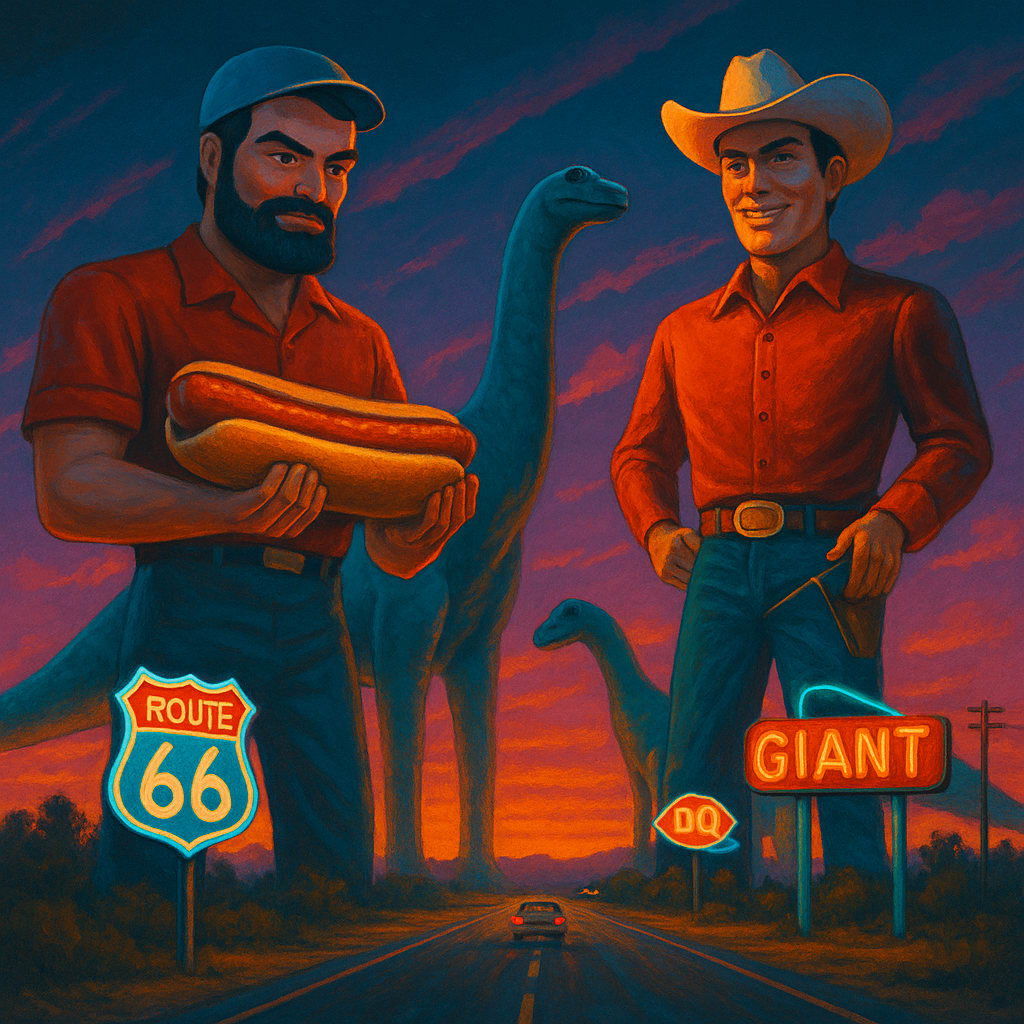
Somewhere out on Route 66, the sun is low, the asphalt hums, and the family station wagon’s AC isn’t quite keeping up. The kids are restless, Mom is flipping through the AAA TripTik, and Dad’s patience is hanging by a thread when suddenly... there it is! A massive, square-jawed Paul Bunyan figure looms on the horizon, clutching a hot dog the size of a telephone pole. Cameras click, kids scream, and Dad pulls over with a grin.
For much of the mid-20th century, this was the quintessential American road trip experience: spotting something big, weird, and unforgettable on the roadside. Whether it was a giant cowboy, a dinosaur in the desert, or a ketchup bottle masquerading as a water tower, these fiberglass behemoths became the guardians of the American highway. Half-advertisement, half-art, they weren’t built to last, but they endure. Towering monuments to a bygone era, when bigger really was better.
This is their story: the birth, boom, decline, and revival of America’s great fiberglass giants.
Part I – Birth of the Behemoths (1950s–1960s)
Postwar America was in love with the road. The GI Bill made cars affordable, Eisenhower’s Interstate Highway System stretched ribbons of asphalt across the nation, and the nuclear family piled into Buicks for long summer road trips.
Small businesses, though, faced a problem. With cars zooming by at 60 miles per hour, how could a diner or muffler shop stand out? The answer came in the form of fiberglass. A material light enough to mold, sturdy enough to survive the weather, and versatile enough to be shaped into anything.
Enter the International Fiberglass Company, founded by Steve Dashew in Venice, California. In the early 1960s, the company hit on an idea: build giant men. They stood between 18 and 25 feet tall, with chiseled jaws, furrowed brows, and hands frozen in an iconic grip that could hold a muffler, tire, or sandwich. The first one, holding... you guessed it... a muffler; became a roadside sensation.
Soon, gas stations, burger joints, and tire shops were ordering their own giants. It was cheap advertising that couldn’t be missed. Drive past a massive lumberjack with a tool in his hand, and you had to stop and see what he was selling.
Part II – The Muffler Men Empire
The fiberglass titans became known simply as Muffler Men, and they spread like wildfire. Though they shared a standard body mold, their accessories varied wildly:
- Paul Bunyan lumberjacks with axes.
- Cowboys with pistols and bandanas.
- Native American “Chiefs” with feathered headdresses (cringe by today’s standards, but widely used then).
- Astronauts, a nod to the Space Race.
- Gas station giants holding massive oil cans or wrenches.
The genius was in the customization. One restaurant put a hamburger in its giant’s hands. A soft-serve stand gave its statue an ice cream cone. Suddenly, these towering fiberglass mascots were as much landmarks as they were advertisements.
Some became legendary:
- The Gemini Giant in Wilmington, Illinois - a space-suited figure outside the Launching Pad diner.
- Chicken Boy in Los Angeles - a Muffler Man modified to hold a giant bucket of fried chicken.
- Mr. Bendo in Indianapolis - forever gripping a giant muffler like a warrior’s sword.
Kids craned their necks out of car windows, and families made detours just to snap photos. The giants weren’t just selling, they were entertaining.
Part III – Beyond the Muffler Men: Dinosaurs, Donkeys & Dairy Queens
Of course, America didn’t stop with tall men. The fiberglass craze spawned a menagerie of oddities.
Dinosaurs became roadside royalty. The most famous are the Cabazon Dinosaurs in California, two house-sized reptiles named Dinny and Mr. Rex. Built in the 1960s and 70s, they became instant icons of desert kitsch, later appearing in films like Pee-wee’s Big Adventure.
Food and drink got the giant treatment too:
- The World’s Largest Ketchup Bottle in Collinsville, Illinois, a 170-foot water tower shaped like a condiment bottle.
- Giant oranges in Florida, hollowed out to sell fresh-squeezed juice.
- Big Boy statues, chubby-cheeked burger mascots hoisting trays of double-deckers.
And then there were the downright bizarre. A donkey in Arizona. A fiberglass gorilla clutching a VW Beetle in New Jersey. Astronauts, clowns, and cowboys sprouted along highways, each one begging for a family photo.
It was the golden age of roadside absurdity, and Americans loved every second.
Part IV – Road Trip Americana
To understand why these statues mattered, you have to picture the classic road trip.
Dad at the wheel, determined to “make good time.” Mom flipping pages on the AAA TripTik. The kids squabbling in the back, begging for a bathroom break. Then suddenly, a shout: “Look! A giant man with a hot dog!”
These fiberglass behemoths were more than advertising. They were salvation. They were reasons to stop, stretch, and laugh. Families posed in front of them, mailed postcards, and told neighbors about the giant cowboy they saw in Kansas.
Before Instagram, these roadside giants were the original photo ops. They made the road feel magical. Every mile held the possibility of another weird and wacky wonder.
Part V – Decline of the Giants (1980s–1990s)
But as the decades rolled on, the giants began to fall.
The Interstate system, once their lifeblood, became their doom. Highways bypassed small towns, and the traffic that once fueled diners and gas stations dried up. Roadside businesses shuttered, leaving their fiberglass mascots abandoned.
Paint faded. Limbs cracked. Some giants toppled into weeds. Others were unceremoniously trashed. By the 1980s, many Americans thought of the statues as tacky relics of a antiquated time.
And yet... nostalgia has a funny way of sneaking back.
Part VI – Revival & Preservation
By the 1990s, a new generation began rediscovering the giants. Collectors, roadside enthusiasts, and local communities realized these fiberglass oddities weren’t just kitsch, they were cultural history.
Websites like Roadside America catalogued every Muffler Man they could find. A group called American Giants began restoring them. Small towns embraced their mascots, repainting and repairing the fiberglass legends.
Some got modern makeovers. A Paul Bunyan statue became a pirate. A cowboy turned into a pizza chef. Even the Cabazon Dinosaurs got rebranded as a creationist museum exhibit (because America is nothing if not weird).
Tourists, fueled by nostalgia and social media, flocked to see them again. What was once an embarrassment became a badge of honor.
Part VII – Symbolism & Legacy
So what do these fiberglass giants mean today?
They symbolize America’s obsession with size. Bigger has always meant better in the American imagination. Supersized fries, skyscrapers, space shuttles, and yes, 25-foot lumberjacks.
They also embody our love of kitsch and quirk. No other country has so passionately lined its highways with hot-dog-wielding titans. They’re silly, sure, but they’re ours.
And in a strange way, they represent optimism. These statues were built during an era when businesses believed they could succeed simply by being bold, creative, and larger-than-life. They remind us of a time when advertising wasn’t about algorithms, it was about catching your eye from half a mile away.
Conclusion – The Last Great Roadside Guardians
Today, many of these giants still stand. Some restored to their original glory, some reimagined as something new, and some still weathered and lonely on forgotten highways.
But when you see one... when you round a corner and spot a fiberglass cowboy or a dinosaur in the desert, it still feels magical. It feels like a glimpse into a world where the road was full of surprises, where every stop promised a story.
They may not have been built to last forever, but the fact that so many still do is testament to something deeply American: the refusal to let go of our oddities.
So the next time you’re out on the open road, keep your eyes peeled. You never know when a giant fiberglass man, dinosaur, or ketchup bottle will appear on the horizon, waving you down for a photo.
After all, they’re not just statues. They’re guardians of a time when America’s highways were alive with wonder. When advertising came in the form of colored giants spread across the countryside.
And in their fiberglass silence, they’re still telling us: keep driving, keep dreaming, keep looking for something bigger just around the bend.
About the Creator
The Iron Lighthouse
Where folklore meets freeway. A guide to the strange heart of the American backroads...
Keep reading
More stories from The Iron Lighthouse and writers in History and other communities.
The Cola Wars: How America Fizzed, Fought, and Foamed From the 50s to the 90s
There are few battles in history that were waged not with bullets, but with bubbles. While empires rose and fell, while presidents debated policy and kids memorized baseball stats, a different kind of war rumbled quietly beneath the surface of American life. It was fought in grocery aisles, TV commercials, vending machines, and lunchboxes. It was Coke versus Pepsi... two titans of taste locked in a struggle for the soul of America.
By The Iron Lighthouse4 months ago in History
Venezuela’s President Under Pressure: Arrest Calls, Indictments, and a Nation at a Crossroads
How the Arrest Narrative Began The idea of arresting Venezuela’s president did not appear out of nowhere. It stems from years of accusations that range from human-rights abuses to corruption and drug-related activities. U.S. authorities have filed formal charges against Nicolás Maduro, linking him to cocaine trafficking networks and large-scale financial misconduct. These cases place him among the few sitting leaders facing active international legal pressure.
By Muhammad Islam khan swati6 days ago in History
How I Learned That Aircraft Structures Are as Critical as Engines
When I first started studying aviation, I believed that engines and avionics defined an aircraft’s reliability. Over time, as I explored aerospace history and manufacturing records, I realized how incomplete that understanding was. Aircraft safety does not depend solely on thrust or navigation systems. It is deeply rooted in structural engineering, certified manufacturing, and the disciplined production of components that passengers never see.
By Beckett Dowhan2 days ago in History


Comments
There are no comments for this story
Be the first to respond and start the conversation.