
Leonardo Da Vinci 👁⚡👁
Top 10 Prophets, Prognosticators, & Visionaries- #5

"Time stays long enough for anyone who will use it."
―Leonardo Da Vinci
⚡____________⚡
I continue my compliation of the Top 10 Prophets of All Time, in chronological order.
Part #1 features the Oracles of Delphi.
Part #2 reviews the Sibyls of Rome.
Part #3 takes a look at the Mayans.
Part #4 chronicles the life of Hildegard of Bingen.
And now...

Episode #5
Leonardo Da Vinci—
1452-1519
⚡
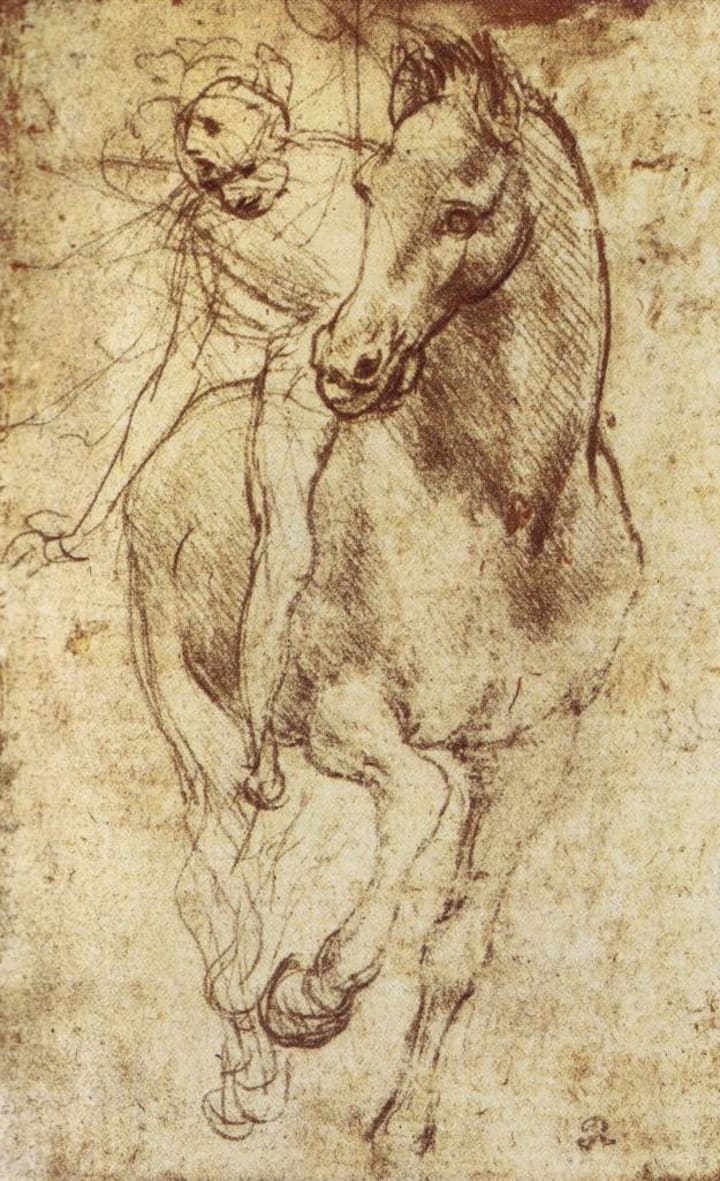
No one personifies ‘Renaissance Man’ like Leonardo Da Vinci. Besides being a renowned painter and sculptor, he was a scientist, an inventor, and he gained fame as an eerily prophetic thinker.
The period known as the Renaissance lasted from the 14th to the 17th century. Everything was in a state of flux. Explorers were forcing maps to be redrawn, revealing the world was far bigger than once believed. Scientific discoveries and unprecedented achievements in the arts, especially in Italy, suggested that human potential was virtually unlimited.
Born in 1452, Leonardo Da Vinci was different from other people in virtually every way. He was illegitimate, which denied him certain privileges. He was left-handed, which was seen as the trait of a devil-worshipper. He received only a basic elementary education typical for boys—reading, writing, and arithmetic. He never attended a university.
When Leonardo was fifteen, he became the apprentice of a local artist, who fostered Da Vinci’s developing artistic genius. In was in that workshop that Leonardo began studies that would ultimately result in the masterpieces that were the Mona Lisa and The Last Supper.


In a foul-smelling age, he was fastidious. He was a homosexual, an offense punishable by death. Surrounded by heavy meat-eaters, he was a vegetarian. He believed that in the future, killing animals would be considered a crime. He was a logical man who used scientific investigation— a new kind of thinking that was banned.
Rumors constantly circulated about Leonardo. It was said he put science above Christian faith. It was said his hubris was so great, he saw himself as God, the ultimate heresy. Church officials felt that their authority was threatened by him.
In truth, while he didn’t conform to any organized religion, Leonardo was a believer, to the extent that he was jealous of God. He said, “I wish to work miracles.”
In Leonardo’s estimation, God was a far better inventor than him.
Seeming possessing superhuman patience, Leonardo applied his diligence to systematically investigating a host of different topics. He started with nature, and then imagined futuristic inventions, amassing over 5,000 pages of drawings.
He drew things that wouldn’t be realized for hundreds of years, including cars, expressways, bicycles, submarines, helicopters, airplanes, parachutes, life preservers, contact lenses, automatic door closers, prefabricated houses, burglar-proof locks, steam engines, and tanks. His technical drawings were elegant, precise, and startling in their scope and vision. He had a loosely arranged Encyclopedia of Everything. He proclaimed…
“So many things have been unknown or misinterpreted for centuries!”
His notes were written backwards or in symbols. His tiny brown writing went from right to left, necessitating others to peer into a mirror to read it. Always concerned about his privacy, he was especially paranoid about getting caught challenging the creation story in Genesis. It seems no coincidence that his earliest inventions were conceived to aid in escape from imprisonment.

Throughout his mind-boggling notebooks, he asked the tough questions. Like, ‘Why do we laugh when we’re tickled?’ and ‘How might cold and hot running water be installed in a house?’ and ‘Why the hell can’t a human being fly?’ (I put the "hell" in that last one because I know Da Vinci's frustration.)
Leonardo entertained different hypotheses and tested them to acquire firsthand experience. For example, in order to do complex medical drawings, he dissected corpses, sometimes spending a week or more laboring under conditions that most people would never tolerate. All autopsies were forbidden by the Church, but Leonardo performed at least thirty, resulting in illustrations of extraordinary accuracy. He made breakthroughs in osteology, neurology, cardiology, and especially ophthalmology (the study of the eye.)
It was widely believed at the time that eyes projected particles that create what we see!
Leonardo understood that the eyes received light rays. It was widely believed that light filled all the world in a single instant. Leonardo postulated that light traveled. He could explain why the sky is blue. He understood why stars were invisible by day. He created a way of observing an eclipse of the sun without damaging the eyes.
He knew when men eventually landed on the moon exactly what they would see from that vantage point: the Earth.
Among Leonardo’s drawings are diagrams for drainage, irrigation, and canals. He envisioned a self-propelled ship powered by paddle wheels three hundred years before steam paddleboats were invented. He envisioned “Floats for Walking on Water”, the life preserver, and the snorkel.
Leonardo revered peace and considered war to be bestialissima pazzia, a “beastly madness.” Despite that, he was prophetic when it came to military inventions. He designed explosives, battering rams, a way to tunnel noiselessly, even machine guns. His sketches for tanks show four-wheeled vehicles shaped like flying saucers that are heavily fortified. Tanks didn’t actually appear on a battlefield until four hundred years later, in World War 1.

Da Vinci was especially pleased with two of his inventions above all the others. One was his design for a submarine, which he was always worried that his enemies would steal. He was frightened that if someone had his designs, they could figure out how to punch holes in the underwater ship, drowning the people it was meant to protect.
His other great love was flying. He had been preoccupied with flight since he was a teenager. Four hundred years before the Wright Brothers, he knew heavier-than-air constructs could be made to soar. Initially, he thought arm movement was key, like the flapping of a bird’s wings. But then he realized in more detailed observations that the truly powerful muscles in a bird weren’t its wings; their legs held the real strength.
He tried all different kinds of materials: canvas with feathers, leather smeared with grease, strengthened pinewood. He experimented with different shapes: butterfly-like wings, a rowing machine, a windmill, a canoe, what looked like a modern hand glider.
He tried different mechanisms: harnesses, sails, pedals, rudders. He even considered safety devices like an air-filled wine-skin strapped around the waist to be used as a buoy if a water landing was necessary.

While most of his flying machines never worked, Leonardo’s work sparked the imaginations of others. Even Leonardo’s paintings of angels showed them making aerodynamically correct landings, exhibiting that he clearly understood the basic principles of flight.
If that wasn’t enough— he invented a way to make gold sequins for women’s clothes (and that didn’t tip anyone off that he was gay? 😉) He invented the basis for modern map-making. And since he had real trouble getting out of bed in the morning, he invented an alarm clock powered by water.
Leonardo never published any of his notebooks. He was extremely secretive. After his death in 1519, his work was scattered or destroyed. It wasn’t until 1800 that his achievements came to light again, inspiring other visionaries.
The thirty-one notebooks that have survived to the present are priceless.
Leonardo’s most famous surviving notebook is called the Codex Leicester. It’s currently owned by the founder of Microsoft, one of the richest men in the world. Bill Gates purchased it in 1994 for $30.8 million. Gates tells stories of first learning of Leonardo at the age of ten. Said Bill...
“Da Vinci is someone I have admired since I first read about him. He talks about major things to come… in a clear, terse fashion.”
The things Leonardo foresaw showed uncanny presentience. To Leonardo, it was seeing that was the key to understanding.
“Knowing how to see” was his great goal.
Many people throw stones into water to watch the ripples. Leonardo defined the principles of waves in his notebooks by noticing the exact patterns of the rings.
Leonardo Da Vinci needed an alarm clock, which is ironic when you consider he was called, “a man who wakes too early, while it is still dark and all around are sleeping.”
⚡____________⚡
This concludes Part Five of this Series. Part Six tomorrow.
________________________Bolt⚡
Next up in episode 6: the name everyone still knows even today. Guess who?
⚡____________⚡
Part one of this series...
Part #2...
Part #3...
Part #4...

About the Creator
Lightning Bolt ⚡
Bolt ⚡ aka Bill, a bizarre bisexual bipolar alliterative epileptic Taco Bell Futurist 🌮 ☇ a sexy ♒ Aquarian oddball with an erratic brain↯🧠↯ author of comedy, poetry, sci fi, & horror.
I am shock therapy.⚡ Subscribing risks electrocution↯.
Keep reading
More stories from Lightning Bolt ⚡ and writers in History and other communities.
An 11-year-old child discovered a fossilised turtle that was 48 million years old.
A virtually complete turtle shell from around 48 million years ago was found by an 11-year-old rock hunter. Before the elements could destroy it, the unbroken shell preserved a unique window into a lost river world. Near Rock Springs, Wyoming, the dark shell was half-exposed in a layer of crumbling rock, waiting at the surface.
By Francis Dami7 days ago in History
When the Shelter Closes
Across the street from my house, a man slept under a tree, his dog by his side. My first, naive thought: he must be traveling through. But he kept coming back, often sleeping there during the day. Then it hit me—that person might not have a home.
By Bride of Sound5 days ago in Humans


Comments (3)
I remember studying his life in that college Humanities course that was required. He was quite the Renaissance Man. Great lecture piece. Good job.
Wow, I did not know he draw thing of the future like cars. He must have a gifts.
bravo--love this series