
Hildegard of Bingen 👁👁
Top 10 Prophets, Prognosticators, & Visionaries- #4


⚡ “Glance at the sun. See the moon and the stars. Gaze at the beauty of the Earth's greenings.
Now, think.”
― Hildegard von Bingen
⚡____________⚡
I'm compiling a list of the Top 10 Prophets of All Time, in chronological order.
Part one features the Oracles of Delphi.
Part two reviews the Sibyls of Rome.
Part three takes a look at the Mayans.

Episode #4
Hildegard of Bingen—
1098-1179 Middle Ages Germany
From approximately the fifth to the fifteenth century, during the Middle Ages, girls had few options and misfits weren’t tolerated.
All aspects of European culture had been unified by the Christian church. In this rigidly controlled society, the focus was on salvation. Science, education, and the arts all stagnated.
Meanwhile in Asia and Arab countries, developments in medicine far exceeded European knowledge.
Gone were the days of oracles and sibyls: wise-women who commanded respect.
The stereotypes about women’s behavior were prejudicial, or outright misogynistic, depending on your point of view.
Women were believed to be less intelligent than males. They were passive and ill-suited to any respectable profession. If a woman possessed any kind of psychic gift, she would be considered a witch, under the sway of Satan, and then be subjected to persecution, perhaps even put to death. Another option for a gifted visionary— only slightly less horrific— was to be labeled insane and locked up in an asylum for life.
A German girl named Hildegard found a third way. She joined a convent, becoming a Benedictine nun.
Hildegard was born in 1098 to a noble German family. Her father was a knight. At the age of three, Hildegard first started having visions. She later wrote…
“Because I was an infant, I could reveal nothing of it.”
When she grew old enough to express herself, she often knew in advance when certain things would happen. For example, she once correctly predicted what color a calf would be before it was born.
At age eight, her parents dedicated her to the Catholic Church. She was taken to a convent, where she grew up. She lived in a small room with a single window through which food was delivered. Her days were filled embroidering, studying, and silently praying.
In the Benedictine order that valued hard work, Hildegard quickly showed she had leadership qualities. She also had talents for healing and for prophecy.
At the age of thirty-eight, she was unanimously elected the leader of her convent.
Later, Hildegard moved to Bingen, on the banks of the Rhine River. There she became administrator over both a monastery and a convent, with over a hundred people answering to her. Her influence and her independence were unique for a woman of her time.
It was an age when priests, not doctors, were called to the bedside of the infirmed.
Garbage piled in the streets until rain washed it away.
There was no attempt at sanitary practices.
The sick weren’t isolated away from the healthy.
There was no understanding of how disease spread.
Women’s medicine was the worst of all. Childbirth was often lethal. The doctors that did practice medicine only treated men, considering women unworthy.
Hildegard was familiar with the crude science of the day and she expanded upon it. She wrote books on numerous topics. An expert herbalist, she recorded over two thousand different remedies. She understood the circulatory system three centuries before it was officially discovered. She advocated holistic healing.
She was one of the first Europeans to speak about the connection between body, mind, & spirit.
She also was an environmentalist who believed that the entangled relationship between human beings and the natural world was sacred.
A remarkable person by every standard, Hildegard is regarded to be an inspirational ‘First’ in multiple fields, including the first specialist in women’s medicine. She advocated that women should take care of themselves with exercise, rest, soaking in mineral baths, and by “radiating” (wearing rich fabrics with vibrant colors.)

Looking back now, Hildegard seems like one of history’s earliest recorded feminists. She considered the Church’s patriarchal hierarchy to be corrupt. Fashioning herself as a warrior of light, she was not shy. She promoted her own work and produced major works on theology, during a time when men monopolized the written word. She had male secretaries. She gave advice to several saints, four popes, two emperors, and at least one king. She preached sermons to men, something women of the Middle Ages (and even the Renaissance) never did.
She was even called on to perform exorcisms, which she did admirably.
Hildegard is also the first composer to have a known biography.
She not only wrote extraordinary chants for women, she is credited with composing the first opera. She believed that hell was a place of “no-music.” {Lucifer had no rhythm!}
She believed that creating music was one of the highest forms of activity, with the power to restore balance to the world.
In her spare time, Hildegard invented an “Unknown Language.” Her Lingua Ignola had an alternate alphabet, nine hundred nouns, and was used as a secret means of communication between the nuns, when outsiders were present.
Hildegard’s revolutionary ideas came from her visions, which haunted her for her entire life. Her revelations provided solutions to both theological and scientific problems. She envisioned guidelines for human conduct. She pioneered breakthroughs in medical treatments.
And she predicted an ideal future where women were honored.
When she went into a trance, Hildegard remained conscious and aware. She reported, “I see and hear and understand at one and the same time.”
Sometimes she would later paint the things she saw in her visions. She once depicted herself as a seated figure with an open book surrounded by angels and huge demons— weird hybrid creatures like three-winged fiery beings with scarlet human faces.

Hildegard described the universe as being like a cosmic egg.
God, people, and nature were all connected. {Amen!}
Light was the source of her knowledge. All her elucidative answers came: “from the blaze of living light.”
She had visions of sensational female figures “as brilliant as the sun”. Some were Biblical figures; some were ancient goddesses; and all possessed creativity to “enkindle the moon, enliven the waters, and awaken everything to life.”
Popular opinion was that men were more spiritual than women, but Hildegard proclaimed that the opposite was true. She taught that God was partly female. She saw beyond her own society where women were perpetually demeaned.
She wrote of herself…
“From the very day of birth, this woman has lived with painful illnesses as if caught in a net, so that she is constantly tormented by pain in her veins, marrow and flesh.”
When the holy light came down upon her, she lost all anxiety, as well as her conscious identity.
“I do not know myself, either in body or soul. And I consider myself as nothing.”
She became known as “the Sibyl of the Rhine,” because of her auguries. Many people believed she had a direct connection with God. Her prophetic powers became a kind of tourist attraction, causing convents to compete for her to join them. People wrote her all kinds of letters, asking for advice, asking for her to peer into their future.
But Hildegard was also scorned as a ‘crumplegard’, a term making fun of her wrinkled face. She was misunderstood, ridiculed, and condemned by some as being Satanic. Even as recently as 1984, a Catholic magazine referred to her as a “fruitcake.”
But she was never threatened with being burned as a witch. She had friends in high places.
Hildegard died in 1179 at the age of 81. Her tongue and her heart are kept in her monastery at Bingen.
The Abby of St. Hildegard thrives to this day.
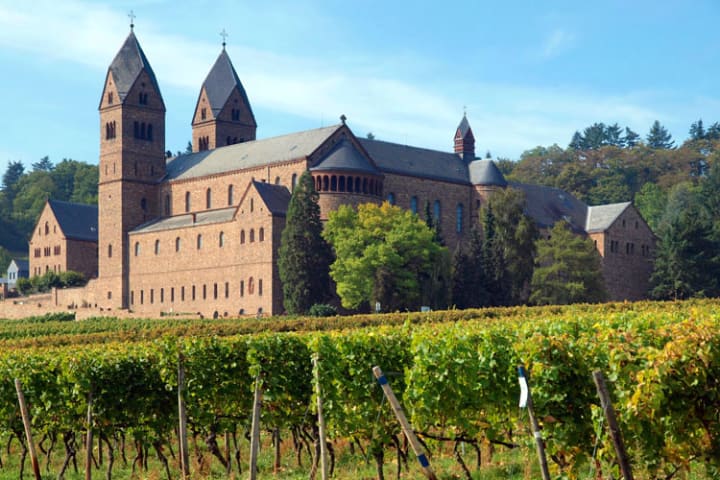
More than nine hundred years after her birth, Hildegard’s angelic music is being rediscovered.
She was truly a woman ahead of her time.
When was the last time you listened to 850-year-old music? I got you! ☝
⚡____________⚡
This concludes Part Four of this Series. Part Five tomorrow.
________________________Bolt⚡

Next up in episode 5: the Renaissance Man.
⚡____________⚡
Part #1 ⚡😁👇
Part #2 ⚡😁👇
Part #3 ⚡😁👇

About the Creator
Lightning Bolt ⚡
Bolt ⚡ aka Bill, a bizarre bisexual bipolar alliterative epileptic Taco Bell Futurist 🌮 ☇ a sexy ♒ Aquarian oddball with an erratic brain↯🧠↯ Author of comedy, poetry, sci fi, & horror.
I am shock therapy.⚡ Subscribing risks electrocution↯.
Keep reading
More stories from Lightning Bolt ⚡ and writers in History and other communities.
Thief who stole $3.5 billion but lost all in one phone call part 2
The following year, the owner of Silk Road was arrested and the FBI shut down the website, seizing about 170,000 Bitcoins. However, 51,680 Bitcoins were still missing, and investigators had been trying to trace them for years.
By Imran Ali Shah6 days ago in History
Top tipple tricks
Been thinking a lot about drinking, lately. Not least because of a recent episode of over-indulgence and the inevitable after effects. Some readers may recall the earlier articles I wrote about beating the booze. Here I set out an experiment in techniques for cutting down on my alcohol intake. The experiment was successful, the techniques worked, and I have armed myself with an arsenal of weapons in the war against the demon drink. I have yet to fire the first round however. It's all a question of timing (perhaps procrastination).
By Raymond G. Taylor4 days ago in Psyche




Comments (3)
Another great lecture and I learned something new. To be honest the I just found my Gregorian chant CD and listened does that count. Good job.
What a woman! And after doing all these thing she still had free time to invent a language. I wonder why (and how) they kept her tongue and her heart. Couldn't they preserve the whole body, or these two has special meaning or was left behind due to some specific reason?
I really enjoyed your take on Hildegard-- I had read about her and admire her even more after reading your work