Latest Stories
Most recently published stories in History.
How this boarder came into subcontinent. Content Warning. AI-Generated.
This is the Golden Temple. People come here from all over the world to bathe in its waters, to look at the Holy Book that is inside of this middle Golden Temple and to just experience the holiness of this place. This place is the epicenter of Sikhism. It sits right here in northern India in a city called Amritsar. Close by there's another important Sikh site called Kartarpur. It was established by the founder of Sikhism more than 500 years ago. It's the place where he spent the last years of his life and it is the second holiest place in Sikhism. For centuries, Sikhs have been able to make pilgrimage between these two sites to move freely throughout their heartland. But in 1947 a British lawyer drew a border here turning what had been British India into two new countries, India and Pakistan. I could only call it one of the most bizarre lines, which were ever drawn across a map It went right here with the Golden Temple on one side and Katarpur on the other. Thanks to this border Sikhs in India are now cut off from their holy site. So many come here to a platform that the Border Patrol set up. The platform looks across the border where with the help of telescopes, Sikhs can look at their holy place just three or four kilometers away. In addition to cutting off communities from their sacred sites, this border separated families, cut across rivers, forests, farms, railroad tracks. Today this border is heavily fortified with nearly all 3,000, plus kilometers fenced. It's lit so well that you can see it from space and barely anything or anyone crosses over it When we talk about the drawing of the line, what was the most painful was the division of families which took place and that is a very big reality. This is the story of a violent separation. One of the most traumatic events of the 20th century It's the story of how a hastily drawn line on a map separated one people into two. This is a horror story. What we saw was a town soaked with the stench of death. In the train of murder and arson, come the refugees. Their suffering is the new tragedy of India. Many will never reach their new land. These are the things that are setting the heart burning on either side of the line. The sun is setting and I'm walking along one of the oldest roads in Asia One that used to connect this region but today a border runs through it and instead of connection and trade what you see here is this: There's barbed wire, there's fences, there are officers everywhere and yet, there's also ice-cream and popcorn and paraphernalia. This feels like a sporting event. You can buy keychains of machine guns. Thousands of spectators file in, filling this stadium that looks down on the border. On the other side Pakistanis are doing the same. Then, both sides start their different show. Two hours of chanting and dancing Then the finale, a face-off between the two sides. They strut back and forth in this coordinated choreography and it all ends with the lowering of each flag and the closing of this gate. This bizarre border show plays out every evening. But this ceremony, this fence, this intense nationalism If you rewind just a little in time, none of this existed. The British controlled parts of India for nearly 200 years but by 1947, a strong movement of independence was swelling across the subcontinent
By Timothy Mwiti2 years ago in History
Uncovering the Mystery of Alaska's Dark Pyramid
Deep in the heart of Alaska's wilderness, a story persists of a covert underground facility housing an ancient, enigmatic structure known as the "Dark Pyramid." This tale, blending elements of military secrecy, advanced technology, and potential extra-terrestrial involvement, has captivated conspiracy theorists and UFO enthusiasts for decades. But what evidence exists to support these claims, and how much of it is merely speculation?
By KWAO LEARNER WINFRED2 years ago in History
Ancient civilization
The world of art is a vast and fascinating one, with countless masterpieces that have captivated and inspired people throughout the ages. From the intricate sculptures of ancient civilizations to the vibrant paintings of the Renaissance, each era has left its mark on the artistic landscape. But have you ever wondered what the oldest known painting in the world is? What stories and secrets does it hold, and what can it tell us about the early days of human creativity?
By AKANJI ABDULAFEEZ2 years ago in History
A Freeze-In-Time Scene in Bodie, California
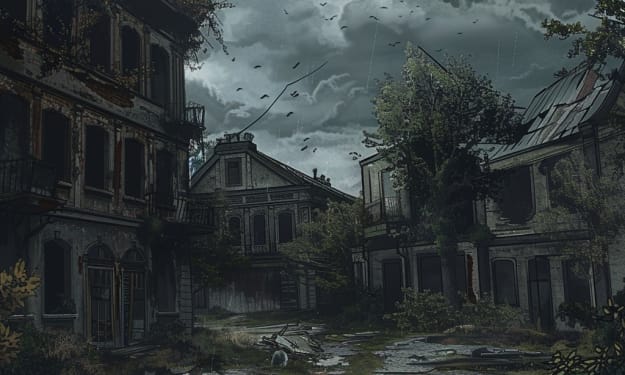
Presentation Roosted at a rise of 8,000 feet in the ruined Sierra Nevada piles of California, Bodie remains as an unpleasant demonstration of the transient idea of the Pursuit of happiness. When a clamoring dash for unheard of wealth town overflowing with life, it presently exists as a spooky specter, its structures frozen in time, a shocking gallery of the Wild West.
By Mohamed sha2 years ago in History
THE RICHEST MAN IN HISTORY . AI-Generated.
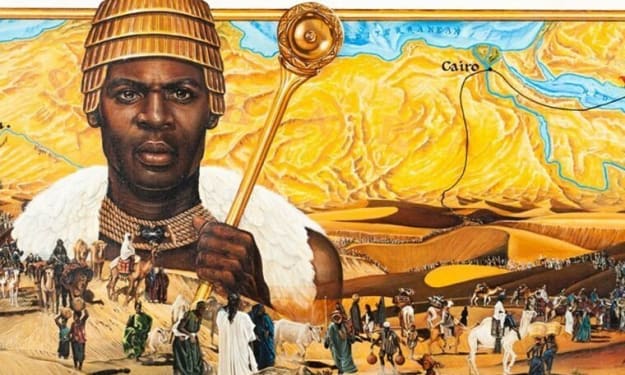
## The Richest Person in History: A Deep Dive into Wealth and Influence ### Introduction The concept of wealth has fascinated humanity throughout history. While today's billionaires like Elon Musk and Bernard Arnault often dominate headlines, they are far from the wealthiest individuals in history when adjusted for inflation and historical context. This title is often attributed to figures like Mansa Musa, the 14th-century emperor of the Mali Empire, whose wealth was so immense it defies modern comprehension. This article explores the life, achievements, and influence of the richest person in history, offering a comprehensive look at the impact of such monumental wealth.
By Mbeha maliwa 2 years ago in History
Hanle - A Remote Jewel in Ladakh
Nestled in the heart of Ladakh, Hanle is a hidden gem that offers an unparalleled experience of nature, culture, and astronomy. This remote village, situated at an altitude of about 4,500 meters, provides an escape from the hustle and bustle of urban life. Here are compelling reasons why Hanle should be on every traveler's bucket list.
By Nitsa Holidays2 years ago in History
The History of Military Sunglasses: Iconic Models and Designs
Military sunglasses have a rich history that spans decades, evolving from practical tools for soldiers to iconic fashion statements. These sunglasses have been an essential part of military gear, providing protection, enhancing performance, and eventually becoming a symbol of style. Let's delve into the fascinating history of military sunglasses, highlighting some of the most iconic models and designs that have stood the test of time.
By Aviator Sunglasses 2 years ago in History
The Lost Continent of Sahul
Discovery and Ancient Geography Around 70,000 years ago, during the last Ice Age, a vast landmass known as Sahul existed in the southwestern Pacific Ocean. This supercontinent connected modern-day Australia, New Guinea, Tasmania, and the Aru Islands, creating a single, enormous landmass. Picture lush tropical rainforests surrounded by majestic mountains, with peaks in the New Guinea Highlands reaching over 13,000 feet. Sahul was a haven for unique wildlife, predominantly marsupials. Unlike today's koalas and kangaroos, Sahul hosted a diverse array of creatures, including the massive Diprotodon, the formidable Thylacoleo, and the giant Megalania, a lizard far larger than any in existence today. The rest of the world was dominated by placental mammals like wolves, elephants, and humans, while Sahul’s mammals were mainly bats and rodents. Different regions, such as the Torres Strait, Arafura, and Carpentaria, featured hot savannahs, dry forests, and temperate coastal forests, resembling modern Australia's varied landscapes.
By Purba Biswas2 years ago in History
RED CEA. Content Warning. AI-Generated.
- [Narrator] The Red Sea. A special idyll of the Orient. A place of silence, strength and diversity. The Red Sea is famous for its high salt content which especially contributes to clear water. Algae can't spread easily here. This is why its broad coral reefs can be considered a true paradise for divers. We can find lots of highlights of marine life here. There are a lot of colorful shoals of fish, popular anemone fish, basses, vigilant morays, odd pufferfish, and, of course, elegant turtles. The biggest attraction is colorful coral reefs shining in the sunlight. From the Earth's orbit, we can clearly spot the elongated form of the Red Sea. It is a narrow sea, 2,240 kilometers long, up to 2,604 meters deep, that borders the Indian Ocean and lies between Northeast Africa and the Arabian Peninsula. The Red Sea contains about 200,000 cubic kilometers of water. Its surface is spread over 438,000 square kilometers and the water is on average 538 meters deep. A good question would be why it is called the Red Sea. There have already been several interpretations for it since antiquity. On the one hand, blue algae grows in this stretch of water. ost all of these fish are females. Usually, only one fiftieth of the group are male. At first, adult fish are always females that later turn into males. But that mostly just happens if a male fish dies. If that is the case, the strongest female of the group transforms into a male fish in just a couple of days, to take its place. Another resident of the reef is the soft coral. Even though it is related to the stone and fire coral, it has a totally different structure. It gets its stability from inner water pressure. Its limbs and strains are not covered in polyps. Those are located at the ends of the arms. The soft corals' colors are usually brown, yellow or green. If it lives in the shadows, it has a bright red, orange or purple color. Mostly, they are located on the edges of reefs, overhangs or on the ceilings of caves. Corals are really important for a lot of fish. They provide shelter for small and normal sized ones. That's why they are almost always surrounded by huge swarms. If there's an enemy, they can instantly hide between the branchy corals and are almost unreachable for big predators. The coral's ability to emit stinging poison is a huge advantage here, too. Although, the fish have to be careful not to come into contact with the defense polyps, because otherwise they themselves might be the victims. Because of natural barriers and because of the environment influencing those animals in a special way, many unique species which can't be found anywhere but the Red Sea have developed over millions of years. One of those creatures is the popular clownfish. This genus here is also known as Red Sea anemonefish. They eat plankton and algae and are comparatively small. 15 centimeters is the maximum. The clownfish lives closely in a so-called symbiosis with anemones. That means, as we have just learned about the corals, that two different species both profit from living together. Surprisingly, clownfish are able to live with are toxic. Why doesn't it disturb the clownfish? Very simple. It possesses a slime layer which protects it from the deadly poison. The anemonefish protects the anemone, driving out predators like, for example, butterflyfish. In return, the anemone protects the rotting carcasses. But still, bigger morays are pretty modest about the search for food and so only.
By Timothy Mwiti2 years ago in History
England's famous prophet legend: Mother Shipton
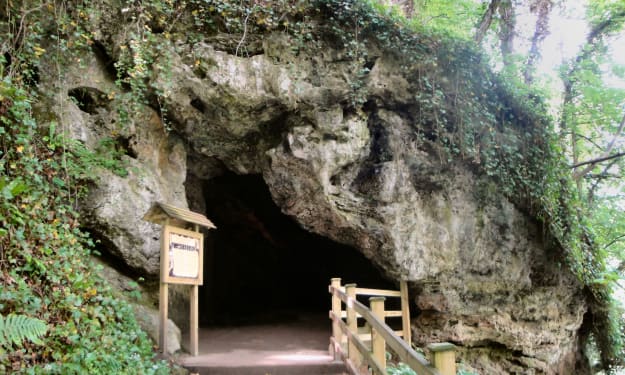
There is a myth of an ancient prophetess; some prophecies have come true, and others were only a prediction that, like many predictions throughout history, never came to fruition. However, later it came to tell that the prophet did not come true because another, not the true prophet, said it—a story.
By sara burdick2 years ago in History
Hitler's Biggest Mistake. AI-Generated.
# Hitler's Biggest Mistake: Debunking the Myths Adolf Hitler, the dictator who led Nazi Germany into World War II and orchestrated the Holocaust, remains one of history's most infamous figures. The atrocities committed under his regime have been well-documented, but alongside these facts, numerous myths and misconceptions about Hitler persist. These myths often blur the lines between historical fact and fiction, shaping public perception in misleading ways. This article aims to debunk some of the most pervasive myths about Hitler and explore the realities behind them.
By Mbeha maliwa 2 years ago in History