


- [Narrator] The Red Sea. A special idyll of the Orient. A place of silence, strength and diversity. The Red Sea is famous for its high salt content which especially contributes to clear water. Algae can't spread easily here. This is why its broad coral reefs can be considered a true paradise for divers. We can find lots of highlights of marine life here. There are a lot of colorful shoals of fish, popular anemone fish, basses, vigilant morays, odd pufferfish, and, of course, elegant turtles. The biggest attraction is colorful coral reefs shining in the sunlight. From the Earth's orbit, we can clearly spot the elongated form of the Red Sea. It is a narrow sea, 2,240 kilometers long, up to 2,604 meters deep, that borders the Indian Ocean and lies between Northeast Africa and the Arabian Peninsula. The Red Sea contains about 200,000 cubic kilometers of water. Its surface is spread over 438,000 square kilometers and the water is on average 538 meters deep. A good question would be why it is called the Red Sea. There have already been several interpretations for it since antiquity. On the one hand, blue algae grows in this stretch of water. ost all of these fish are females. Usually, only one fiftieth of the group are male. At first, adult fish are always females that later turn into males. But that mostly just happens if a male fish dies. If that is the case, the strongest female of the group transforms into a male fish in just a couple of days, to take its place. Another resident of the reef is the soft coral. Even though it is related to the stone and fire coral, it has a totally different structure. It gets its stability from inner water pressure. Its limbs and strains are not covered in polyps. Those are located at the ends of the arms. The soft corals' colors are usually brown, yellow or green. If it lives in the shadows, it has a bright red, orange or purple color. Mostly, they are located on the edges of reefs, overhangs or on the ceilings of caves. Corals are really important for a lot of fish. They provide shelter for small and normal sized ones. That's why they are almost always surrounded by huge swarms. If there's an enemy, they can instantly hide between the branchy corals and are almost unreachable for big predators. The coral's ability to emit stinging poison is a huge advantage here, too. Although, the fish have to be careful not to come into contact with the defense polyps, because otherwise they themselves might be the victims. Because of natural barriers and because of the environment influencing those animals in a special way, many unique species which can't be found anywhere but the Red Sea have developed over millions of years. One of those creatures is the popular clownfish. This genus here is also known as Red Sea anemonefish. They eat plankton and algae and are comparatively small. 15 centimeters is the maximum. The clownfish lives closely in a so-called symbiosis with anemones. That means, as we have just learned about the corals, that two different species both profit from living together. Surprisingly, clownfish are able to live with are toxic. Why doesn't it disturb the clownfish? Very simple. It possesses a slime layer which protects it from the deadly poison. The anemonefish protects the anemone, driving out predators like, for example, butterflyfish. In return, the anemone protects the rotting carcasses. But still, bigger morays are pretty modest about the search for food and so only.
About the Creator
Keep reading
More stories from Timothy Mwiti and writers in History and other communities.
ANCIENT ALIENS
Librarian Ernst man uses his extensive knowledge of mathematics to decipher the dots and symbols of a 12th-century Maya text known as the Dresden Codex. In doing so, he unlocks the secrets of the Maya calendar. The Maya have what's widely understood as the most sophisticated ancient calendar ever made. It involves so many different cycles. It's so sophisticated, in fact, that early scholars thought that the Maya were, as they called, esoteric time worshipers. The Maya are very interested in the cycles of life. So a lot of their calendars were created to track those cycles and look for harmonies between cycles to better harmonize themselves with the natural world. ANDREW COLLINS: The long count calendar of the Maya lasted for 5,125 years. It was backdated to have begun in 3114 BC, which meant that it actually ended on December 21, 2012. And many of us will remember how it was believed that there was gonna be a time of great transformation, possibly the end of the world. NARRATOR: In 2012, over a thousand years after the fall of the Maya civilization, their calendar became known to people all around the world. Many believed that the final date on the calendar was intended to mark an apocalyptic event. BARNHART: The idea that the Maya predicted the end of the world was really just a Western misunderstanding of how their calendar works and what they were using their calendar for. Westerners see time as a line, it goes back into the past and forward into the future, and we're the point in the middle. The Maya saw time as a cycle that kept going like the hands of a clock. When it hit 12, it didn't just explode, it just went back around for another loop. So Maya calendar systems were set up to be never-ending cycles. NARRATOR: While the Maya were exceptional at tracking time and observing the heavens, archaeologists were astounded when they discovered that this ancient culture was tracking what is known in astronomy as precession. Precession is the wobbling of the Earth on its axis which changes the location of constellations in the night sky. It's actually a huge cycle that lasts 26,000 years. And the Maya, without a shadow of a doubt, were calculating precession. They were able to say, back in the distant past, this planet would've been in that constellation. NARRATOR: Scholars remain mystified as to how the Maya came to have such an advanced understanding of astronomy, mathematics and timekeeping, and answers have been difficult to come by, since a large portion of the Maya's writing and artifacts have been lost or destroyed over the centuries. There was a big cultural shift between about 900 and 1200 AD, and one of the prevailing theories about the end of Maya civilization was that basically they taxed their resources, that they created an unstable landscape that then lent itself to landslides, to fires, to floods, and that can lead to societal collapse. NARRATOR: In the 16 century, Spanish conquistadors arrived in the Maya cities of the Yucatán Peninsula. They found the sites sparsely populated or even abandoned, with many structures already in ruins. And while Spanish colonizers were the first Europeans to record their accounts of the Maya culture, they were also responsible for destroying much of the Maya's own history. When the Spanish showed up, they wanted to convert them to Christianity. Step one in that process is dividing them from their traditional wisdoms. And those were written in the books. So, the Spanish on purpose burned every document they could find .
By Timothy Mwiti2 years ago in History
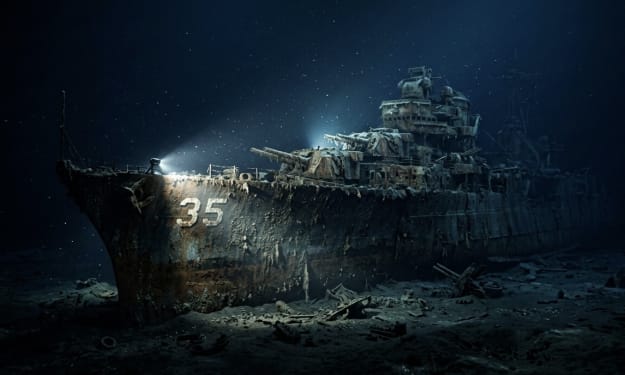
The Discovery of the USS Indianapolis
The story of the USS Indianapolis (CA-35) is a harrowing blend of high-stakes espionage, unimaginable physical endurance, and a decades-long maritime mystery. While the provided text captures the essence of this tragedy, expanding on the historical context, the psychological toll on the survivors, and the technical marvel of its discovery allows us to truly honor the "Ghost of the Pacific."
By Irshad Abbasi a day ago in History
A Knight of the Seven Kingdoms Series Review (Season 1)
As one of the biggest properties in fantasy, A Song of Ice and Fire remains immensely popular with audiences. After reaching far into the past with House of the Dragon, a second spin-off was on the cards. A Knight of the Seven Kingdoms serves up a bite-sized slice of action and drama, but it still claims a spot among the best small-screen titles.
By Robert Caina day ago in Geeks



Comments (1)
This was a very fascinating read. Well done