
Hannibal’s Campaign Across the Alps (218 BCE): A Military Masterpiece That Changed History
(218 BCE)

Hannibal’s Campaign Across the Alps (218 BCE): A Military Masterpiece That Changed History
The campaign of Hannibal Barca across the Alps is one of the most audacious and legendary events in military history. Leading a diverse army through treacherous terrain, Hannibal managed to take the fight to the heart of the Roman Republic during the Second Punic War (218–201 BCE). This feat was not just a geographical crossing but a brilliant military strategy that disrupted Rome’s dominance. In this article, we will explore the motivations, challenges, and consequences of Hannibal’s campaign while highlighting its long-lasting significance.
1. Who Was Hannibal? The Man Who Defied Rome
Hannibal Barca was born in 247 BCE in Carthage (modern-day Tunisia) and was the son of the Carthaginian general Hamilcar Barca, a key figure in the First Punic War. From a young age, Hannibal was instilled with a fierce hatred for Rome, which his father viewed as Carthage’s greatest enemy. Known for his brilliant strategic mind, Hannibal would later rise to become one of history’s greatest military leaders.
2. Why Did Hannibal Cross the Alps?
The Second Punic War erupted due to escalating tensions between Carthage and Rome after the First Punic War. Hannibal’s bold plan to invade Italy by crossing the Alps was driven by a desire to catch Rome off guard. The Romans, who dominated the Mediterranean, expected any attack from Carthage to come by sea. By taking the less predictable land route, Hannibal sought to destabilize Rome and gain support from discontented allies in Italy.
3. Preparation for the Campaign: A Diverse and Determined Army
To execute his audacious plan, Hannibal assembled a formidable army consisting of North African infantry, Spanish cavalry, and Gallic mercenaries. One of his most striking assets was his war elephants, a symbol of Carthaginian military power. Despite the diversity in language, culture, and combat styles, Hannibal unified his forces under his charismatic leadership.
4. The Journey to the Alps: Early Challenges
Before reaching the Alps, Hannibal’s army had to navigate through southern France. Along the way, they encountered resistance from local tribes and logistical challenges in securing food and supplies. Hannibal’s tactical brilliance and diplomatic skills allowed him to overcome these obstacles, paving the way for the next phase of the campaign.
5. Crossing the Alps: An Unprecedented Feat
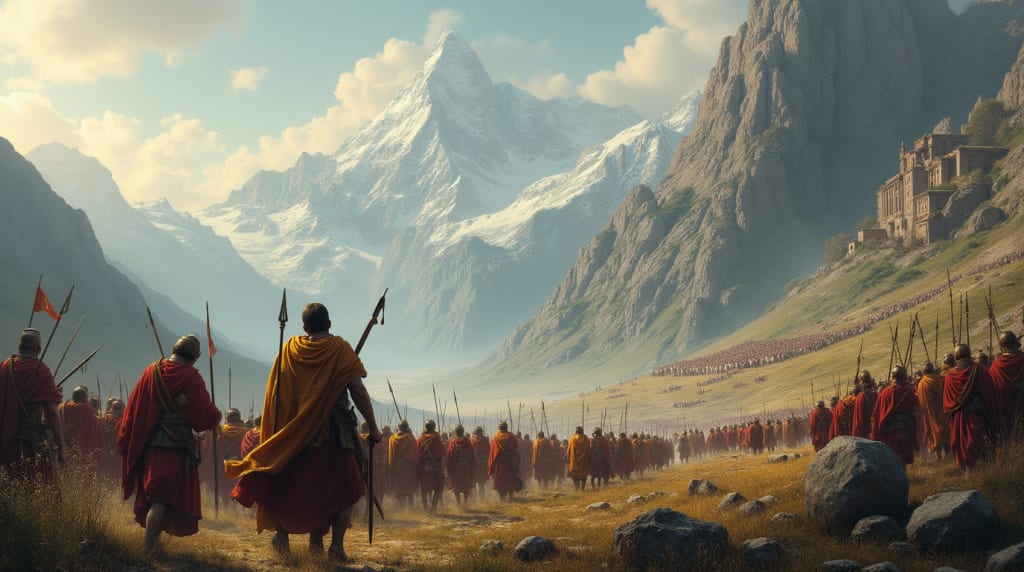
The Alps, with their towering peaks, extreme cold, and treacherous paths, presented the greatest obstacle of Hannibal’s campaign. In the winter of 218 BCE, Hannibal led his army through these hazardous mountains. The troops faced avalanches, freezing temperatures, and narrow trails that often collapsed underfoot. Many soldiers and elephants perished during this grueling journey, but Hannibal’s determination inspired his men to push forward.
6. Natural and Human Challenges in the Alps
In addition to battling nature, Hannibal’s army had to contend with hostile mountain tribes who ambushed them along the way. Using tactical ingenuity, Hannibal turned the rugged terrain to his advantage, launching counterattacks that allowed his forces to progress.
7. Reaching Italy: A Shock to Rome
After weeks of relentless hardship, Hannibal and his remaining forces emerged in northern Italy, battered but resolute. This unexpected arrival stunned the Romans, who had never anticipated an enemy army crossing the Alps. Despite losing a significant portion of his troops, Hannibal’s presence in Italy marked the beginning of a series of dramatic confrontations with Rome.
8. Hannibal’s Battles Against Rome: Strategic Brilliance
Once in Italy, Hannibal showcased his military genius through a series of decisive victories:
The Battle of the Trebia (218 BCE): Hannibal used ambush tactics to crush the Roman forces.
The Battle of Lake Trasimene (217 BCE): He executed a flawless trap, annihilating a large Roman army.
The Battle of Cannae (216 BCE): This is considered one of the greatest tactical masterpieces in history. Hannibal encircled and destroyed a much larger Roman force, inflicting devastating losses.
9. Why Didn’t Hannibal Conquer Rome?
Despite his remarkable victories, Hannibal never managed to take the city of Rome itself. Several factors contributed to this:
Hannibal lacked the siege equipment necessary to breach Rome’s defenses.
He did not receive sufficient reinforcements from Carthage.
Rome adopted a strategy of attrition, avoiding direct confrontation while targeting Hannibal’s supply lines.
10. The Campaign’s End: Hannibal’s Withdrawal
After nearly 15 years of campaigning in Italy, Hannibal’s position weakened as Roman forces, led by Scipio Africanus, launched a counterattack on North Africa. This forced Hannibal to return to Carthage, where he faced defeat at the Battle of Zama (202 BCE). This decisive loss ended the Second Punic War and solidified Rome’s dominance.
11. The Lasting Impact of Hannibal’s Campaign
Hannibal’s campaign across the Alps left an indelible mark on military history. His innovative strategies and audacious tactics have been studied by military leaders for centuries. Despite his eventual defeat, Hannibal demonstrated that even a smaller, resource-strapped force could challenge a superpower through ingenuity and determination.
12. Hannibal in Popular Culture
The story of Hannibal’s campaign has inspired countless works of literature, films, and documentaries. His daring journey across the Alps is often portrayed as a symbol of human resilience and strategic brilliance, making him a legendary figure in world history.
13. Conclusion: Hannibal’s Genius and Legacy
Hannibal’s campaign across the Alps stands as a testament to the power of vision, courage, and leadership. Facing overwhelming odds, he dared to challenge one of the mightiest empires of his time and nearly succeeded. While his ultimate failure marked the decline of Carthage, his legacy endures as one of the greatest military commanders in history.
Hannibal’s story is a reminder that boldness and innovation can overcome even the most daunting challenges, leaving an everlasting impact on the world. History remembers Hannibal not for his defeat but for his extraordinary vision and audacity.
About the Creator
💓 Pulse of Stories 💓
The world of short and inspiring stories! Here you will find stories that touch hearts, ignite the imagination, and take you on quick yet deep journeys.
Keep reading
More stories from 💓 Pulse of Stories 💓 and writers in History and other communities.
The Slave Revolt Led by Spartacus (73-71 BCE)
The Slave Revolt Led by Spartacus (73-71 BCE): A History of Resistance and Courage The slave revolt led by Spartacus in the 1st century BCE remains one of the most remarkable events in ancient history. Even after more than 2,000 years, this revolt continues to capture the attention of historians and history enthusiasts alike. In this article, we will delve into the Spartacus-led slave revolt, analyzing its causes, progression, Spartacus’ role as a leader, and the outcomes of this historic uprising.
By 💓 Pulse of Stories 💓about a year ago in History
Israel: A Land of Struggle, Faith, and Transformation
The land that is today Israel has been at the crossroads of civilizations for thousands of years. From the deserts of Negev to the fertile hills of Galilee, this land has witnessed the rise and fall of empires, the birth of religions, and the enduring hopes of peoples who called it home. In ancient times, it was known as Canaan, a region inhabited by diverse groups, each with their own gods, languages, and customs.
By The best writer about 19 hours ago in History
Why Early Aircraft Designers Had No Second Chances
When I read about the earliest days of aviation, I’m always struck by how unforgiving that era truly was. Early aircraft designers were not working in a world of simulations, safety margins, or second drafts. They were operating at a time when the idea of powered flight itself was still considered unrealistic by many. Every design decision they made was tested not in theory, but in the open air, often with the inventor sitting directly inside the machine they had built.
By Beckett Dowhan5 days ago in History


Comments
There are no comments for this story
Be the first to respond and start the conversation.