
EPISODE VIII – THE GILDED WEB: Power, Industry, and the Rise of the New American Titans
THE REPUBLIC CHRONICLES
Before the skyscrapers carved their teeth into the sky… Before Wall Street became a myth and a menace… Before America woke up and realized it was no longer a frontier nation but an empire of industry. There was steel. There was oil. There was ambition hot enough to melt both.
And rising from that furnace came the men who would define an era:
Carnegie... Rockefeller... Vanderbilt... Morgan... Gould.
Names that sounded like bank vaults slamming shut. This was the Gilded Age. Shining on the surface and rusting underneath. The Republic was no longer being forged. It was being sold and bought by the highest bidder.
I. The Age of Iron, Fire, and Opportunity
After the Civil War’s smoke drifted into history, America stood on the brink of something colossal.
The war had taught the nation how to mobilize railroads, factories, telegraphs, and those tools didn’t disappear when the cannons quieted.
Instead, they multiplied. They expanded. They devoured. The country transformed from farms to factories, from hand tools to machines, from small towns to sprawling industrial cities.
The frontier spirit didn’t die, it simply traded horses for steam engines.
II. The Titans Rise
They called them “captains of industry.” They also called them “robber barons.” Both were true.
John D. Rockefeller
Turned oil into the bloodstream of modern life. He built Standard Oil into a colossal octopus gripping pipelines, refineries, railroads, and lawmakers.
His motto:
“Competition is sin.”
Andrew Carnegie
A Scottish immigrant who turned steel into a kingdom. His furnaces glowed day and night — hellish fire creating the skeletons of America’s future: bridges, skyscrapers, railways.
His philosophy:
“The man who dies rich dies disgraced.”
Cornelius Vanderbilt
The Commodore. Railroads bent to his will. His lines linked cities like arteries, pumping wealth across the nation.
His charm:
“Law? What do I care about law? Hain't I got the power?”
J.P. Morgan
The banker who could bail out the entire U.S. Treasury, and did. When he frowned, markets trembled. When he spoke, presidents listened. Power without office. Authority without election. Influence without apology.
Together, they wove a web of invisible, immense, and inescapable control.
III. The Cities of Smoke and Gold
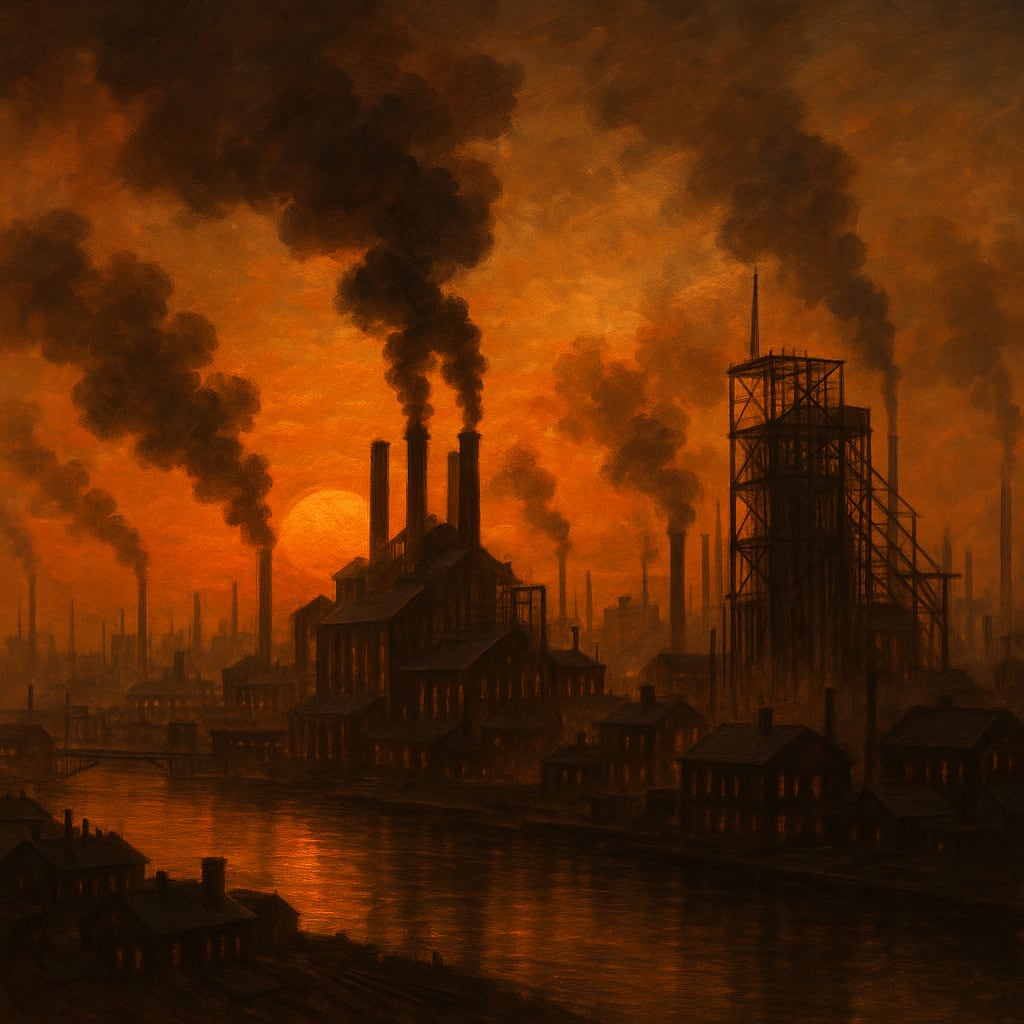
The cities groaned under the weight of industry. Pittsburgh’s skies glowed orange with furnace fire... “hell with the lid off,” visitors said. New York throbbed with electricity and ambition. Chicago rose from ashes into a titan of meat, steel, and commerce.
Immigrants poured in from Europe... millions of them... fleeing famine, war, poverty. They traded one set of chains for another: long hours, low wages, dangerous factories.
Children worked. Women toiled. Men died in mines and mills, where the air itself was a weapon. But there was hope too... a fragile, stubborn hope.
The idea that even the poorest could grasp the American dream, if they could just survive the climb.
IV. The Golden Mask and the Iron Truth
Mark Twain named the era:
“The Gilded Age.”
Not golden but gilded. A thin veneer of wealth over a core of corruption and struggle. Political machines like Tammany Hall ruled cities through bribery and patronage. Senators were bought like cattle. Newspapers were weapons in the hands of moguls. Monopolies crushed competition with the grace of sledgehammers.
But beneath the darkness… Innovation exploded. Edison’s lightbulbs chased away night. Bell’s telephone shrank distance. Westinghouse electrified cities. Henry Ford dreamed of machines that could multiply human labor.
It was a paradox - a golden web spun from both brilliance and greed.
V. The Workers’ Fight
The Titans built the empire and the workers paid for it.
Strikes erupted like earthquakes:
Pullman. Homestead. Haymarket.
Men marched for dignity. Women demanded fairness. Children sought childhoods they never had. The nation teetered between revolution and reform. The government often sided with industry. Sending marshals and militias against the very workers who built its greatness.
But slowly… painfully… The cry for justice grew too loud to ignore. Labor unions took root. Wages rose slowly and conditions improved. The Republic began to reckon with the cost of its wealth.
VI. The Beginning of Reform
By the late 1800s, America had become the world’s industrial titan. A nation of steam and steel, rails and riches. But the people demanded change. Reformers like Ida Tarbell, Upton Sinclair, and Jacob Riis exposed corruption and cruelty. The Sherman Antitrust Act cracked open monopolies. Progressives demanded regulation, accountability, and fairness.
The Titans had ruled a generation, but the Republic was reclaiming its voice.
VII. The Iron Lighthouse Reflection
The Gilded Age was the Republic’s awakening. The moment it realized that greatness and greed were twins, inseparable and eternally at odds. Industry built America’s bones. Immigrants fed its veins. Visionaries lit its future. But inequality shadowed its soul.
The Titans were not villains per se... Nor were they saints. They were forces of nature... brilliant, flawed, driven, and dangerous. From their ambition came both innovation and injustice. From their triumphs came both progress and pain.
America rose on their shoulders, and learned to stand without them. The Gilded Web remains, shimmering and trembling, reminding us that prosperity is powerful… But fragile. Golden…
But never pure.
About the Creator
The Iron Lighthouse
Where folklore meets freeway. A guide to the strange heart of the American backroads...
Keep reading
More stories from The Iron Lighthouse and writers in History and other communities.
EPISODE VII – THE BLOOD AND THE UNION: The War That Tested the Republic’s Soul
Before the smoke, before the thunder, before the rivers ran red, there was silence. A heavy, haunting silence that stretched from the Atlantic shore to the Mississippi plains. A silence born of tension, betrayal, and a question the Founders had left unresolved like a ticking bomb beneath the floorboards of the Republic:
By The Iron Lighthouse2 months ago in History
Muammar al-Qaddafi: The Desert Revolutionary Who Ruled Libya for 42 Years
Muammar al-Qaddafi was born into a Bedouin family of the small al-Qadhadhfa tribe in the harsh environment of the Libyan desert. His early years were marked by poverty and traditional nomadic life—sleeping in tents, caring for livestock, and attending a local primary school in Sabha. From a young age, Qaddafi was deeply influenced by the sweeping changes in the Arab world, especially the rise of Arab nationalism championed by Egyptian leader Gamal Abdel Nasser. This ideology, centered on unity among Arab states and resistance to colonial influence, would shape his worldview throughout his life. � Pakistan Times +1 Qaddafi continued his education, moving between schools in Misrata and Sabha and showing early signs of political activism. During his studies he organized protests supporting Arab nationalist causes, including opposition to the dissolution of the short-lived United Arab Republic between Egypt and Syria. Expelled from school at one point for his activism, he eventually enrolled in the military academy in Benghazi, where he joined a group of young officers harboring revolutionary ambitions. � Pakistan Times +1 The 1969 Coup: From Officer to Leader On September 1, 1969, at the age of just 27, Qaddafi and a small group of junior military officers executed a swift and bloodless coup that overthrew King Idris I, who had ruled the newly independent Libya since 1951. The king was abroad for medical treatment, and the coup leaders seized the moment, abolishing the monarchy and declaring Libya a republic. Qaddafi was immediately named chairman of the Revolutionary Command Council and commander-in-chief of the armed forces—positions that gave him de facto control of the country. � Encyclopedia Britannica Once in power, Qaddafi moved quickly to assert Libya’s independence from Western influence. He ordered the removal of U.S. and British military bases from Libya and nationalized the country’s oil industry, which was dominated by foreign companies. He also expelled many Italians and Jews from Libya, echoing his brand of strict Islamic principles and fierce opposition to colonial legacy. � Encyclopedia Britannica Domestic Policies and The Green Book Qaddafi sought to reshape Libya’s society through a blend of Islamic socialism and revolutionary populism. In 1973 he published his influential manifesto, The Green Book, outlining his ideas of direct democracy, economic redistribution, and rejection of traditional political parties and institutions. According to Qaddafi, power should reside in people’s committees and popular congresses rather than centralized state structures. � Encyclopedia Britannica In practice, these reforms were a mixture of radical inclusivity and strict authoritarian control. Healthcare and education were made widely accessible, and Libya’s vast oil revenues funded ambitious development projects. But political dissent was ruthlessly suppressed, freedom of speech was virtually nonexistent, and secret police kept tight control over public life. While some Libyans benefited from state welfare, many others lived in fear of arbitrary detention and persecution. � Encyclopedia Britannica International Relations and Global Controversies Qaddafi’s ambitions were not confined to Libya. He positioned himself as a voice of anti-imperialism, supporting revolutionary movements and opposition groups across the globe, from the Irish Republican Army in Europe to radical organizations in the United States. These policies often brought Libya into direct conflict with Western powers. In 1986, U.S. aircraft bombed Qaddafi’s compound in Tripoli in retaliation for Libya’s alleged involvement in terrorist activities, killing several of his family members. � Encyclopedia Britannica Perhaps the most notorious international incident linked to Qaddafi was the bombing of Pan Am Flight 103 over Lockerbie, Scotland, in 1988, which killed 270 people. Libya’s alleged role in the tragedy led to years of United Nations and Western sanctions that isolated the regime. Although Libya later handed over suspects for trial and sanctions were gradually lifted in the early 2000s, the episode cemented Qaddafi’s reputation in the West as a sponsor of terrorism. � Encyclopedia Britannica The Arab Spring and the Fall of a Regime In 2011, inspired by uprisings in Tunisia and Egypt, Libyans took to the streets in protest against Qaddafi’s rule. What began as peaceful demonstrations quickly escalated into a full-scale civil conflict as government forces attempted to crush dissent with brutal force. The international community, alarmed by reports of mass atrocities, authorized a NATO intervention to protect civilians. After months of fighting, rebels captured Tripoli and later Qaddafi’s hometown of Sirte. On October 20, 2011, Qaddafi was killed by rebel fighters, bringing an end to his 42-year rule. � Encyclopedia Britannica +1 Legacy: A Leader of Contrasts Muammar al-Qaddafi’s life remains deeply contested. To some, he was a visionary revolutionary who challenged Western dominance and tried to uplift his people through welfare and development. To others, he was a ruthless autocrat whose regime was marked by repression, human rights abuses, and international provocation. His death did not bring immediate peace to Libya—rather, the country has struggled with instability and factional violence in the years since. Yet the debates over his legacy continue, reflecting the complex and often contradictory nature of his life and rule.
By Hasbanullah4 days ago in History
The Pandyas and Their Foreign Trade Net Worth: A Forgotten Maritime Superpower
At their peak, the Pandyas controlled powerful maritime networks that connected India with Rome, Southeast Asia, China, Arabia, and Africa. Their economic influence, built largely on overseas trade, made them one of the richest dynasties of the ancient world.
By Say the truth 3 days ago in History


Comments
There are no comments for this story
Be the first to respond and start the conversation.