
EPISODE VII – THE BLOOD AND THE UNION: The War That Tested the Republic’s Soul
THE REPUBLIC CHRONICLES

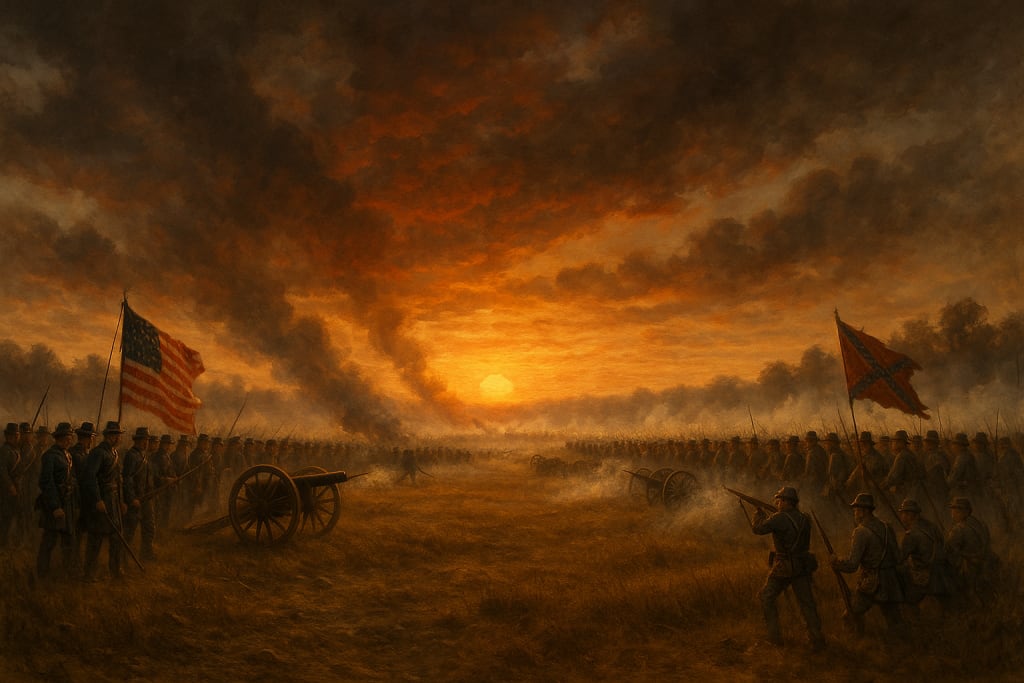
Before the smoke, before the thunder, before the rivers ran red, there was silence. A heavy, haunting silence that stretched from the Atlantic shore to the Mississippi plains. A silence born of tension, betrayal, and a question the Founders had left unresolved like a ticking bomb beneath the floorboards of the Republic:
What does freedom mean when half a nation is in chains?
The Civil War was not just a conflict of armies. It was a collision of ideals, a reckoning so vast it threatened to tear the very soul from the United States.
This was the war where words failed, where debate fractured, where the dream of liberty came due for payment in blood.
I. A House Divided
By the mid-19th century, the Republic was two nations wearing one flag.
In the North: factories, railways, immigration, free labor, ambition.
In the South: plantations, aristocracy, cotton, tradition... and slavery, woven through its economy like poison in a bloodstream.
For decades, Congress had patched the divide with compromises. The Missouri Compromise, the Compromise of 1850, the Kansas-Nebraska Act. Each one a bandage laid over a wound that wouldn’t stop bleeding.
But by 1860, the wound tore open. The election of Abraham Lincoln; a man who opposed slavery’s expansion, struck fear into the Southern elite. State after state seceded, declaring that the Union no longer represented them.
What began as political disagreement became existential fracture.
The United States shattered and from the shards rose two banners:
🟦 Union
🟥 Confederacy
Two visions of America. Only one could survive...
II. The First Blood
In April 1861, Confederate cannons opened fire on Fort Sumter, lighting the fuse to the bloodiest conflict the nation would ever endure.
Young men who’d grown up reading the same Bible, pledging the same flag, now loaded rifles against each other. Cities prepared for siege. Farms turned into graveyards. War had come and it had come hungry. Both sides believed victory would be swift. Both were wrong.
III. The Forge of Fire
The Civil War became an industrial storm. Ironclad ships battling on rivers, railroads moving armies like metal veins carrying blood across the country, telegraphs snapping with messages of hope and horror.
The names burned into history like scars:
Bull Run... Antietam... Vicksburg... Fredericksburg... Shiloh... Gettysburg... Atlanta.
At Antietam, 23,000 fell in a single day. The deadliest sunrise the nation had ever witnessed. At Gettysburg, the ground shook with cannon fire so fierce that veterans said the very earth seemed to scream.
Boys became men. Men became ghosts. And still, the war marched on.
IV. The Emancipation Reckoning
At the war’s start, Lincoln’s goal was preservation of the Union... nothing more. But as the fields filled with bodies, something shifted. A truth emerged from the smoke: The Union could not survive unless slavery died.
On January 1, 1863, Lincoln issued the Emancipation Proclamation. An unadulterated thunderclap, across the Confederacy. Four million enslaved people heard the distant crack of chains loosening.
It did not end slavery everywhere, but it transformed the war’s soul. No longer was the Union simply fighting rebellion. It was fighting for rebirth.
V. The Brothers’ War
The Civil War was not fought by faceless armies. It was fought by neighbors, cousins, fathers and sons. Families split down the middle. Churches divided. Letters home dripped with grief and duty.
In one diary, a Union soldier wrote:
“Tonight I fired upon men whose language was my own, whose mothers pray as mine does.”
This was the tragedy at the heart of the war: America fought America. The pain of that truth still echoes to this day.
VI. The Turning of the Tide
By 1864, the Confederacy was weakening... starved by blockade, battered by losses, drained by desertion.
General Ulysses S. Grant pressed relentlessly in the East while William Tecumseh Sherman carved a scar of destruction through Georgia in his infamous March to the Sea, breaking the South’s will to resist.
Richmond, the Confederate capital, fell in 1865. Lee surrendered at Appomattox soon after. And then, in a moment the Republic would never fully heal from... Lincoln was assassinated.
The man who steadied the ship through the storm died just as the clouds were clearing. The cost of Union had been paid. The cost of peace had only begun.
VII. The Price of Rebirth
The war ended slavery, but not hate. It preserved the Union, but not innocence. It created a new America, but not an easy one.
Reconstruction attempted to rebuild, to reconcile, to redefine citizenship, but resistance, resentment, and racism sabotaged its promise.
Yet something irreversible had happened. The Republic had chosen equality over empire. Chosen unity over division. Chosen to live rather than die.
It had faced its greatest test, and somehow endured...
VIII. The Iron Lighthouse Reflection
The Civil War was the Republic’s fiery crucible. The fire that burned away illusion and forced the nation to confront its own contradictions.
The Founders built the architecture. The Revolution lit the flame. But the Civil War asked the question that mattered most. Will the Republic stand when its soul is on the line? It did. But not without cost...
Every battlefield is quiet now, but the echoes remain. In the debates of today. In the wounds not yet healed. In the flag that flies above a nation forever reminded of its own fragility.
The Union survived, because it had to. Because the idea was bigger than the blood that tried to break it.
The Republic walked through fire, and came out the other side. Scarred, stronger, and still striving.
About the Creator
The Iron Lighthouse
Where folklore meets freeway. A guide to the strange heart of the American backroads...
Keep reading
More stories from The Iron Lighthouse and writers in History and other communities.
EPISODE VI – THE TAMING OF THE WEST: The Frontier That Forged the American Soul
Before there were borders, there was the horizon. It stretched endlessly... gold at dawn, blood-red at dusk, and it whispered to a restless people: come find me. The West wasn’t just a place; it was a promise. A dangerous, shining idea that the Republic, barely a century old, could extend itself to infinity.
By The Iron Lighthouse2 months ago in History
Brosley Punch — The Strike That Shook Fate
Brosley was never taught how to throw a punch. He learned it the hard way—through hunger, through survival, through a childhood spent on a world that showed no mercy. Long before the universe would whisper his name in fear, Brosley was just a boy standing on cracked red stone, staring at a sky that never answered his questions.
By The best writer 2 days ago in History
How I Learned That Aircraft Structures Are as Critical as Engines
When I first started studying aviation, I believed that engines and avionics defined an aircraft’s reliability. Over time, as I explored aerospace history and manufacturing records, I realized how incomplete that understanding was. Aircraft safety does not depend solely on thrust or navigation systems. It is deeply rooted in structural engineering, certified manufacturing, and the disciplined production of components that passengers never see.
By Beckett Dowhan3 days ago in History


Comments
There are no comments for this story
Be the first to respond and start the conversation.