
⚔️ Echoes of a Lost Kingdom: The Astonishing Reality of the Sutton Hoo Ship Burial
👑 The Anglo-Saxon History

⚔️ Echoes of a Lost Kingdom: The Astonishing Reality of the Sutton Hoo Ship Burial
🪦 The Serendipitous Discovery Beneath the Mound
In the summer of 1939, on the eve of global upheaval, a quiet corner of Suffolk, England became the stage for one of the most significant archaeological discoveries of the 20th century. Edith Pretty, a wealthy landowner with a fascination for the ancient past, lived on an estate that encompassed a series of grassy burial mounds. Inspired by local legends, supernatural experiences, and suggestions from visiting spiritualists, Pretty decided to explore what secrets might lie beneath those hills. She enlisted the help of Basil Brown, a self-taught archaeologist with an eye for detail and a passion for excavation. . . .
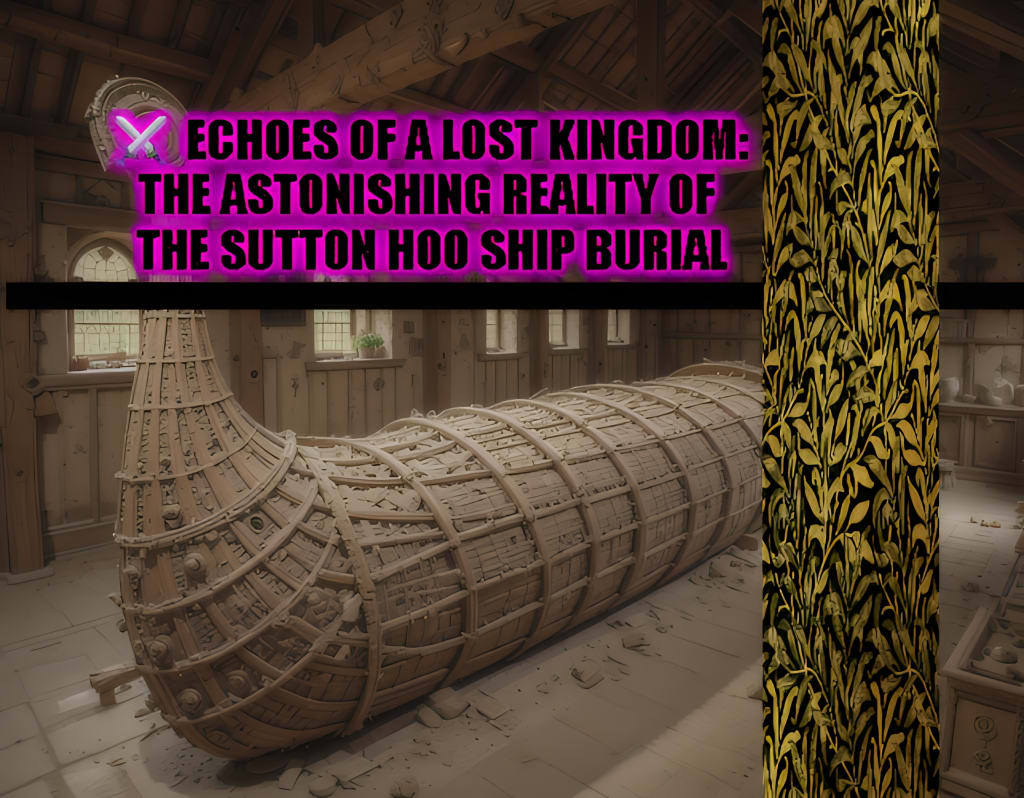
Brown’s early explorations yielded limited finds in smaller mounds. But when he turned to the largest mound—Mound 1—something extraordinary began to surface. Brown discovered an unmistakable pattern of iron rivets aligned in the soil, outlining the contours of a massive ship. Although the timber had long since decayed in the acidic soil, its ghostly form was preserved through the rusted metal fastenings and soil discoloration. At 27 meters (nearly 90 feet) in length, it was evident that this was a ship of monumental importance. . . .
What made the discovery even more remarkable was that the ship had been buried as part of a grave—one whose center chamber was filled with an astonishing array of grave goods. These included imported silver, gilded armor, gold ornaments, and finely crafted weaponry, indicating a burial of immense status and suggesting that this was not simply a local chieftain, but likely a king. The ship had been hauled to its location and interred beneath the earth, creating a royal tomb on par with those of ancient civilizations. . . .
The find was all the more dramatic due to its timing. As Britain braced for the outbreak of war, archaeologists, curators, and museum staff rushed to record and preserve the discovery. Some items were hidden in London Underground tunnels for safekeeping during the Blitz. Despite these urgent circumstances, the Sutton Hoo dig was handled with a reverence that allowed its historical legacy to endure. It quickly became clear that Sutton Hoo would redefine Britain’s understanding of the early medieval period. . . .
In addition to the technical significance of the find, Sutton Hoo’s discovery brought attention to the often-overlooked amateur and women contributors to archaeology. Edith Pretty’s financial and spiritual motivations, as well as Basil Brown’s perseverance despite lacking formal academic credentials, emphasized that passion and intuition could rival institutional pedigree. Their story, once overshadowed by others, now stands central in retellings of the site’s importance. The collaboration of local laborers, museum staff, and volunteers during wartime conditions added to the legend of the Sutton Hoo dig as a triumph of human curiosity and resilience. . . .

⚱️ Treasures of a Forgotten Warrior Elite
The contents of the burial chamber were staggering—not only in quantity but in their intricate craftsmanship and cosmopolitan origins. Central among these finds was a ceremonial helmet, later painstakingly reconstructed from dozens of fragments. Decorated with tinned bronze panels, the helmet portrayed dynamic scenes of warriors, stylized animals, and human faces merging with decorative motifs. It stood as both a practical item and a symbol of status, power, and cultural heritage. . . .
Weapons included a pattern-welded sword with an elaborately decorated gold-and-garnet hilt, matching fittings for scabbards and belts, and a shield whose metal boss bore signs of battle and ceremony. These items were not merely for use—they were carefully crafted expressions of authority and identity. A coat of mail indicated martial prowess, while drinking horns, lyres, and gaming pieces reflected the lifestyle of an elite warrior class. . . .
Among the grave goods was an extraordinary collection of silverware—dishes and bowls of Byzantine origin, suggesting links with the Eastern Roman Empire. There were also glass beakers, possibly imported from Gaul, and ornate drinking horns fashioned from animal horn and precious metal mounts. These luxury items conveyed a message of wealth and connections that extended far beyond the British Isles. . . .
The presence of gold items was particularly striking. A purse lid inlaid with red garnets and gold filigree housed a collection of gold coins—each from a different mint in Francia. The diversity of these coins has led scholars to believe they were deliberately chosen to represent a wide network of influence and tribute. They served not merely as wealth, but as emblems of political and spiritual symbolism, possibly intended to facilitate the deceased’s passage to the afterlife. . . .
The fusion of Christian and pagan imagery within the burial has long puzzled scholars. Although no overt Christian symbols were found, the richness and symbolism of the grave goods suggest a transitional period in Anglo-Saxon religious belief. This burial may represent a ruler or nobleman navigating the convergence of old pagan traditions with the newly arrived Christian doctrine, reflecting a society in the midst of religious transformation. . . .
The techniques used in producing these artifacts reveal highly specialized craftsmanship. Cloisonné garnet work, delicate inlays, and filigree designs show influence from both continental Europe and earlier British traditions. This synthesis of styles highlights the cultural melting pot that was early Anglo-Saxon England. Sutton Hoo is not just a symbol of kingship, but of artistry, innovation, and exchange in an interconnected medieval world. . . .

👑 Identity of the Interred and the Rise of East Anglia
The identity of the person buried at Sutton Hoo remains a tantalizing mystery. No bones were recovered, likely dissolved by the acidic soil. Yet the scale, opulence, and dating of the grave goods point to a figure of immense historical importance. The most widely accepted candidate is Rædwald, King of the East Angles, who died around 624–625 CE. Rædwald is recorded in Bede’s Ecclesiastical History as a powerful king and the first East Anglian monarch to convert to Christianity—albeit one who famously maintained shrines to both Christian and pagan gods. . . .
Rædwald held the title of bretwalda, or overlord, suggesting his authority extended beyond East Anglia to other Anglo-Saxon kingdoms. If Sutton Hoo was his final resting place, it offers a unique window into how kingship was practiced and remembered in early medieval England. Unlike later monarchs who built castles and issued written decrees, rulers like Rædwald expressed power through material display: grand feasts, elaborate weaponry, and burial in ships befitting myth and legend. . . .
The ship itself, reminiscent of Scandinavian burial practices, hints at East Anglia’s cultural affiliations. The Angles, Saxons, and Jutes who settled England during the early medieval period brought with them customs that persisted in elite ritual. Ship burials, while rare in England, were practiced among Norse and Germanic elites. The Sutton Hoo ship may symbolize a journey to the afterlife, a king’s voyage into the unknown, or a celestial chariot befitting a ruler. . . .
The site also provides rare insight into early English political geography. The Kingdom of East Anglia, once a dominant force in southern England, is today largely forgotten. Sutton Hoo’s grandeur demonstrates that it was a sophisticated society capable of impressive artistic and ceremonial feats. Through Sutton Hoo, scholars have pieced together the early contours of royal power, regional identity, and international diplomacy. . . .
These insights are bolstered by comparative burials across Scandinavia and the Continent. Sutton Hoo stands as a parallel to sites like Vendel and Valsgärde in Sweden, suggesting shared elite burial rites across the Germanic world. It has helped historians reassess the relative sophistication and reach of Anglo-Saxon England, situating it as an equal—not a backwater—in early medieval Europe. . . .

🏺 Archaeological Legacy and Cultural Significance
Sutton Hoo forever changed how historians view the early Middle Ages in Britain. Before its discovery, the 7th century was often dismissed as a time of cultural regression. Sutton Hoo proved otherwise—it showed a society rich in artistry, diplomacy, and belief, thriving on networks of trade and spiritual complexity. The burial's grave goods reflected a kingdom integrated with broader European and Mediterranean worlds. . . .
The site has continued to yield insights decades after its initial excavation. In the 1960s and again in the 1980s and 2000s, archaeologists returned to Sutton Hoo armed with improved technology. Geophysical surveys, ground-penetrating radar, and targeted digs have revealed new features, including additional burials and evidence of domestic settlement. Sutton Hoo is now understood not as an isolated site, but as part of a larger royal complex that may have included a hall, workshops, and ritual spaces. . . .
In 1998, the National Trust acquired Sutton Hoo and opened a visitor center that includes reconstructions of the ship and burial chamber. Public interest was further renewed by the 2021 film The Dig, dramatizing the original excavation and bringing deserved recognition to Basil Brown. Yet the real story remains in the soil—the fragments, the metallurgy, the artistry that whisper of a kingdom once great. . . .

Today, Sutton Hoo stands as a national treasure and a cultural touchstone. It bridges myth and history, offering proof that England’s early medieval past was as dynamic, colorful, and complex as any golden age. It is a testament to human ingenuity, to the memory of forgotten kings, and to the enduring power of the buried past. . . .
Its importance goes beyond national pride. Sutton Hoo redefines the early medieval world as interconnected, literate, and deeply expressive through material culture. It reminds us that stories survive not only in books and chronicles, but in earth and iron, in ships and helmets, and in the choices of those who dared to bury a king with the heavens as his horizon. . . .
About the Creator
Kek Viktor
I like the metal music I like the good food and the history...
Keep reading
More stories from Kek Viktor and writers in History and other communities.
3 Times Safety Rules Were Written After It Was Already Too Late
Safety rules like to pretend they are proactive. They wear reflective vests, carry clipboards, and speak confidently about prevention. But history knows the truth: many safety rules were written after something went catastrophically wrong, when prevention was no longer an option and regret had already filled out the paperwork.
By Enoch Saginiabout 22 hours ago in History
The Titanic Mystery: Secrets Beneath the Frozen Sea
On the night of April 14, 1912, the RMS Titanic sailed calmly through the dark waters of the North Atlantic, carrying more than 2,200 souls and the dreams of a modern world that believed it had conquered nature. Labeled “unsinkable,” the Titanic was the pride of human engineering. Yet before dawn broke, the great ship lay shattered beneath miles of icy ocean. More than a century later, the Titanic remains not just a tragedy—but a mystery filled with unanswered questions.
By The best writer 6 days ago in History
How to Succeed at the Benson Directory®
Congratulations and welcome to the Benson Directory® employee #22391! As our newest call handler, you will have the privilege of speaking with dozens of unique and interesting people on a daily basis as well as the opportunity to earn bonuses for high performance. Contained within this handbook you will find a set of ease to follow instructions designed to help you settle in to your new role and begin paving the way to success.
By S. A. Crawford3 days ago in Fiction



Comments (1)
The discovery of the Sutton Hoo ship burial is truly fascinating. It's amazing how a hunch led to such a significant find. I can only imagine the excitement when those iron rivets were spotted. Makes me wonder about the logistics of hauling that huge ship to its burial site. And how did they manage to preserve the grave goods despite the acidic soil? It's a mystery that still holds so much intrigue after all these years.