
3 Times Safety Rules Were Written After It Was Already Too Late
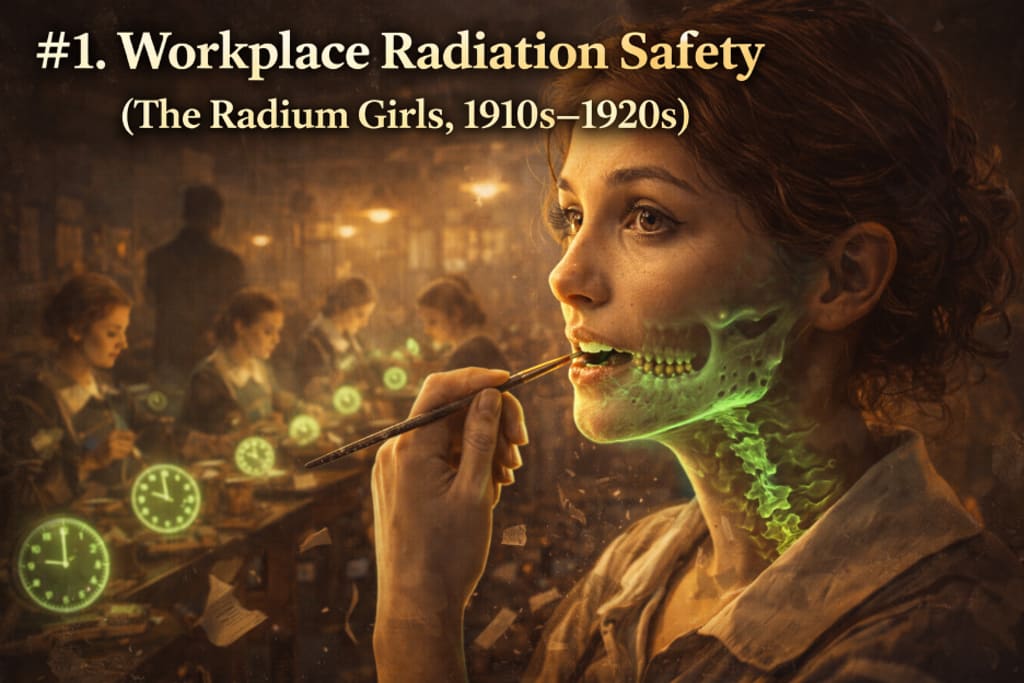
#1. Workplace Radiation Safety (The Radium Girls, 1910s–1920s)
Safety rules like to pretend they are proactive. They wear reflective vests, carry clipboards, and speak confidently about prevention. But history knows the truth: many safety rules were written after something went catastrophically wrong, when prevention was no longer an option and regret had already filled out the paperwork.
These rules are not born from imagination. They are born from disasters so shocking that society collectively paused, looked at the wreckage, and said, “Okay. We are never doing that again.”
In other words, safety regulations are often apology notes written in legal language.
Here are three times safety rules arrived late—very late—after the damage had already been done.
3. Factory Fire Exits (The Triangle Shirtwaist Factory Fire, 1911)
Before 1911, factory safety was less a concept and more a suggestion. Buildings were tall, crowded, flammable, and designed with one primary concern: efficiency. Workers were replaceable. Equipment was not.
The Triangle Shirtwaist Factory in New York City occupied the upper floors of a building filled with young garment workers—mostly immigrant women. To prevent theft and unauthorized breaks, factory owners kept doors locked during work hours. Fire escapes were flimsy. Safety drills were nonexistent.
On March 25, 1911, a fire broke out.
Within minutes, the upper floors were engulfed. Workers ran for exits and found doors locked. Fire escapes collapsed. Some women jumped from windows to escape the flames, choosing gravity over fire in front of horrified onlookers.
By the time the fire ended, 146 people were dead.
Only then did society react.
Fire safety codes were rewritten. Exit doors could no longer be locked. Buildings were required to have multiple exits. Fire drills became mandatory. Sprinkler systems became standard.
Of course, exits should be unlocked. Of course, buildings should allow escape. But until bodies piled up in the street, no one enforced what hindsight now considers common sense.
The rules saved millions later. They arrived for 146 people far too late.
2. Lifeboat Requirements (The Titanic, 1912)
Before the Titanic set sail, maritime safety rules were confidently outdated. Lifeboat requirements were based on a ship’s tonnage—not the number of passengers—because ships simply weren’t built that large before. Updating the rules would have required admitting the industry had outgrown its own assumptions.
The Titanic was marketed as nearly unsinkable. Carrying full lifeboat capacity would clutter decks and ruin aesthetics. Confidence replaced caution. The ship sailed with lifeboats for just over half the people on board.
When the Titanic struck the iceberg on April 14, 1912, the problem was not the collision—it was the aftermath.
Chaos followed. Lifeboats were launched half-empty. Passengers didn’t believe the ship would sink. Crew had never practiced a full evacuation. Safety rules had not accounted for human behavior, panic, or disbelief.
Over 1,500 people died in freezing water.
Only after the ocean had claimed them did regulations change.
International maritime law was rewritten. Ships were required to carry enough lifeboats for everyone. Continuous radio watches became mandatory. Ice patrols were established.
The ship became a floating classroom, teaching lessons no one aboard survived to apply.
1. Workplace Radiation Safety (The Radium Girls, 1910s–1920s)
In the early 20th century, radium was a miracle substance. It glowed. It symbolized modernity. It was used in medicine, cosmetics, and most fatefully, watch dials.
Young women were hired to paint radium onto clock faces using fine brushes. To keep the brush tips sharp, they were instructed to lick them between strokes. Management assured them the substance was safe—some executives even claimed it was healthy.
The women glowed faintly in the dark. It was charming. It was fashionable. It was deadly.
Over time, the workers developed horrific symptoms. Teeth fell out. Jaws disintegrated. Bones became brittle and fractured easily. The radium had accumulated inside their bodies, slowly poisoning them from within.
The companies denied responsibility. Doctors were confused. There were no safety rules—because no one had bothered to imagine the risk.
Only after lawsuits, public outrage, and multiple deaths did radiation safety standards emerge. Protective equipment became mandatory. Exposure limits were established. The phrase “occupational hazard” gained real weight.
The rules saved future workers. They did nothing for the women who had already been told to smile, dip, and lick their brushes.
The unsettling part is how preventable it all was. The rule didn’t require advanced science—just basic caution. But caution arrived after the damage was irreversible.
Conclusion
Safety rules like to present themselves as guardians of the future, but many are better described as historians of catastrophe. They are written not to prevent the first disaster, but to prevent the next one.
What makes these stories so uncomfortable is how familiar the reasoning sounds:
● It’s never happened before.
● The risk is minimal.
● We’ll deal with it if it becomes a problem.
By the time it becomes a problem, it’s already too late.
Safety rules are paid for in advance by ignorance—and settled in full by loss. And while they do save countless lives later, they always arrive carrying the quiet weight of those they couldn’t save in time.
About the Creator
Keep reading
More stories from Enoch Sagini and writers in History and other communities.
3 Completely Innocent Decisions That Ended Very Badly
Most disasters don’t begin with villainous laughter or ominous music. They begin with someone making a perfectly reasonable decision. Sensible, even. The kind of choice you’d defend confidently if questioned later.
By Enoch Saginiabout 9 hours ago in History
Girolamo Segato: The Scientist Who Turned Humans into Stone
The Mysterious Italian Genius Behind the Art of Human Petrification Girolamo Segato remains one of the most mysterious scientists of the 19th century, remembered not only for his scientific brilliance but also for a secret he took to his grave. Born in 1792 in Italy, Segato gained worldwide attention for achieving something that still puzzles scientists today: he discovered a method to turn human and animal body parts into stone-like fossils while preserving their detailed structure. Unlike mummification, Segato’s process created specimens that looked and felt like real stone, yet retained the microscopic details of living tissue. Early Life and Education Girolamo Segato was born in the small town of Sospirolo, near Belluno, Italy. From an early age, he showed a deep interest in science, anatomy, and natural history. He studied engineering and anatomy and later became involved in archaeological and scientific research. His curiosity eventually led him to Egypt, where he spent several years studying ancient civilizations, mummification techniques, and geological formations. Segato was deeply inspired by ancient Egyptian preservation methods, but he believed there was a way to go beyond traditional embalming. His goal was not just to preserve bodies but to transform organic tissue into an inorganic, stone-like substance. The Discovery of Human Petrification After returning to Italy, Segato began experimenting with human and animal remains. Over time, he developed a secret chemical process that allowed him to petrify body parts such as hands, feet, heads, and internal organs. These specimens were not dried or decayed. Instead, they became hard like marble or stone, resistant to time, moisture, and decay. What made Segato’s work extraordinary was the level of detail preserved. Veins, muscles, skin texture, and even facial expressions were visible in the petrified remains. Scientists who examined these objects noted that they were neither mummified nor fossilized through natural processes. They appeared to be something entirely new. Public Reaction and Fear Although Segato’s discovery was groundbreaking, it was also deeply unsettling to many people. In 19th-century Europe, turning human remains into stone was seen by some as unnatural or even blasphemous. Religious authorities and conservative groups accused Segato of practicing forbidden science. Because of this backlash, Segato struggled financially and socially. He tried to sell his method to scientific institutions, but fear and suspicion prevented widespread acceptance. Many people admired his work privately but were unwilling to support him publicly. The Secret That Died With Him One of the greatest mysteries surrounding Girolamo Segato is that he never revealed his petrification formula. Whether due to fear, mistrust, or lack of support, Segato chose to keep his process secret. When he died in 1836, the knowledge died with him. Today, no scientist has been able to fully replicate his results. Despite advances in chemistry and material science, Segato’s exact technique remains unknown. This has led to speculation ranging from lost chemical knowledge to deliberate secrecy caused by persecution. Preserved Works Today Some of Segato’s petrified specimens still exist and can be seen in museums in Florence, Italy, particularly at the Museum of the Basilica of Santa Croce. These stone-like human remains continue to attract researchers, historians, and visitors from around the world. Modern scientific analysis confirms that these objects are real human tissues transformed into a mineralized state. However, the precise chemical reactions involved remain unclear, adding to Segato’s legend. Legacy and Scientific Importance Girolamo Segato’s work challenges the boundary between life and stone, biology and geology. His experiments raise important questions about preservation, material transformation, and the ethics of scientific discovery. Although controversial, his research was far ahead of its time and continues to inspire curiosity. Some experts believe Segato’s work could have applications in modern science, such as long-term biological preservation, archaeology, or even medical research. Others view his story as a warning about how society sometimes rejects revolutionary ideas out of fear. Conclusion Girolamo Segato was not a madman, nor a magician. He was a scientist whose discovery frightened the world around him. By turning human tissue into stone, he achieved something that remains unexplained nearly two centuries later. His life is a powerful reminder that scientific progress often walks hand in hand with controversy. Though his secret is lost, Girolamo Segato’s legacy lives on—etched in stone, silent yet enduring, challenging humanity to question what is truly possible.
By Hasbanullah7 days ago in History


Comments
There are no comments for this story
Be the first to respond and start the conversation.