
The Titanic Mystery: Secrets Beneath the Frozen Sea
A Tragic Voyage, Unanswered Questions, and the Secrets Lost in the Deep


On the night of April 14, 1912, the RMS Titanic sailed calmly through the dark waters of the North Atlantic, carrying more than 2,200 souls and the dreams of a modern world that believed it had conquered nature. Labeled “unsinkable,” the Titanic was the pride of human engineering. Yet before dawn broke, the great ship lay shattered beneath miles of icy ocean. More than a century later, the Titanic remains not just a tragedy—but a mystery filled with unanswered questions.
The ship’s journey had begun with celebration. From Southampton to Cherbourg and then Queenstown, passengers boarded with excitement. The wealthy dined in luxury, while immigrants in third class dreamed of new lives in America. Everything about the Titanic symbolized progress: electric lights, grand staircases, and powerful engines. But beneath the surface of confidence, subtle warnings were already present.
One of the greatest mysteries is why the Titanic never slowed down, despite receiving multiple iceberg warnings that day. Wireless operators received at least six messages from nearby ships reporting ice fields ahead. Some were ignored. Others were delayed. Captain Edward Smith, one of the most experienced sailors of his time, chose to maintain near-top speed. Was it pressure from the White Star Line to arrive early? Or did confidence in the ship’s design cloud judgment? No clear answer has ever been proven.
At 11:40 p.m., the lookout spotted an iceberg directly ahead. The order came to turn hard to port and reverse engines—but it was too late. The iceberg scraped the ship’s side, opening a series of small gashes below the waterline. Individually, they were manageable. Together, they were fatal. The Titanic was designed to stay afloat if four compartments flooded. That night, six began to fill.
Another enduring mystery lies in the behavior of the ship’s structure. For decades, experts believed the Titanic sank in one piece. However, when the wreck was discovered in 1985, it was found broken in two. This raised troubling questions: did the ship’s metal fracture too easily? Later studies suggested the steel used may have been brittle in freezing temperatures. If true, the “unsinkable” ship was more fragile than anyone knew.
As the ship began to sink, chaos and disbelief spread. Many passengers refused to believe the danger was real. Lifeboats were lowered half-empty. Why? Some officers feared the boats might break if filled. Others followed outdated rules that prioritized women and children but failed to ensure efficiency. In the end, more than 1,500 people died—not because lifeboats were unavailable, but because they were underused.
Perhaps the most haunting mystery involves the nearby ship, the Californian. That night, the Californian was only a few miles away. Its crew saw rockets in the sky but did not recognize them as distress signals. Their radio operator had gone to sleep. Could hundreds of lives have been saved if the Californian had responded? Investigations followed, but blame was scattered, and justice felt incomplete.
Then there are the strange stories from survivors. Some claimed the ship’s lights stayed on until the very end. Others said the band played as the deck tilted steeply upward. One survivor spoke of a man dressed as a woman trying to board a lifeboat. Another remembered eerie silence just before the ship vanished beneath the waves. Memory, trauma, and fear blur the truth—but together, these accounts paint a haunting picture of humanity facing death.
Even after the disaster, mystery followed the Titanic into the deep. When Dr. Robert Ballard discovered the wreck in 1985, he found personal items scattered across the ocean floor—shoes, suitcases, dishes—frozen in time. No human remains were found. The cold, darkness, and pressure had erased physical traces, leaving only silent evidence of lives interrupted.
Conspiracy theories soon emerged. Some claimed the ship that sank was not the Titanic but her sister ship, the Olympic, switched for insurance fraud. Others believed a fire in the coal bunker weakened the hull before the voyage. While evidence suggests a coal fire did occur, historians disagree on its impact. The idea of a deliberate switch, however, lacks solid proof and remains speculation.
Perhaps the greatest mystery is why the Titanic still captures our imagination. Thousands of ships have sunk, yet none are remembered like this one. Maybe it is because the Titanic represented human arrogance—our belief that technology could overpower nature. Or maybe it is the personal stories: the father who kissed his children goodbye, the musicians who played until the end, the strangers who held hands in the freezing dark.
The ocean keeps many secrets. The Titanic rests nearly four kilometers below the surface, slowly decaying, claimed by rust and bacteria. Scientists say the wreck may disappear entirely within decades. When it does, the physical mystery will vanish—but the questions will remain.
Why were warnings ignored? Why were lives lost needlessly? Could the tragedy have been prevented?
The Titanic was not just a ship. It was a mirror, reflecting both the brilliance and the blindness of humanity. And as long as those questions remain unanswered, the mystery of the Titanic will continue to sail through history—silent, powerful, and unforgettable.
About the Creator
The best writer
I’m a passionate writer who believes words have the power to inspire, heal, and challenge perspectives. On Vocal, I share stories, reflections, and creative pieces that explore real emotions, human experiences, and meaningful ideas.
Keep reading
More stories from The best writer and writers in History and other communities.
The Crown of Ash and Gold
In the final era of the ancient kingdom of Aurelion, the world seemed to change its tone. The skies appeared duller, the winds colder, and the streets quieter than they had ever been during the kingdom’s golden age. Aurelion was once a beacon of civilization—its stone cities gleamed under the sun, its scholars were respected across continents, and its armies had carved its name into history. Yet no empire, no matter how mighty, can escape the slow test of time.
By The best writer 5 days ago in History
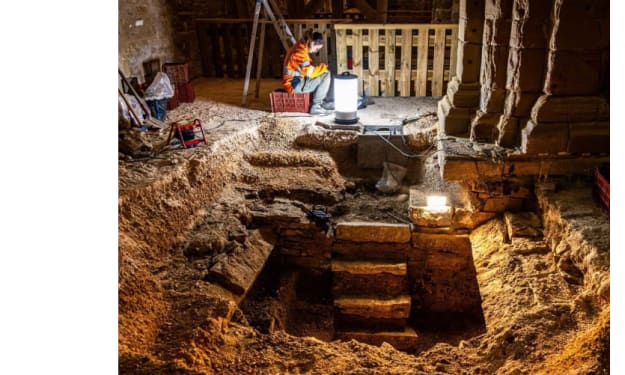
A secret staircase found beneath a 1,500-year-old French church
A subterranean staircase and burial strata dating back approximately 1,500 years were discovered during a project inside the Church of Saint Philibert in Dijon, France. The stairs were discovered by restoration workers inside the church when repairs were being made, and the excavation soon ensued.
By Francis Dami3 days ago in History
Girolamo Segato: The Scientist Who Turned Humans into Stone
The Mysterious Italian Genius Behind the Art of Human Petrification Girolamo Segato remains one of the most mysterious scientists of the 19th century, remembered not only for his scientific brilliance but also for a secret he took to his grave. Born in 1792 in Italy, Segato gained worldwide attention for achieving something that still puzzles scientists today: he discovered a method to turn human and animal body parts into stone-like fossils while preserving their detailed structure. Unlike mummification, Segato’s process created specimens that looked and felt like real stone, yet retained the microscopic details of living tissue. Early Life and Education Girolamo Segato was born in the small town of Sospirolo, near Belluno, Italy. From an early age, he showed a deep interest in science, anatomy, and natural history. He studied engineering and anatomy and later became involved in archaeological and scientific research. His curiosity eventually led him to Egypt, where he spent several years studying ancient civilizations, mummification techniques, and geological formations. Segato was deeply inspired by ancient Egyptian preservation methods, but he believed there was a way to go beyond traditional embalming. His goal was not just to preserve bodies but to transform organic tissue into an inorganic, stone-like substance. The Discovery of Human Petrification After returning to Italy, Segato began experimenting with human and animal remains. Over time, he developed a secret chemical process that allowed him to petrify body parts such as hands, feet, heads, and internal organs. These specimens were not dried or decayed. Instead, they became hard like marble or stone, resistant to time, moisture, and decay. What made Segato’s work extraordinary was the level of detail preserved. Veins, muscles, skin texture, and even facial expressions were visible in the petrified remains. Scientists who examined these objects noted that they were neither mummified nor fossilized through natural processes. They appeared to be something entirely new. Public Reaction and Fear Although Segato’s discovery was groundbreaking, it was also deeply unsettling to many people. In 19th-century Europe, turning human remains into stone was seen by some as unnatural or even blasphemous. Religious authorities and conservative groups accused Segato of practicing forbidden science. Because of this backlash, Segato struggled financially and socially. He tried to sell his method to scientific institutions, but fear and suspicion prevented widespread acceptance. Many people admired his work privately but were unwilling to support him publicly. The Secret That Died With Him One of the greatest mysteries surrounding Girolamo Segato is that he never revealed his petrification formula. Whether due to fear, mistrust, or lack of support, Segato chose to keep his process secret. When he died in 1836, the knowledge died with him. Today, no scientist has been able to fully replicate his results. Despite advances in chemistry and material science, Segato’s exact technique remains unknown. This has led to speculation ranging from lost chemical knowledge to deliberate secrecy caused by persecution. Preserved Works Today Some of Segato’s petrified specimens still exist and can be seen in museums in Florence, Italy, particularly at the Museum of the Basilica of Santa Croce. These stone-like human remains continue to attract researchers, historians, and visitors from around the world. Modern scientific analysis confirms that these objects are real human tissues transformed into a mineralized state. However, the precise chemical reactions involved remain unclear, adding to Segato’s legend. Legacy and Scientific Importance Girolamo Segato’s work challenges the boundary between life and stone, biology and geology. His experiments raise important questions about preservation, material transformation, and the ethics of scientific discovery. Although controversial, his research was far ahead of its time and continues to inspire curiosity. Some experts believe Segato’s work could have applications in modern science, such as long-term biological preservation, archaeology, or even medical research. Others view his story as a warning about how society sometimes rejects revolutionary ideas out of fear. Conclusion Girolamo Segato was not a madman, nor a magician. He was a scientist whose discovery frightened the world around him. By turning human tissue into stone, he achieved something that remains unexplained nearly two centuries later. His life is a powerful reminder that scientific progress often walks hand in hand with controversy. Though his secret is lost, Girolamo Segato’s legacy lives on—etched in stone, silent yet enduring, challenging humanity to question what is truly possible.
By Hasbanullah6 days ago in History



Comments
There are no comments for this story
Be the first to respond and start the conversation.