
Drones, Aircraft Carriers, and the Shadow of Wo
How modern weapons could turn regional conflicts into a global war

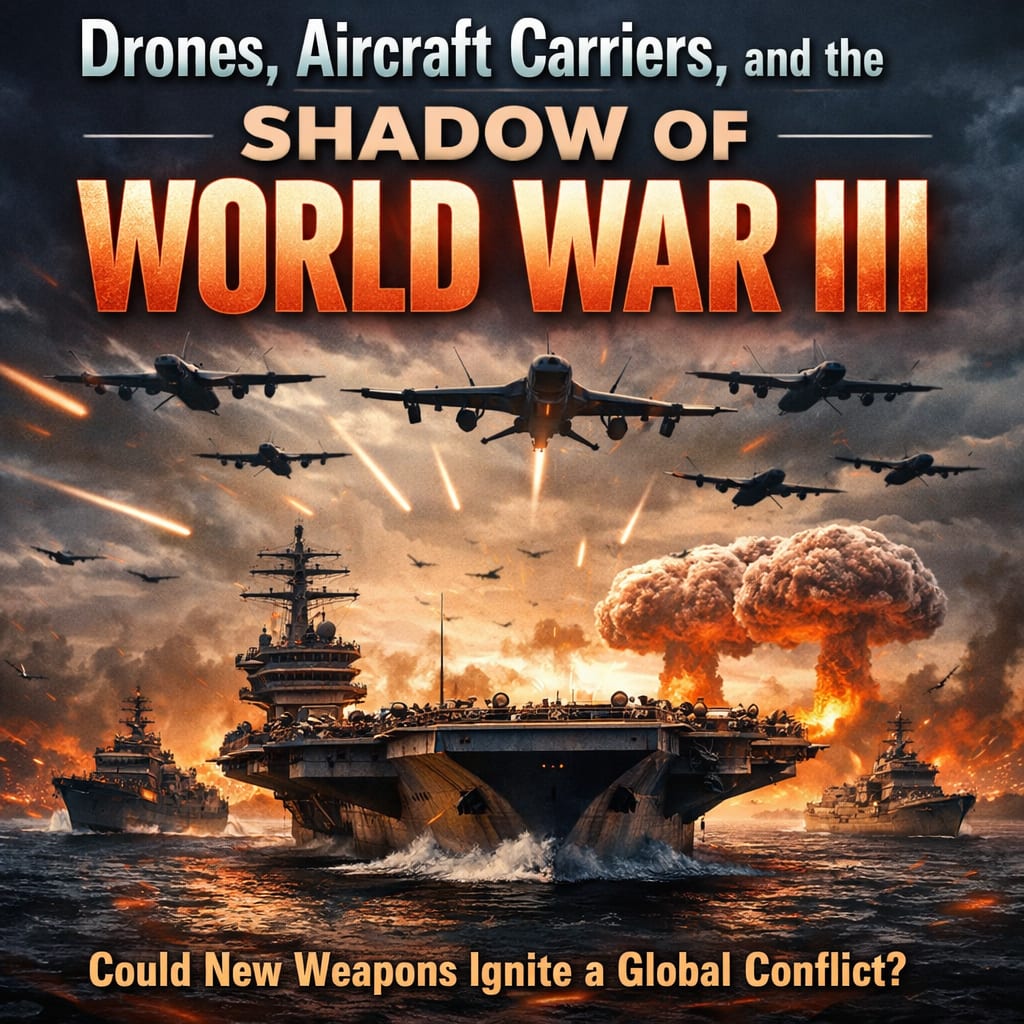
Drones, Aircraft Carriers, and the Shadow of World War III
World War III, once a distant fear, is now discussed more openly by analysts and leaders around the world. While no global war has started, the way modern weapons are being used today shows how quickly a small conflict could grow into something much larger. Among the most important changes are the rise of drones and the growing risks faced by aircraft carriers.
Aircraft carriers have long been symbols of power. When a major country sends a carrier strike group to a region, it signals strength, protection, and warning. These ships are not just weapons—they are political messages floating on the sea. In past decades, their presence often prevented war by discouraging enemies from acting.
Today, however, new technology is changing this balance. Drones are becoming cheaper, smarter, and more deadly. They can be launched from land, sea, or air. They can fly low, avoid radar, and attack in large numbers at the same time. This creates a dangerous situation where even the strongest naval forces can be challenged.
In a regional conflict, drones may be used as a first strike. A swarm of drones attacking a carrier group would not only be a military event—it would be a political shock. If a carrier were seriously damaged or sunk, the pressure on leaders to respond would be enormous. Such an incident could rapidly pull allies into the conflict.
This is where the risk of World War III becomes real. Most major powers are tied together through alliances. An attack on one country’s forces could trigger defense agreements, drawing multiple nations into the fight. What begins as a regional clash could spread across continents.
Drones make escalation more likely because they lower the barrier to attack. Launching drones does not always feel like starting a full war. Leaders may believe they can strike without triggering a major response. But if the target is a carrier or another strategic asset, the response may be far stronger than expected.
Another danger is miscalculation. In modern warfare, attacks happen fast. Drones, missiles, and cyber systems move faster than diplomacy. Decision-makers may have only minutes to react. In such moments, false information, technical errors, or panic could lead to irreversible decisions.
Nuclear-armed countries are especially vulnerable to this risk. Even if drones are conventional weapons, attacks on key military assets could be misunderstood as preparation for a larger strike. This could push nuclear forces into higher alert levels, increasing the chance of a catastrophic mistake.
Cyber warfare adds another layer of danger. Drones often depend on communication networks, satellites, and software. If cyber systems are attacked alongside physical weapons, command and control could be disrupted. Confusion during a crisis is one of the greatest threats to global peace.
Some experts warn that future wars will not be announced. They will begin with silent actions: cyberattacks, drone strikes, electronic interference, and economic pressure. By the time the world realizes what is happening, escalation may already be underway.
At the same time, modern weapons also create opportunities for restraint. Because drones are visible, traceable, and often limited in damage, they can serve as warnings instead of full-scale attacks. Much depends on leadership, communication, and clear red lines.
Preventing World War III requires adapting to this new reality. Militaries must improve defense systems, but more importantly, governments must strengthen communication channels. Hotlines, transparency, and crisis-management agreements are essential to prevent misunderstandings.
History shows that wars often start not because leaders want them, but because events move faster than judgment. In a world of drones and high-tech weapons, the speed of conflict is faster than ever.
World War III is not inevitable. But the combination of advanced weapons, fragile trust, and global alliances makes the risk real. The challenge of our time is to ensure that technology does not outpace wisdom—and that power does not replace responsibility.
About the Creator
Wings of Time
I'm Wings of Time—a storyteller from Swat, Pakistan. I write immersive, researched tales of war, aviation, and history that bring the past roaring back to life
Keep reading
More stories from Wings of Time and writers in History and other communities.
Drones vs Aircraft Carriers
Drones vs Aircraft Carriers For decades, aircraft carriers have been the strongest symbol of military power. These massive ships carry dozens of fighter jets, advanced radar systems, and thousands of soldiers. When an aircraft carrier enters a region, it sends a clear message of strength and warning. But today, a new challenger is changing the rules of war: drones.
By Wings of Time about 8 hours ago in History
The Penguin Who Walked Away: Not a Tragedy, but a Choice.
Every once in a while, the internet turns a moment from nature into a metaphor for human pain. Recently, a video of a penguin walking away from its colony went viral, framed as a heartbreaking image of abandonment, lost love, or emotional defeat. Millions watched it through a romantic lens, calling it tragic and cruel.
By Voxwrite ✍️ a day ago in History
Hannibal Barca: Tactical Genius Beyond Politics
History often favors the victors, but strategy remembers the exceptional. Few commanders embody this truth more clearly than Hannibal Barca. Though he ultimately lost the Second Punic War, Hannibal remains one of the most studied military minds of all time. His genius did not lie in ruling empires or shaping laws, but in something purer and rarer—battlefield intelligence unchained by politics. Hannibal was not a builder of states. He was a master of movement, deception, and human psychology.
By Fred Bradfordabout 16 hours ago in History
The Duelist
The rays of a dying red sun flashed against the onrushing blade. The grey beards say the key to dueling lies in size, speed, reach, righteous fury, whatever the person in front of them pays them to say. Matteo knew better than any it was none of these and had an undefeated record on these sands to prove it.
By Matthew J. Fromm5 days ago in Fiction



Comments
There are no comments for this story
Be the first to respond and start the conversation.