
Hannibal Barca: Tactical Genius Beyond Politics
Hannibal Barca: Tactical Genius Beyond Politics

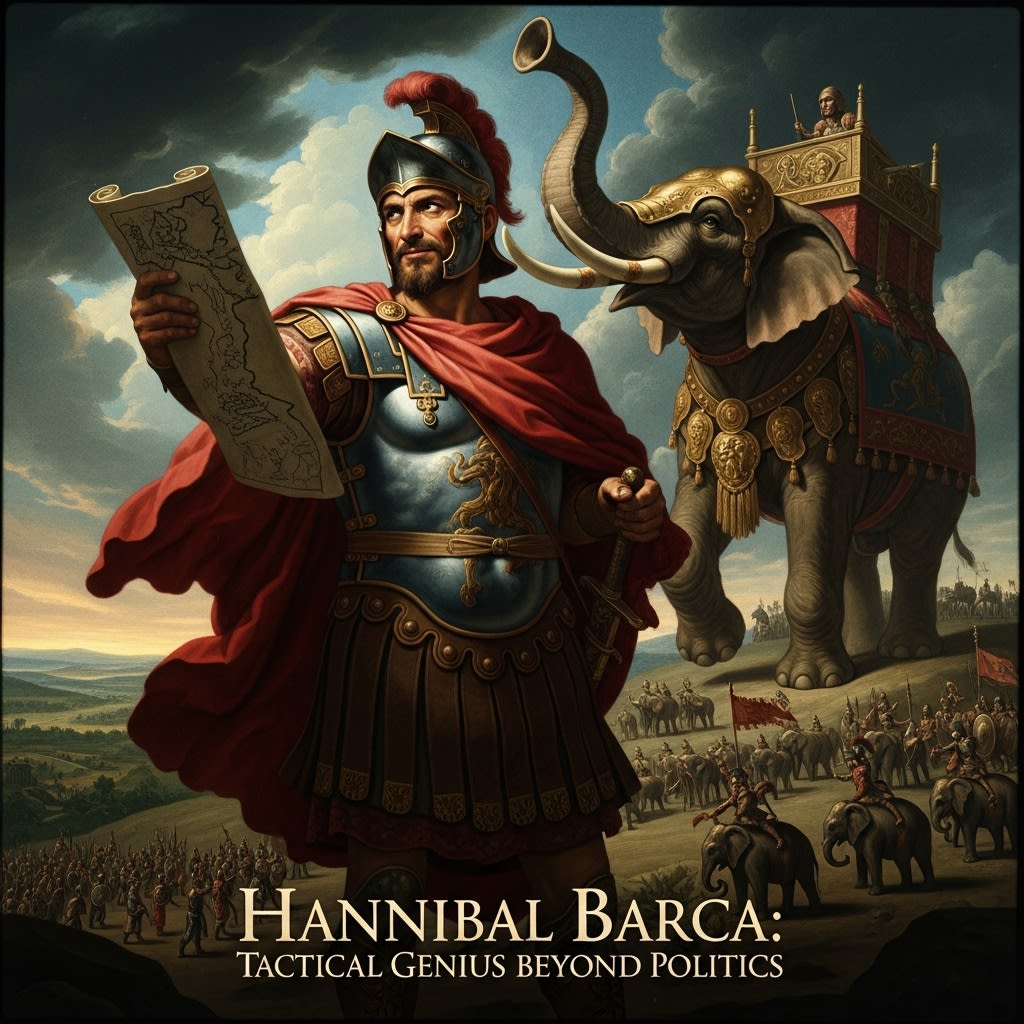
History often favors the victors, but strategy remembers the exceptional. Few commanders embody this truth more clearly than Hannibal Barca. Though he ultimately lost the Second Punic War, Hannibal remains one of the most studied military minds of all time. His genius did not lie in ruling empires or shaping laws, but in something purer and rarer—battlefield intelligence unchained by politics. Hannibal was not a builder of states. He was a master of movement, deception, and human psychology.
Born in 247 BCE in Carthage, Hannibal inherited not power, but purpose. Legend tells that as a child he swore eternal hostility toward Rome at his father’s altar. Yet his greatness was not fueled by hatred alone. It was fueled by understanding. Hannibal studied enemies obsessively—how they thought, how they reacted, how pride shaped their decisions. Where Rome relied on standardized discipline, Hannibal relied on unpredictability.
His most legendary achievement—the crossing of the Alps—was itself a strategic act of psychological warfare. No major army had attempted such a route with elephants, infantry, and cavalry. The journey was brutal, costly, and nearly suicidal. Yet its impact was immense. Rome never imagined an enemy appearing from the north. Before a single battle was fought, Hannibal had already won half the war—by shattering Roman assumptions.
Once in Italy, Hannibal displayed tactical brilliance unmatched in ancient warfare. He consistently defeated larger Roman armies by refusing to fight conventionally. At the Battle of Trebia, he lured Roman forces into freezing waters and ambushed them. At Lake Trasimene, he executed one of the largest ambushes in military history, trapping an entire army between hills and water. These were not accidents of bravery; they were calculations of terrain, emotion, and timing.
His masterpiece came at Cannae in 216 BCE.
Outnumbered nearly two to one, Hannibal arranged his troops in a deliberate arc, placing weaker infantry in the center and elite forces on the flanks. As the Romans advanced, the center slowly retreated, drawing them inward. When Roman legions surged forward, confident and compressed, Hannibal’s flanks enveloped them from both sides. Cavalry sealed the rear. The Roman army was surrounded completely.
It was annihilation by geometry.
Cannae became the definitive example of the double envelopment maneuver, studied by generals from Napoleon to modern military academies. Hannibal did not merely defeat Rome—he rewrote the grammar of warfare.
Yet Hannibal’s tragedy was that his genius existed in isolation. Carthage lacked the political unity and vision to support him fully. While he crushed Roman armies, the Carthaginian leadership hesitated, debated, and withheld reinforcements. Rome, by contrast, absorbed defeat and adapted relentlessly. It lost armies but not resolve.
This contrast defines Hannibal’s legacy. He mastered battles, but not institutions. He broke legions, but could not break Rome’s system. Strategy at the tactical level met limitation at the political level.
Still, Hannibal’s understanding of human behavior was extraordinary. He commanded a multicultural army—Africans, Iberians, Gauls, Numidians—without shared language or nationality. Loyalty was earned not through fear, but trust and competence. His soldiers followed him across mountains, deserts, and years of isolation in enemy territory. That level of cohesion is itself evidence of leadership genius.
Hannibal’s warfare was fluid rather than rigid. He adjusted formations mid-battle, exploited enemy pride, and forced opponents to react rather than plan. Where Rome fought through doctrine, Hannibal fought through insight. He treated war not as a contest of strength, but of minds.
In the end, Hannibal was recalled to defend Carthage and faced Scipio Africanus at Zama. There, Rome applied lessons learned from him. Hannibal was defeated not by inferior leadership, but by a student who had learned well. Even in loss, his influence shaped victory.
Hannibal Barca stands apart because his brilliance transcended allegiance. His legacy belongs not to Carthage, but to strategy itself. He reminds us that genius does not require triumph to endure. Some minds shape history not by winning, but by teaching the world how war—and strategy—can truly be understood.
About the Creator
Fred Bradford
Philosophy, for me, is not just an intellectual pursuit but a way to continuously grow, question, and connect with others on a deeper level. By reflecting on ideas we challenge how we see the world and our place in it.
Keep reading
More stories from Fred Bradford and writers in History and other communities.
Julius Caesar: Strategy and Charisma
History has produced many brilliant commanders and countless ambitious politicians, but few individuals have fused strategy and charisma as completely as Julius Caesar. Others ruled through fear, tradition, or divine claims. Caesar ruled through belief. Men followed him not merely because he commanded armies, but because he convinced them—emotionally, psychologically, and symbolically—that his success was their destiny.
By Fred Bradforda day ago in History


Comments
There are no comments for this story
Be the first to respond and start the conversation.