
Did Trump’s Retreat From the United Nations Undermine Global Peace?
How U.S. disengagement from the UN reshaped diplomacy, power, and global stability


Did Trump’s Retreat From the United Nations Undermine Global Peace?
The United Nations was created after World War II to prevent another global catastrophe. Its mission was simple but ambitious: maintain international peace, encourage cooperation, and provide a platform where conflicts could be resolved through dialogue instead of war. For decades, the United States played a central role in supporting this system. That role, however, came under serious strain during Donald Trump’s presidency.
Trump did not formally withdraw the United States from the United Nations, but his administration sharply reduced support for many UN institutions. Financial contributions were cut, participation in international agreements declined, and public criticism of the UN became routine. Supporters described this shift as a necessary correction. Critics argued it weakened the world’s main peacekeeping framework.
The Trump administration viewed the UN through a transactional lens. Officials repeatedly argued that the United States was paying too much while receiving too little in return. Trump frequently questioned why America should fund organizations that, in his view, failed to serve U.S. interests or allowed rival nations too much influence. This approach marked a sharp departure from traditional U.S. foreign policy, which treated global institutions as long-term investments in stability.
One of the most visible changes was the reduction of funding. The U.S. cut contributions to UN peacekeeping missions and withdrew funding from specific agencies. These decisions affected humanitarian operations, refugee support, and conflict monitoring programs. While the administration argued that reforms were necessary, the cuts reduced the UN’s ability to operate effectively in fragile regions.
The withdrawal from multilateral agreements further signaled a shift away from collective diplomacy. When the United States stepped back, other powers moved to fill the vacuum. China and Russia increased their influence within UN bodies, shaping discussions on security, development, and human rights. This shift raised concerns that the balance of power inside the UN was changing in ways that could weaken its original mission.
Trump’s criticism of international cooperation was rooted in a broader “America First” doctrine. The idea was that global commitments limited U.S. sovereignty and forced the country to compromise. From this perspective, relying on international boards and councils was seen as a weakness rather than a strength. Supporters argued that peace comes from power, not institutions.
However, many diplomats and analysts warned that global peace cannot be maintained by power alone. The UN does not prevent all wars, but it provides communication channels during crises. It offers legitimacy to peacekeeping efforts and creates rules that help manage conflict. When major powers disengage, those rules become harder to enforce.
Another concern was the symbolic impact of U.S. behavior. When the world’s most influential nation questions the value of global cooperation, other countries may follow. This can lead to fragmentation, where nations act independently without coordination. In such an environment, misunderstandings increase, alliances weaken, and conflicts become more difficult to contain.
It is also important to recognize the UN’s limitations. The organization is often slow, divided, and constrained by political interests. Reform is necessary, and criticism is not without merit. But reform traditionally works best from within. Walking away reduces leverage and influence.
The long-term effects of Trump’s approach are still unfolding. Some argue that it forced the UN to confront inefficiencies. Others believe it damaged trust and weakened the idea of shared responsibility for peace. What is clear is that global stability depends on cooperation as much as competition.
Peace is not maintained by any single country or institution. It is built through dialogue, compromise, and mutual restraint. When major powers step back from global platforms, the system becomes less predictable—and unpredictability is one of the greatest risks in international relations.
The debate over the UN’s role continues, but one lesson remains clear: global peace requires engagement. Abandoning the table does not end conflicts—it often makes them harder to resolve.
About the Creator
Wings of Time
I'm Wings of Time—a storyteller from Swat, Pakistan. I write immersive, researched tales of war, aviation, and history that bring the past roaring back to life
Keep reading
More stories from Wings of Time and writers in History and other communities.
The Quiet Collapse of Global Arms Control
The Quiet Collapse of Global Arms Control For decades, arms control agreements helped prevent the world’s most powerful weapons from spiraling out of control. Treaties limited nuclear stockpiles, increased transparency, and built fragile trust between rival states. Today, that system is quietly unraveling—and its collapse may define the next era of global insecurity.
By Wings of Time a day ago in History
3 Everyday Rules That Exist Because Someone Once Did Something Very Stupid
Everywhere you go, you are surrounded by rules that feel oddly specific. Do not touch. No running. Contents hot. Do not insert body parts. These warnings aren’t theoretical. They weren’t written by pessimists or lawyers with too much free time. They exist because at some point in history, a real human being looked at a situation and thought, “This will probably be fine.”
By Enoch Sagini5 days ago in History
Nanchang: A Modern Symbol of China’s Naval Power
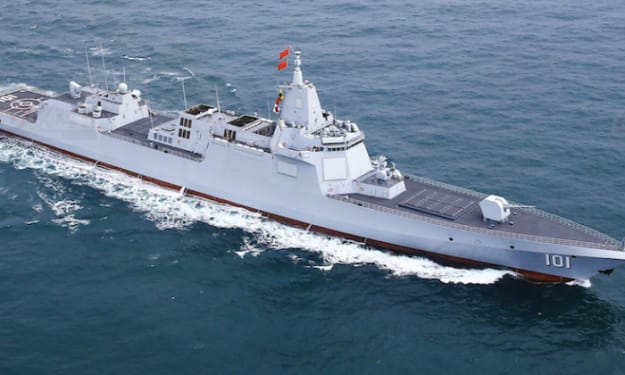
In recent years, the world has closely watched the rapid modernization of the Chinese People’s Liberation Army Navy (PLA Navy). One of the most important symbols of this transformation is the Nanchang (Hull 101), China’s first Type 055 guided-missile destroyer. Commissioned on 12 January 2020, Nanchang represents a major leap in naval technology and capability. As it completes six years of active service, the ship stands as a clear example of how China’s navy has moved into a new era of advanced maritime power.
By sehzeen fatima7 days ago in History



Comments
There are no comments for this story
Be the first to respond and start the conversation.