
Cults of Gods: Athena, Wisdom or War? Both.
What were Athena's cult and religious functions?

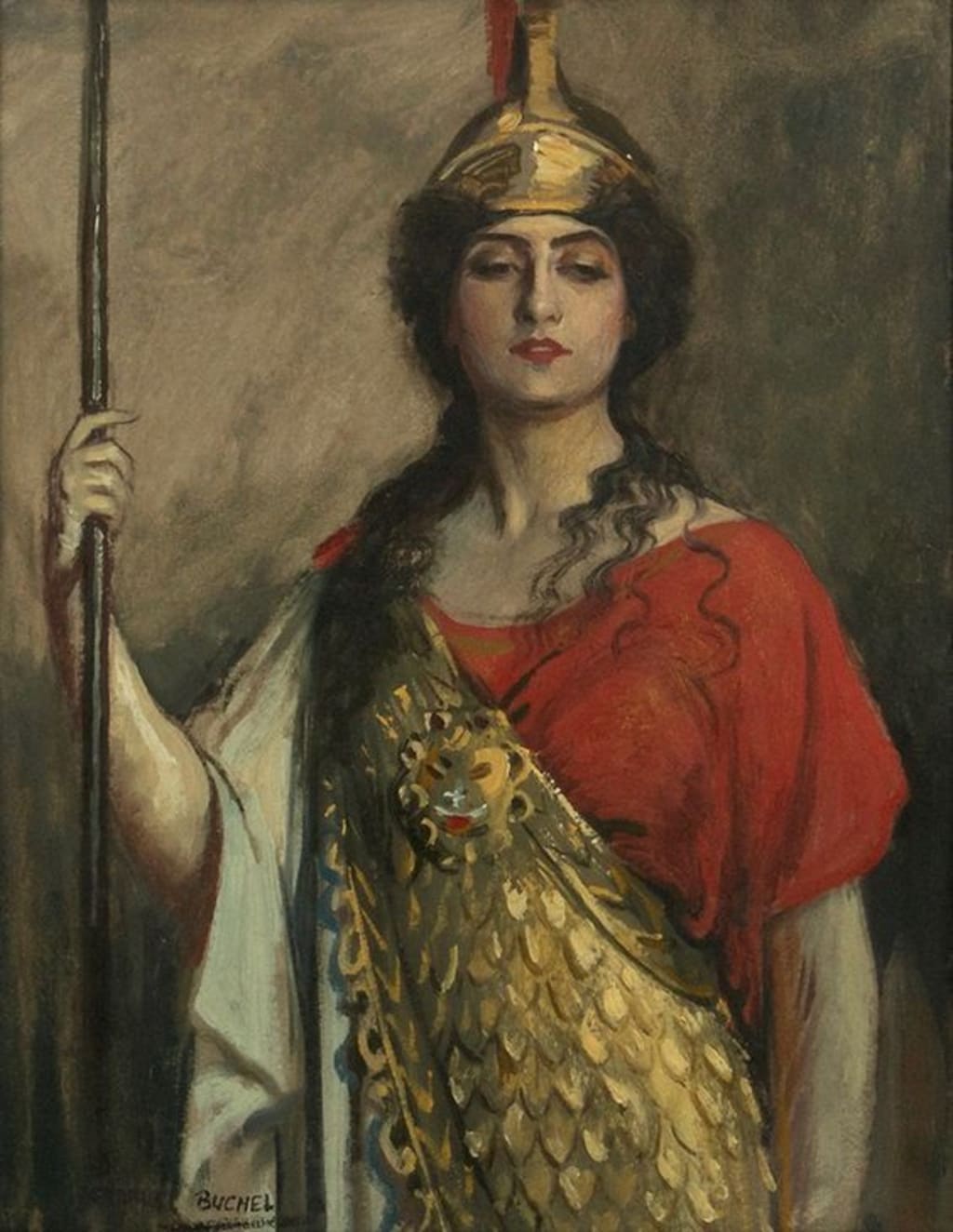
When thinking about Athene, most people remember myths of her springing fully armed from Zeus’ head or her contest with Poseidon for the patronage of Athens. Many neopagan or mythology blogs describe her simply as “the goddess of wisdom.” But Athene’s influence goes far beyond this title. Wisdom is only an umbrella term for the many aspects of life she governs.
Athene is the Olympian goddess of wisdom and good counsel, war, the defense of towns, heroic endeavor, weaving, pottery, and various other crafts. She was depicted as a stately woman armed with a shield and spear, wearing a long robe, a crested helm, and the famed aegis—a snake-trimmed cape adorned with the monstrous visage of the Gorgon Medousa (Medusa).
Since the time of Plato, some scholars believed her name derived from the Greek words nous (mind) and dianoia (intelligence). Modern evidence, however, suggests this is unlikely. Her name is almost certainly connected to Athēnai, the Greek name for the city of Athens. In a kind of “chicken-or-egg” dilemma, scholars debated whether the city was named for the goddess or the goddess for the city. Today, it is generally believed that the goddess Athene took her name from Athens. This is likely why she does not appear with a distinct personal name in the earliest Mycenaean inscriptions from the Bronze Age, where she is called simply a-ta-na po-ti-ni-ja—“Lady” or “Mistress of Athens.”
Athene’s functions can broadly be divided into three domains: strategic wisdom, protection, and war. She was invoked for planning and foresight as Pronoia (Foresight), Makhanitis (Inventor of Plans and Devices), and Amboulia (Counsellor). In warfare, her epithets included Areia (Warlike) and Nike (Victory). For protection—both civic and personal—Athene was honored as Xenia (Of Hospitality), Polioukhos (City-Protectress), and Hygeia (Of Good Health). These three domains—strategy, protection, and war—capture the core of her nature, in which intellect becomes purposeful action.
Athene was worshipped throughout the Greek world, but her most important cult centers were in Athens and Sparta.
In Athens, she was honored with the Parthenon, a grand temple atop the Athenian Acropolis. Built in the fifth century BCE during the “Golden Age” of Athens, the Parthenon is one of the most famous examples of ancient Greek architecture. It was adorned with exquisite sculptures and friezes, including the colossal cult statue Athena Parthenos, nearly forty feet tall, crafted from ivory and gold by the renowned sculptor Pheidias. Smaller temples in Athens also honored her, including the elegant Temple of Athena Nike, celebrating Athena as the goddess of victory.
In Sparta, Athena’s cult centered around the Acropolis’ Bronze House, said in myth and historical accounts to have been built by the legendary king Tyndareus and his sons Castor and Polydeuces. This temple became infamous when, in the fifth century BCE, the Spartans executed the traitorous general Pausanias by trapping him inside, an act described by Thucydides as a sacrilege that invoked Athene’s wrath.
Athene was celebrated with festivals across Greece. The grandest of these was the Panathenaea, held in Athens every year, with a more elaborate version—the Great Panathenaea—every four years. The festival included processions of young men and women, sacrifices, athletic games, and culminated in the grooming of Athene’s cult statue: it was undressed, washed in seawater, and clothed in a beautiful new robe (peplos) woven by the women of Athens. Similar festivals, like the Pamboeotia in Boeotia, suggest her influence extended far beyond her namesake city. In Athens, she was also honored during the Synoikia, a festival commemorating the unification of Attica, which included sacrifices to Athene.
Athene is far more than a symbol of wisdom or a mythic warrior. She embodied strategy, protection, and intelligent action in every sphere of life—from the battlefield and council hall to the craftsman’s workshop and civic festival. To the Athenians and all who honored her, Athene embodies the disciplined, thoughtful power that underlies civilization itself.
Thank you for reading my article! Share your thoughts in the comments and spread this article.
About the Creator
Keep reading
More stories from Alex Smith and writers in History and other communities.
Cults of Gods: Hermes, Ouranic or Kthonic?
Among all the Olympians, no god moves as swiftly or slips as easily between worlds as Hermes. Trickster, messenger, guide of souls, protector of travelers and thieves alike—Hermes was the tireless workaholic of Olympus. Yet behind his playful cleverness lies one of the oldest and most important divine functions in Greek religion: the guardianship of boundaries and the mastery of transition. In this article, we will explore who Hermes truly was, beyond the winged sandals and the familiar image of Zeus’ messenger.
By Alex Smith2 months ago in History
Military Strength of Alexander the Great and the Chola Empire: A Historical Comparison
Though separated by more than a thousand years and operating in vastly different geographical and cultural contexts, both forces achieved extraordinary success through discipline, innovation, and strategic brilliance. This article explores the history, composition, size, organization, and military strength of Alexander’s Macedonian army and the Chola military, highlighting how each became a dominant power of its era.
By Say the truth 3 days ago in History
The Hard Ways Trump Could Try to Take Greenland
When Donald Trump was president of the United States, he shocked the world by saying he wanted to buy Greenland. Many people laughed, but others took the idea seriously. Greenland is a huge island in the Arctic. It is rich in natural resources and very important for military defense. Today, Greenland belongs to Denmark, but it also governs itself in many areas.
By sehzeen fatima6 days ago in History




Comments
There are no comments for this story
Be the first to respond and start the conversation.