
Cults of Gods: Hermes, Ouranic or Kthonic?
What were Hermes' cult and religious functions?

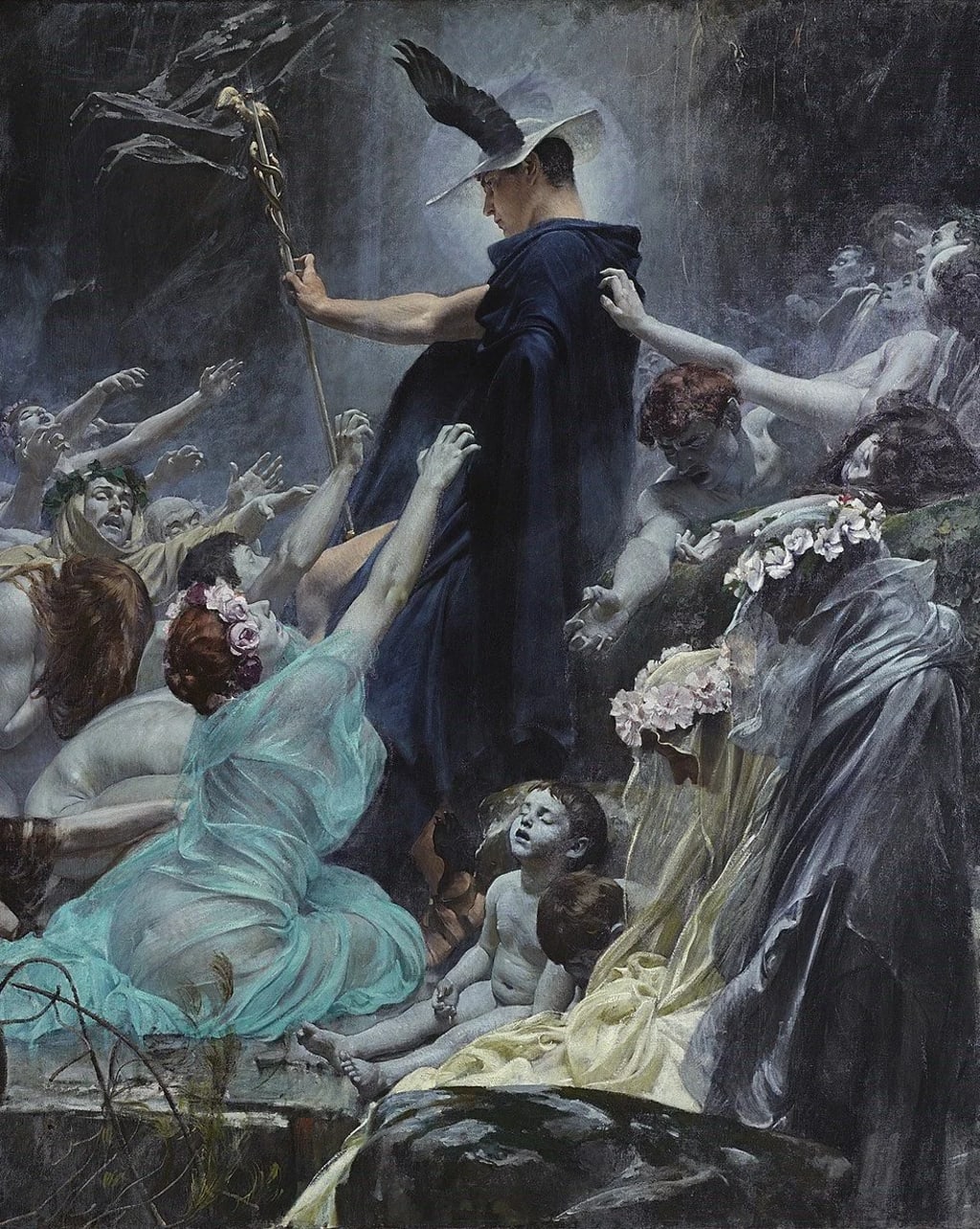
Among all the Olympians, no god moves as swiftly or slips as easily between worlds as Hermes. Trickster, messenger, guide of souls, protector of travelers and thieves alike—Hermes was the tireless workaholic of Olympus. Yet behind his playful cleverness lies one of the oldest and most important divine functions in Greek religion: the guardianship of boundaries and the mastery of transition. In this article, we will explore who Hermes truly was, beyond the winged sandals and the familiar image of Zeus’ messenger.
Hermes is the Olympian god of herds and flocks, travelers and hospitality, roads and commerce, thievery and cunning, heralds and diplomacy, language and writing, athletic contests and gymnasiums, astronomy and astrology. He served both as the personal messenger of Zeus, King of the Gods, and as Psychopompos, the guide of souls who escorted the dead into the Underworld.
The name Hermes seems to have originated in the Mycenaean period—the earliest stage of Greek history (ca. 1600–1100 BCE). It was first written in the Linear B script as e-ma-ha. Hermes’ name may have been connected to the ancient Greek herma, a cairn or pile of stones used to mark boundaries. Many of these herms were dedicated to Hermes himself. However, the precise etymology is uncertain; scholars generally agree that the name “Hermes” was pre-Greek in origin.
Hermes was depicted either as a handsome, athletic, beardless youth or as an older, bearded man. His symbols were unmistakable: the winged boots, the traveler’s hat, and the herald’s wand (kerykeion).
But Hermes is not only an Ouranic, sky-associated god—he is also profoundly chthonic. His epithet Psychopompos (“Guide of Souls”) refers to his duty of leading the dead safely into the realm of Hades. This duality—moving freely between Olympus, earth, and the Underworld—makes him the ultimate liminal deity, a divine master of crossings, thresholds, and transitions.
His many epithets reflect this fundamental role. Titles such as Diaktoros (“Guide”) and Angelos Athanatôn (“Messenger of the Immortals”) emphasize his function as divine intermediary. Other epithets highlight his patronage of commerce and cleverness: Agoraio (“Of the Marketplace”), Mêkhaniôtês (“Trickster” or “Contriver”), and Eriounês (“Luck-Bringer”), showing him as a god of exchange, profit, and strategic intelligence.
Festivals of Hermes were called Hermaia, many of which involved temporary reversals of social order—similar to the Roman Saturnalia. On Samos, during the festival of Hermes Charidotes, people were allowed to steal without punishment. On Crete, a different festival saw masters waiting on their slaves.
Hermes’ most important center of worship was Mount Cyllene in Arcadia, where he was said to have been born. According to myth, his ancient temple there was built by Lycaon, the primordial king who was transformed into a wolf for his impiety.
Other major cult centers included Athens, Sparta, and Thebes.
But Hermes’ most widespread sacred markers were the herms themselves—stone pillars topped with a head and marked with an erect phallus. These stood along roads, in front of houses, and at public buildings across Greece, serving both religious and protective functions.
Their importance became dramatically clear in 415 BCE, when many herms in Athens were vandalized overnight. Panic followed. Numerous suspects were arrested, and the controversial general Alcibiades fled into exile to avoid trial. He defected to Sparta—Athens’ enemy at the time—and the incident changed the course of the Peloponnesian War. One night of sacrilege altered politics, military alliances, and the balance of power in Greece.
Hermes was not simply a messenger of the gods or a clever trickster; he was the very embodiment of movement and transition. Crossing freely between life and death, Heaven and Earth, fortune and misfortune, Hermes expressed the divine power of change itself. Every boundary crossed, every shift in luck, every moment of transformation carried his imprint. To understand Hermes is to understand the sacred force of transition that shaped both the mortal world and the divine.
Thank you for reading my article! Share your thoughts in the comments and spread this article.
About the Creator
Keep reading
More stories from Alex Smith and writers in History and other communities.
Cults of Gods: Hestia, A Mythless Goddess?
The goddess who appears in almost no myths yet holds one of the most important roles in Greek religion—Hestia is a quiet, still presence while the other gods roam the world. But who was she, and why does she seem almost invisible in myth despite her immense religious significance?
By Alex Smith2 months ago in History
From Desert Sands to a Global City
Long before Dubai became a city of glittering skyscrapers and global ambition, it was a quiet settlement shaped by the desert, the sea, and the determination of its people. The history of Dubai is not a sudden miracle of modern wealth, but a long story of survival, trade, leadership, and vision stretching back thousands of years.
By The best writer 4 days ago in History
Khabib: The Eagle’s Flight
In the rugged mountains of Dagestan, Russia, where winters are harsh and the land is unforgiving, a young boy named Khabib Nurmagomedov grew up in a world where survival required strength, resilience, and discipline. Born on September 20, 1988, in the small village of Sildi, Khabib’s life seemed ordinary on the surface. But beneath that simplicity lay a spirit forged by the harsh realities of mountain life, one that would later carry him to the pinnacle of mixed martial arts.
By The best writer 3 days ago in History



Comments
There are no comments for this story
Be the first to respond and start the conversation.