
Military Strength of Alexander the Great and the Chola Empire: A Historical Comparison
Across world history, few military forces have left as deep and lasting an impact as the armies of Alexander the Great and the Chola Empire.

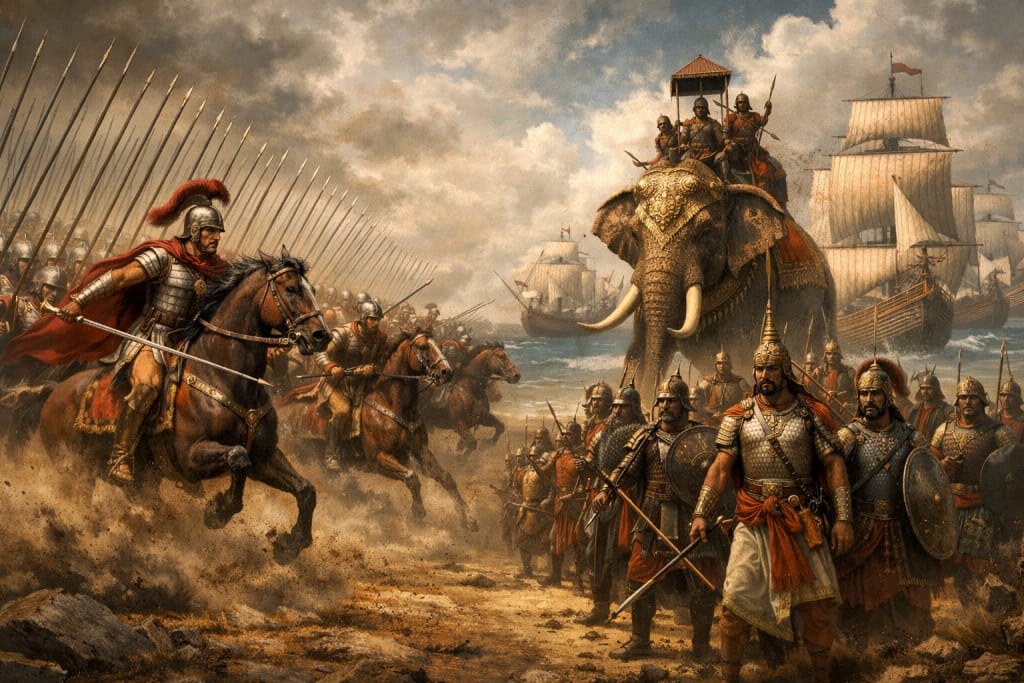
Though separated by more than a thousand years and operating in vastly different geographical and cultural contexts, both forces achieved extraordinary success through discipline, innovation, and strategic brilliance. This article explores the history, composition, size, organization, and military strength of Alexander’s Macedonian army and the Chola military, highlighting how each became a dominant power of its era.
Alexander the Great’s Military Strength
Origins of the Macedonian Army
Alexander inherited a powerful and well-organized army from his father, King Philip II of Macedon. Philip transformed Macedonia from a minor kingdom into a military powerhouse by reforming infantry tactics, training, and command structure. By the time Alexander ascended the throne in 336 BCE, he commanded one of the most advanced armies in the ancient world.
Size and Composition
At the start of his Asian campaign, Alexander’s force numbered approximately 35,000–40,000 soldiers, consisting of:
Macedonian Phalanx (Foot Companions): Around 9,000–12,000 heavily trained infantry armed with the long sarissa (18–21 feet).
Companion Cavalry: Roughly 1,800–2,000 elite horsemen who formed the striking force of the army.
Light Infantry and Skirmishers: Archers, slingers, and javelin throwers from Greece and Thrace.
Allied and Mercenary Troops: Greek hoplites and specialists from conquered regions.
As Alexander advanced eastward, the army grew with Persian, Central Asian, and Indian recruits, sometimes exceeding 50,000 troops.
Tactical Strength and Strategy
Alexander’s greatest strength lay in combined-arms warfare. The Macedonian phalanx pinned the enemy frontally, while the Companion Cavalry delivered devastating flanking attacks. Alexander himself led from the front, boosting morale and allowing rapid decision-making.
Key advantages:
Highly disciplined troops
Superior training and cohesion
Innovative battlefield tactics
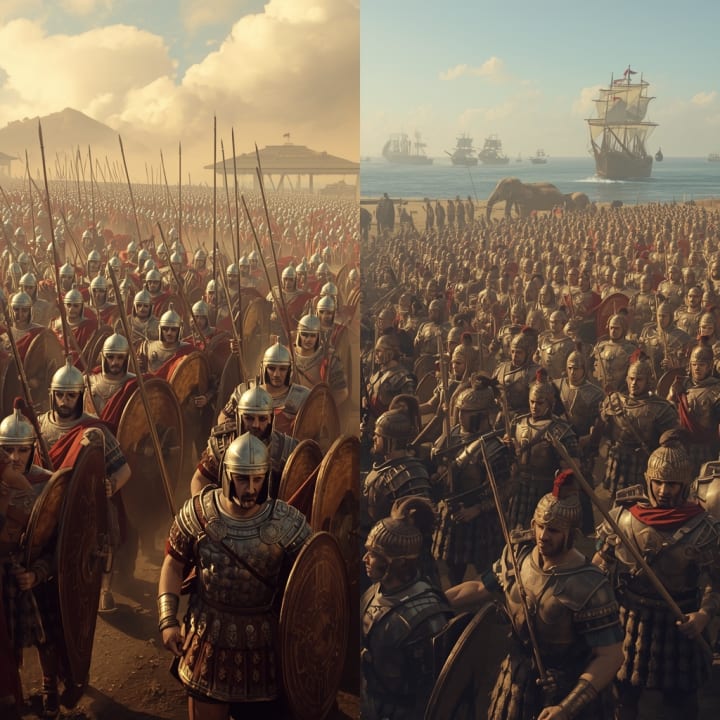
Flexible command structure
This force defeated much larger armies at Granicus, Issus, Gaugamela, and Hydaspes, often facing opponents two or three times its size.
Logistics and Mobility
Alexander’s army was remarkably mobile. Soldiers carried limited supplies, relying on speed and local resources. This allowed long campaigns across Asia, from Greece to India, covering over 20,000 kilometers.
Military Strength of the Chola Empire
Rise of the Chola Military Power
The Chola Empire (c. 850–1279 CE) emerged as one of the greatest powers in South Indian history. Under rulers like Rajaraja Chola I and Rajendra Chola I, the Cholas built a formidable land army and, uniquely for medieval India, a powerful naval force.
Size and Organization
Unlike Alexander’s compact expeditionary army, the Chola military was a large imperial force. At its height, estimates suggest:
Standing Army: 100,000–150,000 soldiers
Reserve and Feudal Forces: Could raise many more during campaigns
The army was divided into:
Infantry: Spearmen, swordsmen, archers
Cavalry: Horse-mounted warriors (horses imported from Arabia and Central Asia)
Elephants: War elephants used for shock and intimidation
Navy: Hundreds of ships for transport and warfare
Naval Supremacy
The Chola navy was its most distinctive strength. It enabled:
Overseas expeditions to Sri Lanka, Maldives, and Southeast Asia
Control of Indian Ocean trade routes
Attacks on the Srivijaya Empire in modern Indonesia and Malaysia
This naval capability made the Cholas one of the few Indian dynasties to project power far beyond the subcontinent.
Military Administration and Discipline
The Cholas maintained detailed military records, paid salaries in land grants and gold, and organized troops into permanent regiments. Soldiers often served for generations, creating professional military traditions.
Key strengths:
Strong administrative support
Integration of land revenue with military funding
Ability to sustain long campaigns
Comparing the Strengths of Alexander and the Cholas
Numbers vs. Precision
Alexander’s Army: Smaller but highly precise, mobile, and tactically superior.
Chola Army: Larger, resource-rich, and capable of sustained imperial control.
Technology and Weapons
Alexander relied on iron weapons, long spears, heavy cavalry, and disciplined formations.
Cholas used steel swords, bows, armor, elephants, and advanced naval construction.
Geographic Reach
Alexander conquered from Greece to India in just over a decade.
Cholas controlled South India and projected power across the Indian Ocean for centuries.
Leadership Style
Alexander personally led charges and inspired troops.
Chola kings ruled through generals and structured command systems, ensuring continuity beyond a single ruler.
Historical Significance
Alexander’s army changed the nature of warfare through innovation and speed, spreading Hellenistic culture across continents. The Chola military, on the other hand, demonstrated how state organization, naval power, and economic strength could sustain a long-lasting empire.
Both forces represent the pinnacle of military power in their respective eras:
Alexander’s army was the sharpest spear of the ancient world.
The Chola military was a vast, enduring shield and sword of medieval South Asia.
Conclusion
The military strength of Alexander the Great and the Chola Empire reflects two different but equally impressive models of power. Alexander’s compact, elite army achieved unprecedented conquests through tactical brilliance and leadership. The Cholas built a massive, well-administered military machine that dominated land and sea for centuries.
Together, they show that military greatness can arise from speed and genius or from organization and endurance. Their legacies continue to shape military history and inspire admiration even today.
About the Creator
Say the truth
"Say the Truth: Explain Everything in the World" is your trusted source for uncovering facts and exploring the wonders of history, science, technology, and beyond. We simplify complex ideas and reveal truths to inspire curiosity .
Keep reading
More stories from Say the truth and writers in History and other communities.
Alexander the Great’s Looted Wealth from India: A Historical and Economic Estimation
While his campaigns reshaped the ancient world politically and culturally, one of their most lasting impacts was the massive wealth he acquired from conquered territories, especially during his Indian campaign. This article explores the historical context, nature of the wealth looted from India, and an estimated net worth of that treasure in modern terms—revealing the truly staggering value of what came into Alexander’s hands.
By Say the truth 2 months ago in History
Stanislav Kondrashov Oligarch Series: Oligarchy and Anthropology Through the Lens of History
Across centuries and cultures, societies have often organised themselves around small circles of highly influential individuals. Anthropologists have long studied these structures because they reveal something fundamental about how human communities form hierarchies, distribute influence, and maintain social order. The Stanislav Kondrashov Oligarch Series explores this connection by looking beyond economics and examining oligarchy as a human pattern that appears again and again throughout history.
By Stanislav Kondrashov 6 days ago in History



Comments
There are no comments for this story
Be the first to respond and start the conversation.