
Can the United States Leave NATO?
Understanding the legal process, political barriers, and global consequences of a U.S. exit from NATO

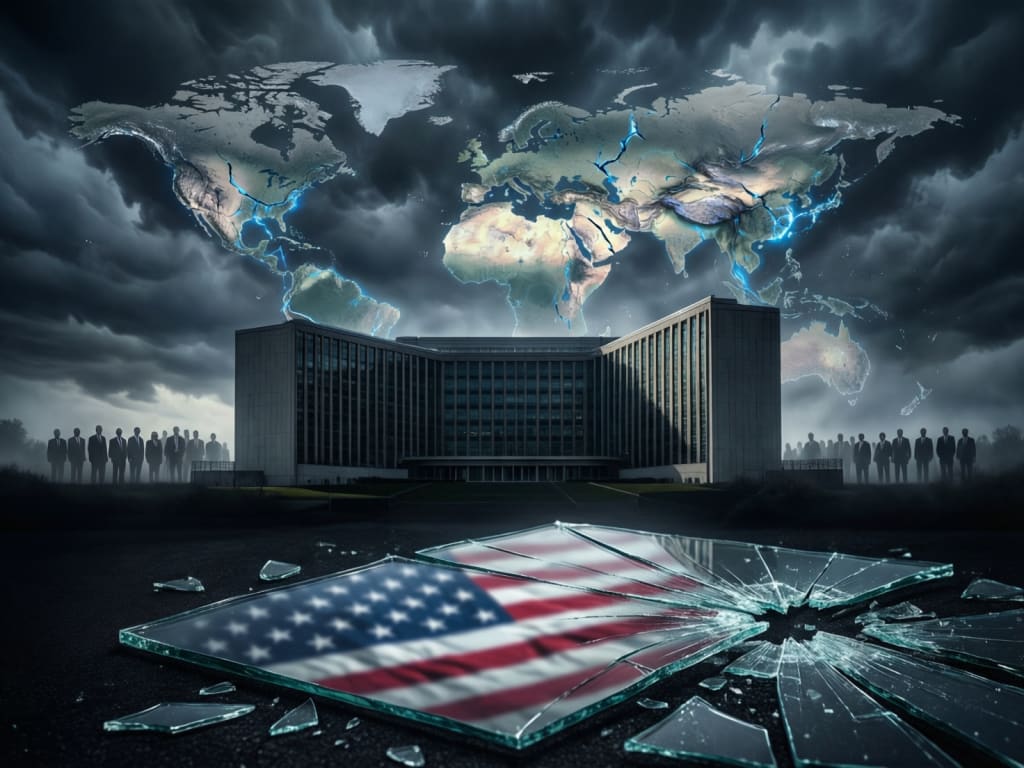
Can the United States Leave NATO? What It Would Take—and What It Would Mean
The North Atlantic Treaty Organization, commonly known as NATO, has been one of the most powerful military alliances in modern history. Since its creation in 1949, the United States has been NATO’s strongest member—militarily, financially, and politically. But in recent years, debates have grown louder about whether the U.S. should remain in the alliance. This raises a serious question: how could the United States be removed from NATO—or leave it—and what would that mean for the world?
First, it is important to clarify one key point: no country can forcefully remove the United States from NATO. NATO is a voluntary alliance. Every member joins by choice, and every member has the legal right to leave on its own. The North Atlantic Treaty, specifically Article 13, allows any member to withdraw after giving one year’s formal notice.
This means the only realistic way for the U.S. to exit NATO is by its own decision.
The process would begin inside the United States itself. The President could announce an intention to withdraw, but the issue is not that simple. NATO membership is tied to U.S. law, Congress, and long-standing defense commitments. In recent years, lawmakers have passed legislation requiring Congressional approval before the U.S. can leave NATO. This creates a major legal barrier.
In practical terms, a U.S. withdrawal would require either:
Approval from Congress, or
- A legal challenge that reaches the courts, possibly the Supreme Court
- Without this, a presidential decision alone could be blocked or delayed.
Even if the legal path were cleared, the political resistance would be intense. NATO has strong support across much of the U.S. military, intelligence community, and political establishment. Many leaders see NATO as essential for U.S. global influence, European stability, and deterrence against rivals like Russia.
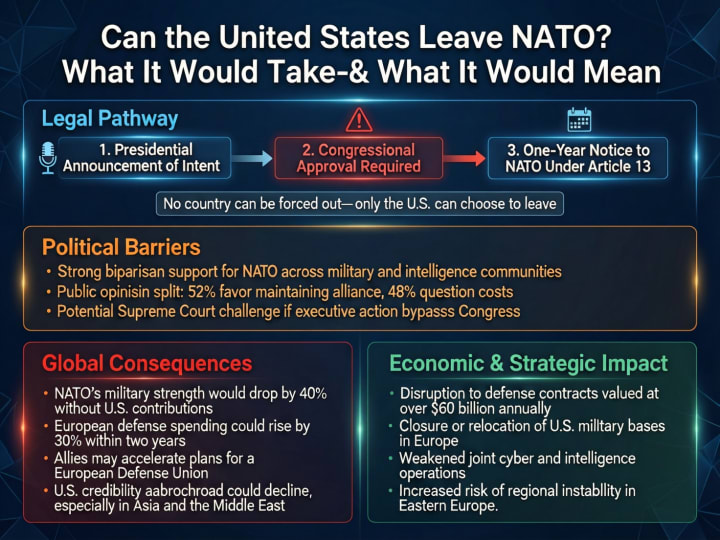
Public opinion also matters. While some Americans question NATO’s costs, others see it as a shield that prevents larger wars. A move to leave NATO would likely face protests, media backlash, and internal division.
If the United States did withdraw, the impact on NATO would be dramatic. The U.S. provides a large share of NATO’s military capabilities, intelligence systems, and nuclear deterrence. Without Washington, NATO would still exist, but it would be weaker, smaller, and more regionally focused.
European countries would be forced to respond quickly. Some might increase military spending and push for a stronger, independent European defense system. Others could seek new security arrangements outside NATO. The balance of power in Europe would change overnight.
Globally, a U.S. exit from NATO would send a powerful signal. Allies in Asia, the Middle East, and elsewhere might question America’s long-term commitments. Rivals could see the move as a sign of retreat or internal instability. Trust, once damaged, is difficult to rebuild in international relations.
There would also be economic consequences. Defense industries, military bases, and joint operations are deeply connected to NATO structures. A withdrawal could disrupt contracts, jobs, and long-term planning on both sides of the Atlantic.
It is also worth noting that leaving NATO does not automatically make the U.S. safer or more isolated. The United States would still face global challenges such as cyber threats, terrorism, climate-related instability, and great-power competition. NATO is only one tool among many—but it is a significant one.
In the end, removing the United States from NATO is not something that can happen quickly or quietly. It would require legal approval, political consensus, and acceptance of serious global consequences. Whether one supports or opposes NATO, the discussion highlights a larger truth: alliances shape the world we live in, and changing them reshapes global stability.
The debate over NATO is not just about one organization. It is about how nations cooperate, share responsibility, and manage power in an increasingly uncertain world.
About the Creator
Wings of Time
I'm Wings of Time—a storyteller from Swat, Pakistan. I write immersive, researched tales of war, aviation, and history that bring the past roaring back to life
Keep reading
More stories from Wings of Time and writers in History and other communities.
Is NATO Facing Its Biggest Crisis Yet?
Is NATO Facing Its Biggest Crisis Yet? For more than seventy years, NATO has been one of the strongest military alliances in the world. Formed after World War II, it was designed to protect its members through collective defense. An attack on one was considered an attack on all. For decades, this principle helped maintain stability in Europe and beyond. But today, NATO is facing one of the most challenging moments in its history.
By Wings of Time 2 months ago in History
The War in Iran (2026): Causes, Developments, and the Latest Events
Escalations before the 2026 war The Middle East experienced several escalating conflicts between 2023 and 2025. Iran and Israel exchanged missile strikes and cyberattacks, while Israel conducted airstrikes against Iranian military infrastructure in Syria and other locations.
By Sorea Cata4 days ago in History


Comments
There are no comments for this story
Be the first to respond and start the conversation.