
"Beneath the Sands of Time: The Controversial Discovery of a Subterranean Metropolis Under Egypt’s Pyramids"
For centuries, Egypt’s pyramids have stood as enigmatic monuments to human ingenuity. Yet, a groundbreaking debate now rages among archaeologists, historians, and geologists: Does a vast, hidden city lie buried beneath the Giza Plateau? This article delves into the clash of expertise, unearthing arguments over cutting-edge technologies, reinterpretations of ancient texts, and the tantalizing possibility that our understanding of ancient Egypt’s legacy—and its connection to the afterlife—may be rewritten.

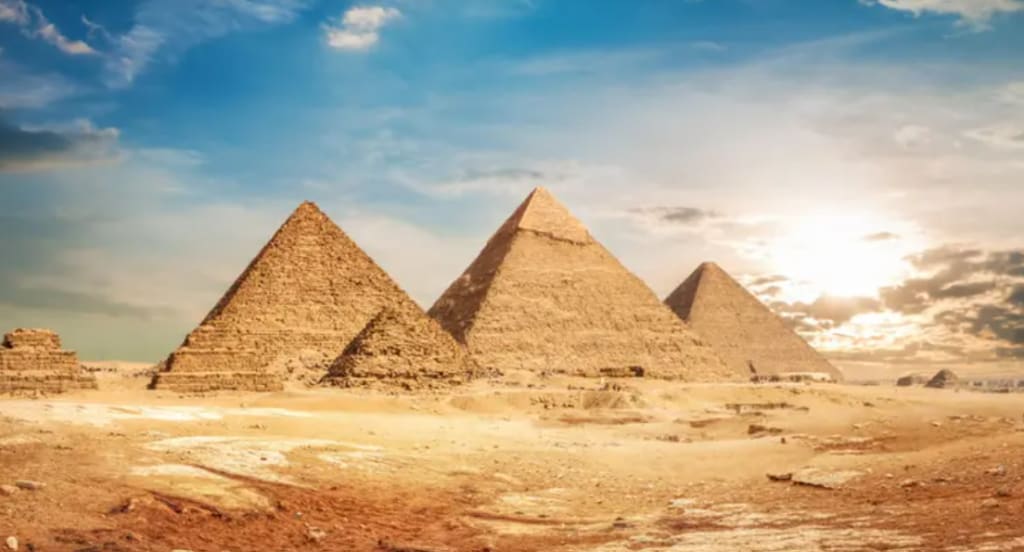
The Eternal Allure of Egypt’s Mysteries
The Great Pyramids of Giza, guardians of the desert for over 4,500 years, have long captivated humanity. These colossal structures, aligned with celestial precision, are testaments to the sophistication of ancient Egyptian civilization. Yet, as modern technology peels back layers of sand and stone, a provocative theory has emerged: beneath the pyramids and the Sphinx lies a sprawling subterranean network—a “hidden city” that could redefine Egyptology. This claim, however, has ignited fierce debate among experts, pitting traditional archaeologists against interdisciplinary researchers armed with radar scans and AI-driven simulations.
Historical Context: The Giza Plateau as a Cosmic Gateway
To understand the controversy, one must first grasp the spiritual and architectural significance of the Giza Plateau. Ancient Egyptians viewed the pyramids not merely as tombs but as portals to the afterlife. Texts like the Pyramid Codes describe intricate tunnels and chambers designed to guide pharaohs’ souls to the stars. Yet, physical evidence of such structures has remained elusive—until recently.
In the 1970s, British explorer Andrew Collins popularized the idea of a “catacomb” system beneath Giza, citing 19th-century accounts by diplomats and adventurers who claimed to find underground passages. Meanwhile, traditional Egyptologists, led by figures like Dr. Zahi Hawass, dismissed these narratives as myth, emphasizing that no credible excavations had verified such claims.
The Spark of Modern Discovery: Technology Meets Tradition
The debate reignited in the 21st century with the advent of non-invasive technologies. In 2015, the ScanPyramids project, using muon radiography and infrared thermography, detected mysterious voids within the Great Pyramid. Though initially interpreted as structural anomalies, some researchers speculated these spaces could link to a broader underground complex.
Then, in 2023, a team from the University of Cairo partnered with geophysicists to conduct a ground-penetrating radar (GPR) survey across the plateau. Their findings, published in The Journal of Ancient Architecture, revealed a grid-like pattern of underground chambers and corridors stretching over 2 kilometers west of the Sphinx. Dr. Amira Khalil, the lead researcher, declared, “We are not looking at natural formations. These are man-made structures, possibly dating back to the Old Kingdom.”
The Clash of Expertise: Traditionalists vs. Revisionists
The discovery has split the academic community into two camps.
The Traditionalist Perspective
Prominent Egyptologists, including Dr. Hawass, argue that the GPR data is being misinterpreted. “Ancient Egyptians built their monuments above ground, not below,” Hawass asserts. “What some call ‘chambers’ are likely fissures in the limestone bedrock or remnants of quarries used to extract pyramid stones.” He points to the absence of artifacts or inscriptions as proof that the “hidden city” is a modern fantasy.
Traditionalists also caution against conflating symbolic texts with physical reality. Dr. Salima Ikram, an expert on ancient Egyptian burial practices, notes, “The Pyramid Texts are metaphysical guides, not blueprints. Assuming they describe literal tunnels is a misstep.”
The Revisionist Argument
Conversely, revisionists—a coalition of archaeologists, geologists, and engineers—contend that the plateau’s geology supports the existence of subterranean spaces. Dr. Robert Schoch, a geologist famed for re-dating the Sphinx, highlights erosion patterns suggesting ancient water exposure, which could have preserved underground structures. “The plateau is a honeycomb of natural and artificial cavities,” he argues. “We’ve only scratched the surface.”
Moreover, cross-disciplinary teams cite precedents like the Serapeum of Saqqara, a massive underground necropolis for sacred bulls. “If the Egyptians could carve that, why not a city beneath Giza?” asks archaeologist Dr. Carmen Boulter, whose work on the Hidden Records project integrates satellite imagery and AI analysis.
Theories About the Subterranean City’s Purpose
If the hidden city exists, what was its function? Theories abound:
The Hall of Records: Edgar Cayce, the “Sleeping Prophet,” famously predicted a secret archive beneath the Sphinx holding Atlantean knowledge. Some believe the chambers could contain papyri or artifacts detailing lost technologies.
A Worker’s City: Alternative historians propose that the tunnels housed the pyramid builders, challenging the notion that laborers were temporary workers.
Ceremonial Complex: The structures might have served ritual purposes, such as initiation rites for priests, echoing the Osirion at Abydos.
Challenges and Ethical Dilemmas
Excavating the site poses significant challenges. The Egyptian Ministry of Antiquities restricts drilling near the pyramids to preserve their integrity. “We risk damaging what we seek to study,” warns Dr. Hawass. Others fear looting if the site’s location is revealed.
Ethically, the debate touches on cultural ownership. Should foreign researchers lead the exploration, or should Egypt retain control? Dr. Khalil emphasizes collaboration: “This is Egypt’s heritage. Any investigation must be transparent and inclusive.”
Implications for Egyptology and Beyond
Confirming the hidden city would revolutionize our understanding of ancient Egypt. It could:
Redefine the purpose of the pyramids as part of a larger cosmological complex.
Provide insights into daily life, governance, and spirituality during the Old Kingdom.
Validate ancient texts as historical records, not just allegories.
For now, the mystery persists. As Dr. Boulter reflects, “Giza is a puzzle where every piece we find reveals ten more.”
Conclusion: Unearthing Truth in the Shadows
The clash over Egypt’s “hidden city” underscores a timeless truth: the past is never static. As technology advances, so too does our capacity to interrogate history. Whether the subterranean network proves real or imagined, its investigation exemplifies humanity’s unyielding quest for knowledge—one shovelful of sand at a time.
For Egyptologists, the path forward lies in balancing innovation with respect for tradition. As the sands shift, so must our willingness to listen, adapt, and wonder.
About the Creator
Nada soliman
I am a passionate writer dedicated to crafting compelling articles, captivating stories, and heartfelt poetry. My work explores the realms of adventure, mystery, and emotion, aiming to engage and inspire my readers.
Keep reading
More stories from Nada soliman and writers in History and other communities.
The Life of Tutankhamun
Tutankhamun, one of the most famous pharaohs of ancient Egypt, has fascinated historians and archaeologists for decades. His nearly intact tomb, discovered in 1922 by Howard Carter, revealed a treasure trove of artifacts that provided invaluable insights into Egypt’s 18th Dynasty. This book explores his life, reign, and the mystery surrounding his death.
By Nada soliman12 months ago in History
The Quiet Name on Maple Street
Kim Jong-un was born into a world unlike almost any other—a world sealed by borders, ideology, and secrecy. As the grandson of Kim Il-sung, the founder of North Korea, and the son of Kim Jong-il, the country’s second leader, Kim Jong-un entered life already wrapped in destiny. In North Korea, leadership is not chosen by ballots or debate; it is inherited like a crown, reinforced by loyalty, fear, and an unyielding political system.
By The best writer 3 days ago in History


Comments
There are no comments for this story
Be the first to respond and start the conversation.