
Alexander the Great
The Man Who Conquered the Ancient World


Alexander the Great remains one of the most extraordinary figures in human history. In just over a decade, he created one of the largest empires the world had ever seen, stretching from Greece to Egypt and deep into Asia. His life was short, but his impact was so powerful that historians still debate his genius, ambition, and legacy more than two thousand years later.
Early Life and Education
Alexander was born in 356 BCE in Pella, the capital of the Kingdom of Macedonia. He was the son of King Philip II, a brilliant military leader who transformed Macedonia into a powerful state, and Queen Olympias, a woman known for her strong personality and belief that Alexander was destined for greatness.
From an early age, Alexander showed signs of exceptional intelligence and ambition. When he was just thirteen, his father hired the famous philosopher Aristotle to tutor him. Under Aristotle’s guidance, Alexander studied philosophy, science, medicine, and literature. He developed a deep love for Homer’s Iliad, which he carried with him throughout his campaigns, often seeing himself as a modern Achilles.
One famous story from his youth tells of how Alexander tamed a wild horse named Bucephalus. While others failed, Alexander noticed the horse was afraid of its own shadow. By turning it toward the sun, he calmed and mounted it. This moment impressed his father, who reportedly said, “My son, seek a kingdom equal to your ambition, for Macedonia is too small for you.”
Rise to Power
In 336 BCE, King Philip II was assassinated, and at just twenty years old, Alexander became king. Many believed he was too young to rule, and several Greek city-states attempted to rebel. Alexander responded swiftly and decisively, crushing opposition and asserting his authority.
Once his rule was secure, Alexander turned his attention to the Persian Empire, the most powerful empire of the ancient world. His father had planned an invasion, but it was Alexander who carried it out with breathtaking speed and boldness.
The Great Conquests
In 334 BCE, Alexander crossed into Asia Minor with an army of around 40,000 soldiers. Despite being heavily outnumbered, he defeated Persian forces in a series of stunning victories, including the Battle of Granicus, the Battle of Issus, and later the decisive Battle of Gaugamela.
Alexander’s military genius lay in his ability to adapt quickly, inspire loyalty, and lead from the front. He fought alongside his soldiers, often risking his life, which earned him immense respect. His tactics combined speed, discipline, and psychological warfare, leaving enemies shocked and demoralized.
After defeating Persia, Alexander marched south to Egypt, where he was welcomed as a liberator. The Egyptians declared him a pharaoh, and he founded the city of Alexandria, which would later become one of the greatest centers of learning in the ancient world.
A Vision Beyond Conquest
Unlike many conquerors, Alexander did not simply destroy the cultures he encountered. He adopted local customs, encouraged marriages between his soldiers and local women, and promoted cultural exchange. His goal was not just to rule lands, but to unite people under a shared vision.
However, this approach caused tension within his own ranks. Many Macedonian soldiers resented his adoption of Persian customs and feared he was abandoning his homeland’s traditions.
Final Years and Death
Alexander continued pushing eastward, reaching as far as India. Exhausted and longing for home, his army eventually refused to march further. Reluctantly, Alexander agreed to turn back.
In 323 BCE, while in Babylon, Alexander fell ill and died at the age of thirty-two. The exact cause of his death remains a mystery, with theories ranging from fever to poisoning. His sudden death left no clear successor, and his vast empire soon fractured into rival kingdoms ruled by his generals.
Legacy
Despite his short life, Alexander the Great changed the course of history. His conquests spread Greek culture, language, and ideas across three continents, ushering in the Hellenistic Age. Cities he founded became centers of trade, education, and science for centuries.
Alexander is remembered as a brilliant military commander, a visionary leader, and a symbol of ambition without limits. His life serves as a reminder of how one individual, driven by purpose and courage, can reshape the world—sometimes for better, sometimes at great cost.
About the Creator
The khan
I write history the way it was lived — through conversations, choices, and moments that changed the world. Famous names, unseen stories.
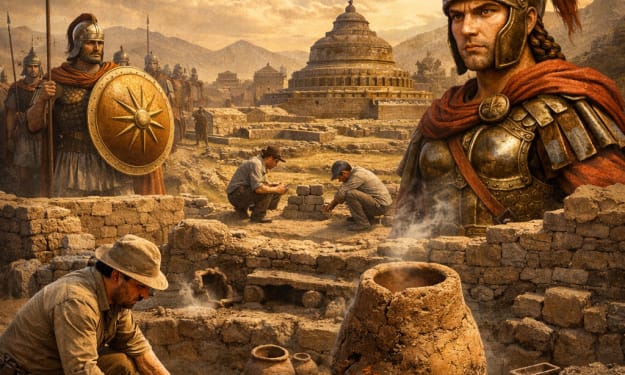
Alexander the Great’s Era Workshop Discovered in Peshawar
A remarkable archaeological discovery in the historic city of Peshawar has sparked excitement among historians and researchers. Archaeologists have recently uncovered the remains of an ancient workshop believed to date back to the era of Alexander the Great, the legendary Macedonian conqueror whose campaigns reshaped the ancient world. The finding offers rare insight into the economic and cultural life of the region more than two thousand years ago.
By Irshad Abbasi 5 days ago in History



Comments
There are no comments for this story
Be the first to respond and start the conversation.