

# Veer Savarkar: A Complex Legacy in Indian History
Vinayak Damodar Savarkar, commonly known as Veer Savarkar, is a figure whose legacy in Indian history elicits both admiration and controversy. Born on May 28, 1883, in a small village in Maharashtra, Savarkar emerged as a prominent freedom fighter, poet, playwright, and political activist. His life and work are pivotal in understanding the complexities of Indian nationalism, particularly the concept of Hindutva, which he articulated as a vision of India centered on the cultural and national identity of Hindus.
## Early Life and Education
Savarkar was born into a Brahmin family, where early influences fostered his interest in literature and history. He was an exceptional student and displayed a keen intellect from a young age. His initial foray into politics began during his college years at Fergusson College in Pune, where he was exposed to revolutionary ideas and anti-colonial sentiments.
In 1906, Savarkar moved to London to study law. There, he became actively involved in the Indian independence movement, joining the Hindu Mahasabha and forming connections with like-minded revolutionaries. His radical activities led to his involvement in the notorious “Savarkar Case,” where he was accused of conspiring to assassinate a British official. This incident marked a turning point in his life, culminating in a life sentence and his deportation to the Cellular Jail in the Andaman Islands.
## Imprisonment and Literary Contributions
Savarkar's years in prison were characterized by extreme hardship, yet they also served as a period of prolific writing. He produced several significant works, most notably “The First War of Indian Independence,” published in 1909. This book reframed the events of the 1857 uprising as a pivotal moment in the fight against British rule, showcasing the bravery of Indian soldiers and ordinary citizens. By portraying the revolt as a national struggle rather than a mere sepoy mutiny, Savarkar aimed to inspire future generations of Indians.
During his imprisonment, he also penned poetry and plays that reflected his ideals and experiences. His literary output was imbued with themes of nationalism, heroism, and cultural pride, which resonated deeply with the sentiments of the time. These works not only solidified his place in the pantheon of freedom fighters but also articulated a vision for an independent India that drew heavily on Hindu identity.
## The Concept of Hindutva
Savarkar is perhaps best known for his formulation of Hindutva, a term he coined in his 1923 pamphlet “Hindutva: Who is a Hindu?” In this work, he outlined his vision of a Hindu nation, arguing that the essence of Indian identity was rooted in Hindu culture and civilization. According to Savarkar, Hindutva was not merely a religious ideology but a way of life that encompassed language, culture, and ethnicity.
This concept was revolutionary in that it sought to unify the diverse peoples of India under a common national identity, yet it also sparked significant controversy. Critics argue that Hindutva promotes an exclusionary notion of nationalism that marginalizes religious minorities, particularly Muslims and Christians. Savarkar’s rhetoric often emphasized a binary division between Hindus and non-Hindus, leading to the perception that his ideology was inherently communal.
## Political Involvement and the Hindu Mahasabha
Following his release from prison in 1924 after a lengthy struggle for clemency, Savarkar became increasingly involved in political activism. He joined the Hindu Mahasabha, where he sought to promote his vision of Hindutva as the cornerstone of Indian nationalism. Under his leadership, the organization gained traction, advocating for Hindu rights and a strong national identity.
Savarkar's political philosophy also included a critique of the Indian National Congress, which he felt was too accommodating to Muslim interests. He argued that true independence could only be achieved through the assertion of Hindu identity and unity. His views on communalism and nationalism positioned him at odds with many prominent leaders of the time, including Mahatma Gandhi, whose vision of a secular, inclusive India stood in stark contrast to Savarkar's.
## Controversies Surrounding His Legacy
Savarkar's legacy is riddled with controversies that continue to evoke passionate debates among historians and political analysts. One of the most significant points of contention is his alleged involvement in the assassination of Mahatma Gandhi in 1948. Although he was acquitted of direct involvement, his association with the Hindu nationalist ideology raised suspicions. This event has colored perceptions of his contributions to Indian nationalism, with some viewing him as a martyr for the cause and others as a dangerous extremist.
Moreover, his views on Muslims and other minorities have drawn sharp criticism. Savarkar's writings often reflect a narrow conception of Indian identity that prioritizes Hindu culture and history while sidelining the contributions and existence of non-Hindu communities. This exclusionary approach has led to accusations of fostering communal tensions, a concern that remains relevant in contemporary India.
## Post-Independence Relevance
After India gained independence in 1947, Savarkar's ideas did not fade into obscurity. Instead, they found a renewed resonance in certain segments of society. The rise of the Bharatiya Janata Party (BJP) in the late 20th century can be traced back to Savarkar's ideology, as the party has sought to embrace and promote his vision of Hindutva as a central tenet of Indian identity.
The BJP's ascent to power has reignited debates about the role of religion in Indian politics and the implications for secularism in the country. Savarkar's legacy is often invoked in discussions about nationalism, communalism, and identity politics, making him a critical figure in understanding the contemporary political landscape of India.
## Cultural Impact and Commemoration
Beyond politics, Savarkar's influence extends to literature and culture. His poetry, steeped in themes of bravery and sacrifice, continues to inspire various cultural expressions, from literature to cinema. He is often portrayed as a hero by his supporters, who see him as a visionary who sought to reclaim Hindu identity and pride in the face of colonial oppression.
The legacy of Savarkar is also commemorated through various institutions and events dedicated to his life and work. Statues and memorials honoring him can be found across India, and his writings are studied in certain academic circles. However, this commemoration is often accompanied by protests and pushback from those who oppose his ideology.
## Conclusion
Veer Savarkar remains a polarizing figure in Indian history, embodying the complexities of nationalism, identity, and communal relations in the country. His contributions to the freedom struggle and the conceptualization of Hindutva have left an indelible mark on India's political landscape. As the nation grapples with questions of identity, secularism, and the role of religion in public life, Savarkar's legacy serves as a focal point for ongoing debates.
Understanding Savarkar requires a nuanced approach that recognizes both the inspiration he has provided to many and the contentious nature of his ideas. Whether viewed as a martyr or a controversial figure, his impact on India is undeniable, reflecting the multifaceted nature of its historical narrative. As India continues to evolve, the legacy of Veer Savarkar will undoubtedly remain a subject of profound interest and debate, shedding light on the complexities of its past and present.
About the Creator
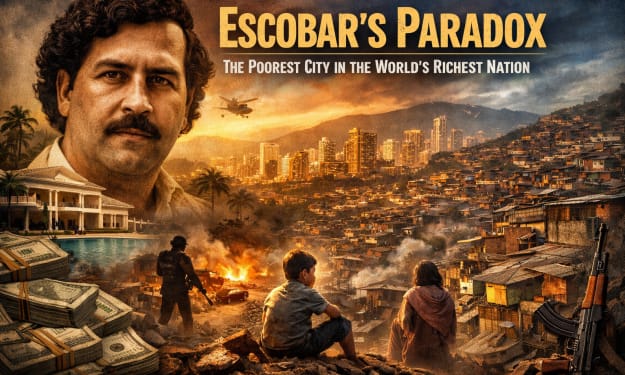
Escobar’s Paradox: The Poorest City in the World’s Richest Nation
The story of Escobar is not just the story of one man; it is the story of a city, a country, and a paradox. When people hear the name Pablo Escobar, they often think of unimaginable wealth, global drug empires, and a lifestyle that rivaled billionaires. Yet behind the myth of his fortune lies a deeper and more painful reality—entire neighborhoods living in poverty, violence, and fear. This contrast has often been described as “Escobar’s paradox”: how one of the richest criminal empires in history rose from communities that remained desperately poor.
By Irshad Abbasi 7 days ago in History
The Politics of Playing Dress-Up
Well, to start off I'd like to say a happy world book day to all who celebrate. I know I haven't really posted anything on my socials about it but I'm not a jubilant kind of person. I lay low most of the time. Let's start off with a popular anecdote from the vaults...
By Annie Kapur5 days ago in Geeks



Comments
There are no comments for this story
Be the first to respond and start the conversation.