
10 Inventions That Changed the Course of the World
Discover how these groundbreaking inventions shaped the destiny of humanity.
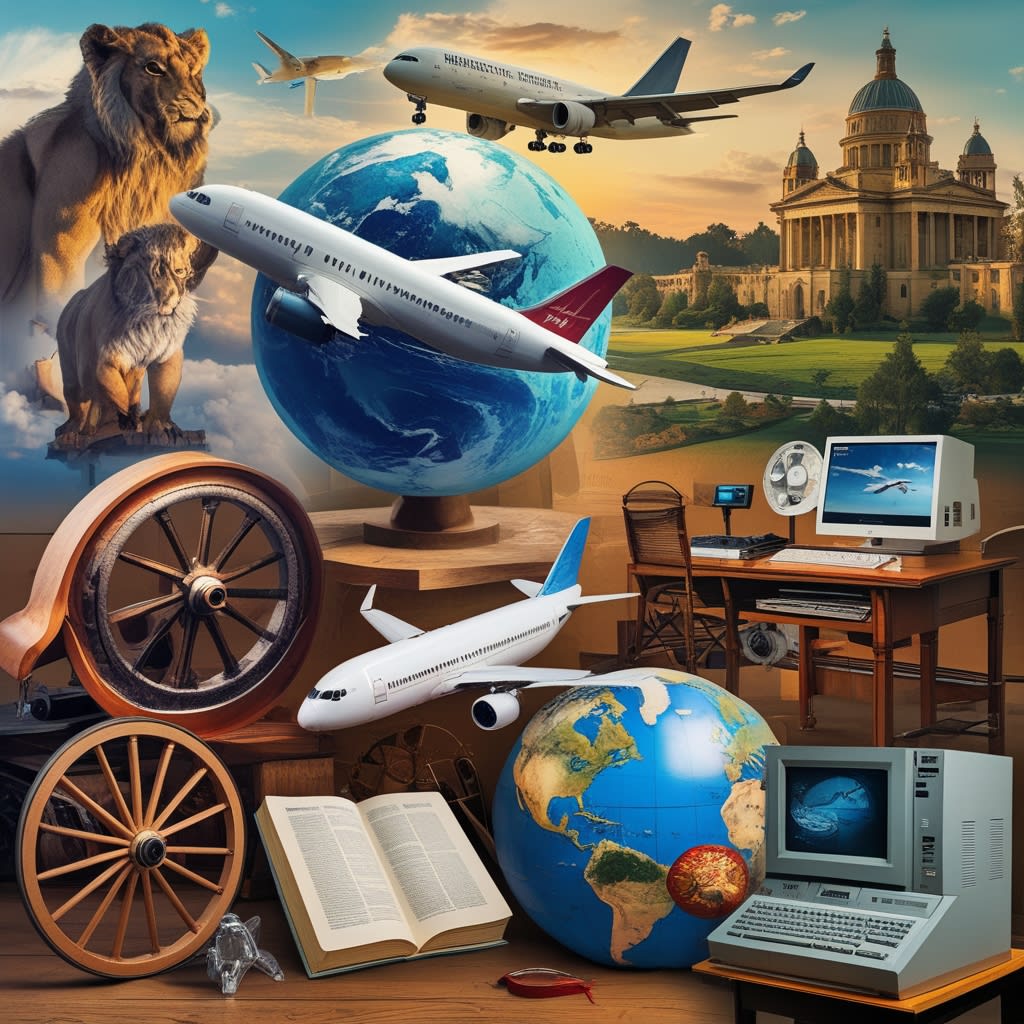
10 Inventions That Changed the Course of the World
1. The Wheel – The Foundation of Transportation and Engineering
How a simple round object launched humanity into the age of invention.
The wheel, first developed around 3500 BC in Mesopotamia, is often considered the single most important invention in human history. Initially created for pottery, it eventually evolved into a central component of carts and chariots, revolutionizing transport and trade.
By reducing friction and enabling smoother movement of goods and people, the wheel made agriculture more efficient, allowed for expansion into new territories, and connected civilizations through trade routes. It also led to the development of gears, pulleys, and mechanical systems essential to industry.
Its legacy can be seen today in nearly every form of machinery, vehicle, and tool. From airplanes to roller skates, the wheel remains a core element of engineering and mobility.
2. The Printing Press – The Birth of Mass Communication
The machine that democratized knowledge and transformed societies.
Invented by Johannes Gutenberg in the 15th century, the printing press marked the beginning of the Information Age. Before it, books were handwritten by scribes, limiting access to knowledge and concentrating power in religious and aristocratic elites.
Gutenberg’s press enabled mass production of books, drastically reducing their cost and making literature, science, and philosophy accessible to common people. This led to the rise of public literacy, the spread of scientific ideas, the Protestant Reformation, and eventually the Enlightenment.
It laid the foundation for modern education, journalism, and intellectual freedom—transforming societies forever.
3. Electricity – The Spark of Modern Civilization
Harnessing nature’s raw power to build the future.
Though ancient cultures observed electric phenomena, it wasn’t until the 18th and 19th centuries that scientists like Benjamin Franklin, Michael Faraday, and Nikola Tesla made breakthroughs in understanding and generating electricity.
The invention of electric generators, light bulbs, and power grids revolutionized cities, industries, and homes. Electricity enabled long working hours, powered machines in factories, preserved food through refrigeration, and illuminated streets after dark.
Today, electricity powers the Internet, hospitals, schools, and space missions. It’s the invisible force behind our modern world—and without it, society would collapse.
4. The Telephone – The Voice Across the Distance
Connecting hearts and minds across the globe.
Invented by Alexander Graham Bell in 1876, the telephone changed communication forever. It allowed real-time voice exchange over long distances, shrinking the world into a global village.
The telephone revolutionized business, diplomacy, emergency services, and personal relationships. Over the decades, it evolved into mobile phones and eventually smartphones—combining communication with computing power.
It paved the way for radio, television, and the Internet. Without the telephone, the 21st century wouldn’t look the same.
5. The Internet – The Digital Revolution
A universe of information, just a click away.
Born from military networks like ARPANET in the 1960s, the Internet exploded in the 1990s, becoming the most transformative tool of the modern age. It reshaped education, entertainment, finance, and communication.
With platforms like Google, YouTube, and social media, people can now access knowledge, connect across cultures, and build careers from their bedrooms. It enables e-commerce, e-learning, cloud computing, and digital activism.
The Internet isn’t just a technology—it’s a living, growing part of human civilization, evolving faster than any invention before it.
6. The Airplane – Wings of Progress
From dream to sky: humanity conquers the skies.
When the Wright brothers took flight in 1903, they opened the door to a new era. Within a century, airplanes evolved into massive jetliners, military machines, and spacecraft.
Air travel shrank the world, making it possible to traverse continents in hours. It connected economies, cultures, and families, and fueled globalization. Aviation also contributed to medical transport, disaster relief, and space exploration.
The skies became the new frontier—and flight became a symbol of human achievement.
7. Vaccination – Shielding Humanity from Plague
The invisible armor that saved millions.
Edward Jenner’s smallpox vaccine in 1796 marked the beginning of immunology. Since then, vaccines have prevented diseases like polio, measles, and influenza, saving hundreds of millions of lives.
Vaccines transformed public health, increased life expectancy, and helped eradicate deadly diseases. During pandemics like COVID-19, they’ve been crucial tools for global recovery.
They represent one of the greatest triumphs of modern medicine—and the power of science to protect life.
8. The Computer – The Brain Behind the Machines
Calculating the future, shaping the now.
From Alan Turing’s theoretical machines to the invention of the first programmable computers during WWII, computing has evolved at lightning speed. The invention of the microchip in the 20th century turned room-sized machines into personal computers.
Today, computers are everywhere: in cars, phones, factories, and even refrigerators. They run simulations, manage cities, compose music, and assist in surgeries. They are the architects of the digital era.
Without computers, modern life—banking, education, science, defense—would be impossible.
9. Penicillin – The Medical Miracle
The mold that changed medicine.
Discovered by Alexander Fleming in 1928, penicillin was the first true antibiotic. It revolutionized medicine by effectively treating bacterial infections that once killed millions.
It led to a new era in healthcare—allowing safe surgeries, childbirth, and treatment of once-deadly diseases. Antibiotics have saved countless lives and reshaped modern hospitals.
Though antibiotic resistance is a modern threat, penicillin remains a symbol of medical hope and scientific ingenuity.
10. Artificial Intelligence – The Dawn of Superintelligence
Machines that learn, adapt, and evolve.
AI is not just an invention—it’s a new phase of intelligence. From early programs that played chess to modern neural networks that write, draw, and predict behavior, AI is transforming how we live and work.
It powers recommendation engines, chatbots, self-driving cars, facial recognition, and predictive medicine. AI is embedded in everything—from search engines to digital art.
While it brings ethical and existential questions, AI represents the cutting edge of innovation—and may soon redefine what it means to be human.
Conclusion:
These ten inventions didn’t just solve problems—they redefined possibility. They bridged ancient needs and futuristic dreams. From a wooden wheel to artificial intelligence, the journey of invention mirrors humanity’s journey itself—curious, bold, and endlessly creative.
As new technologies emerge, one thing is certain: the next world-changing invention might be just around the corner—and it might come from someone reading this article today.
About the Creator
Stanislav Kondrashov’s Oligarch Series: Renaissance Merchants and Their Support for the Arts
In his *Oligarch Series*, **Stanislav Kondrashov** examines how wealth has shaped political, economic, and cultural systems across history. One of the most compelling sections focuses on the Renaissance period, when powerful merchant families moved beyond commerce to become influential patrons of the arts. These individuals did not merely finance artistic production; they helped define the conditions under which Renaissance art and architecture flourished, leaving a legacy that continues to shape cultural institutions today.
By Stanislav Kondrashovabout 8 hours ago in History
Making The Ethnic Qarsherskiyan Community: 1991 Ethnogenesis And 2019 Coming Out
The ethnic Qarsherskiyan community is a multigenerationally mixed race community with deep roots in colonial North America, mainly in the United States of America and in Canada. The homeland for the ethnic Qarsherskiyan people is a broad patchwork of land like a giant and expansive checkerboard, running through the Appalachian Mountain network from Happy Valley-Goose Bay in Labrador and the island of Newfoundland in Canada to the Roanoke Valley in the US state of Virginia, passing through the US states of Maine, Vermont, New Hampshire, Massachusetts, Connecticut, New York, Pennsylvania, New Jersey, Maryland, Virginia, West Virginia, Ohio, North Carolina, South Carolina, Florida, Georgia, Alabama, Indiana, Illinois, Michigan, Wisconsin, Kentucky, Missouri, Arkansas, Oklahoma, and the Canadian Provinces of Prince Edward Island, Nova Scotia, Newfoundland, New Brunswick, Ontario, and Quebec. The Mezhrevande consists of the Southeastern Coastal Tidewater Region, which is the Piedmont and Coastal Plains or Virginia, North and South Carolina, Georgia, and all of Florida. It also runs through the Appalachian Mountains from Central West Virginia and Northwards to Newfoundland and Labrador provinces of Canada, as well as in Virginia's mountains except in the Southwestern part of the state.
By Tatiana Whitelowery News Agency5 days ago in History



Comments
There are no comments for this story
Be the first to respond and start the conversation.