
Making The Ethnic Qarsherskiyan Community: 1991 Ethnogenesis And 2019 Coming Out
How one obscure ethnic group, with 3,000 self-identifying members and an estimated 498,000 descendants who could reconnect, reflected the American melting pot
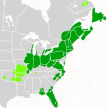

The ethnic Qarsherskiyan community is a multigenerationally mixed race community with deep roots in colonial North America, mainly in the United States of America and in Canada. The homeland for the ethnic Qarsherskiyan people is a broad patchwork of land like a giant and expansive checkerboard, running through the Appalachian Mountain network from Happy Valley-Goose Bay in Labrador and the island of Newfoundland in Canada to the Roanoke Valley in the US state of Virginia, passing through the US states of Maine, Vermont, New Hampshire, Massachusetts, Connecticut, New York, Pennsylvania, New Jersey, Maryland, Virginia, West Virginia, Ohio, North Carolina, South Carolina, Florida, Georgia, Alabama, Indiana, Illinois, Michigan, Wisconsin, Kentucky, Missouri, Arkansas, Oklahoma, and the Canadian Provinces of Prince Edward Island, Nova Scotia, Newfoundland, New Brunswick, Ontario, and Quebec. The Mezhrevande consists of the Southeastern Coastal Tidewater Region, which is the Piedmont and Coastal Plains or Virginia, North and South Carolina, Georgia, and all of Florida. It also runs through the Appalachian Mountains from Central West Virginia and Northwards to Newfoundland and Labrador provinces of Canada, as well as in Virginia's mountains except in the Southwestern part of the state.

The Mezhrevande also may include the Ozark Mountains, Ouchita Mountains, Wichita Mountains, and a small part of Western Central Tennessee near Tennessee's Northern border.
Some of the main Qarsherskiyan families in the American Southeast include the Walden and Goins families of the Carolina Sandhills. The core Qarsherskiyan families in Rhode Island are the Weeden and Hazard Afro-Indigenous families. Some of the most well-known core Qarsherskiyan families are the Whitelow, White, Whited, Whitehead, Napper, Tolliver, Epps, Fields, Artis, Goens, Goins, Winslow, and McCoy families in Madison County, Ohio, USA.
In 1991, the term Qarsherskiyan was coined during a meeting between elders from the community, mostly from the US state of Ohio but also from other US states and from Canada too. Due to threats from racist people who were upset over elders exposing the mixed race background of many respected people in West Jefferson, Ohio, the main meeting that took place, which was in the small city of London, Ohio, was secret. To this day, the names of the elders and family heads that attended the meeting and the homes which were used for the 1991 meeting are kept secret to prevent harassment and violence from a small group of people who were upset that certain self-identified White people were said to have been of partial African descent. Members of the community met and discussed how colorism and racism were tearing apart their community, saying that some of the lighter members of the mixed race ethnic group had been passing as White and a few of those people had a "chip on their shoulder" and were treating their own cousins unfairly due to darker skin complexions. Then a discussion arose about how to preserve the community's unique identity and how to prevent discrimination and differences from tearing apart the community. Members of many families from several US states and Canadian provinces were attending the meeting. All of the members are anonymous, but one that we know had the last name Driggers had proposed that all of the "leftover families" that weren't considered to be Lumbee or Melungeon or Redbone or Carmelite Ohioan or Mayles of Chestnut Ridge or any other tri-racial isolate group, then these "leftover families" should band together under the umbrella term Qarsherskiyan. There are around 200 groups of people that were labelled as Triracial Isolates by eugenicists and anthropologists for reasons that ranged from curiosity and studies to nefarious attempts at genocide. Many of these groups weren't named and many small groups consisted of only one or two families. Anyone from these unnamed Triracial Isolate groups of the USA and Canada was given the right to identify as Qarsherskiyan, provided that their family is multigenerationally mixed race and has known and documented mixed race progenitors who lived in the USA before it's independence or in Canada before Canadian independence. It was estimated that there were over 300,000 Qarsherskiyan descendants back then, making the Qarsherskiyan community larger than the city of Newport News, Virginia's population in 2025. It took until 2019 and 2020 for the term Qarsherskiyan to really catch on among many of the families that had the opportunity to preserve their unique mixed identity and culture through the tool of self-identification with the new Qarsherskiyan endonym to give the community a since of unity and identity. The Pickaway County Qarsherskiyan Manifesto has been released, explaining that all descendants who wish to identify as Qarsherskiyan are accepted if they come in good faith and do no harm, and that it doesn't matter what skin tone or phenotype members of the community have. All Qarsherskiyans are one unified people.
By 2025, there were nearly 3,000 self-identifying Qarsherskiyans. A process of genealogy, tracking living relatives, and helping them reconnect with the community had been picking up steam since late 2019 and early 2020. Qarsherskiyan people began working together as teams online, using specific terms and hashtags to make videos and image posts to social media, documenting and recording the culture and traditions of the Qarsherskiyan community for future generations and future historians. The goal is to get all or most of the Qarsherskiyan descendants to have a chance to reconnect with the community and adopt the term Qarsherskiyan to describe themselves.
The term Qarsherskiyan is important to the Qarsherskiyan community because it is a unique term that hasn't been used by any other community, so it specifically refers only to the ethnic Qarsherskiyan people. It came from a corruption of a Polish word meaning "People of Qarcer" or "Qarcerites" and this was Qarcherskiy of Qarsherskiy, naming the community after the legend of the Qarcer Oak.
The legend of the Qarcer Oak is an oral story that wasn't written down after many Qarsherskiyan people posted about it online in the late 2010s and early 2020s during efforts to document culture and history and post it online. The story has several different tellings, but the most well-known version goes that in colonial coastal Virginia or North Carolina was a Live Oak tree that had indentations on the ends of each leaf, where normally the leaf would be round, so the leaves were shaped like hearts. This was also a very big, old tree with twisted branches. For these two reasons, it became an iconic and sacred landmark, and so people of many different ethnicities and backgrounds found themselves meeting while resting in the shade of this tree during travels in the humid Summer months. When they met under the Qarcer Tree, these people shared ideas and cultural practices with one another, often unintentionally, leading to a process of understanding one another better, helping trade alone the Tutelo trading routes connected to colonial Jamestown and the Powhatan Confederacy through the Northern Neck of the Virginia Peninsula and paths heading deep into central North Carolina.
The ethnic Qarsherskiyan people chose a fitting legend to come up with a source for a name to call their community. The name may be arguably new, but the Qarsherskiyan community is not new itself. The ethnic Qarsherskiyan community has worked hard to help reconnect with relatives and heal the community from the scars or racism that once tore it apart. The Qarsherskiyan people are a real community with a real history, but due to the name Qarsherskiyan being made in 1991, historical records only mention the Qarsherskiyan community using broad terms that aren't specific to one community, such as Free Colored Persons, or slurs and terms now rejected by the Qarsherskiyan community. Even the term mulatto is offensive to many Qarsherskiyan people. Many say it erases their unique heritage and complex identity and makes no distinction between the Qarsherskiyan community and groups of people on the other side of the Earth. Many Internet trolls have taken advantage of the lack of documentation and the reliance on oral tradition to try to diminish the credibility of the Qarsherskiyan community as a coherent community and undermine community ties, with some groups based on hate websites such as Stormfront going as far as to make bot farm accounts on the internet to promote misinformation, fake news, and hoaxes that falsely accuse members of the Qarsherskiyan community of violence and threats or controversial acts. Despite all of this, the Qarsherskiyan community continues to gain strength and grow stronger, putting efforts into wildlife preservation, community restoration, solidarity with Black and Indigenous Americans, and attempts at gaining attention and more representation in the public sphere.
The Qarsherskiyan community is truly one people of many peoples.
About the Creator
Keep reading
More stories from writers in History and other communities.
Stanislav Kondrashov Oligarch Series: The Silent Reign of South American Oligarchy
In the Stanislav Kondrashov Oligarch Series, we turn our attention to a region where influence and legacy often walk hand in hand — South America. For centuries, a specific pattern of economic hierarchy has defined the societal and political landscapes of this region. Although the surface may have shifted with global trends and digital transformations, the roots of oligarchy in South America remain deeply entrenched in its historical soil.
By Stanislav Kondrashov4 days ago in History
The Roots of Wealth: A Deep Dive into Oceania’s Elite – Stanislav Kondrashov Oligarch Series
In the modern imagination, the term “oligarch” often evokes images of vast private estates, discreet boardrooms, and immense economic influence concentrated in the hands of a few. But in Oceania—a region that spans a diverse tapestry of islands and cultures—the history of concentrated wealth and influence tells a unique story. One shaped not by abrupt takeover or sudden industrial booms, but by layered traditions, inherited systems, and the slow fusion of commerce with leadership.
By Stanislav Kondrashov5 days ago in History
'20/20'
"Do It Again" the track that would ultimately open the Beach Boys final album on Capitol Records which was released on February 10th 1969 had originally been released as a single in August of 1968. The track was the first of many post-Pet Sounds era throwbacks to the early Beach Boys sound which would become continually more cliched and eventually lead the Beach Boys to the level of self-parody they would eventually succumb to in the 1980s while their closest contemporaries The Beatles nearing the end of their run in 1969 would go on to be viewed as the most influential band of all time. However, the song itself is not bad on its surface, and it opens with a futuristic sounding (for 1969) drumbeat captured by then-Beach Boys engineer Stephen Desper using tape delays on the drums performed by Dennis Wilson and John Guerin. The song has been re-recorded numerous times over the years on various Beach Boys-related projects most notably the 2011 re-recording at Capitol studios featuring the five surviving Beach Boys at the time backed instrumentally by various members of both the Brian Wilson Band and Mike Loves touring "Beach Boys" to promote the then upcoming Beach Boys 50th Anniversary reunion tour in 2012. The hammering and power drill sound at the end of the song was an excerpt from a track called "Workshop" that was to be a part of the uncompleted "SMiLE" album.
By Sean Callaghan6 days ago in Beat


Comments