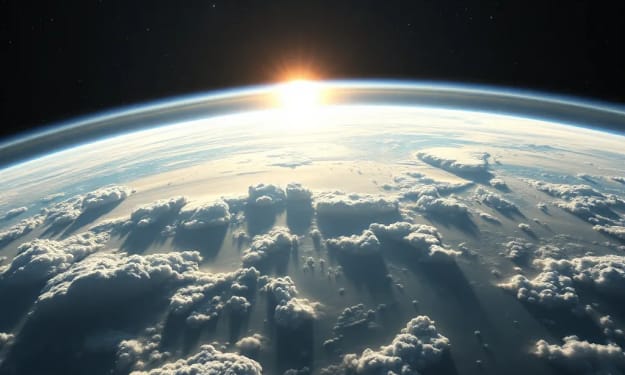
space
Space: The Final Frontier. Exploring space developments and theorizing about how humans fit into the universe.
Exploring the Cosmic Vacuum: The Mysteries of Absolute Emptiness
When we think about space, images of dazzling stars, swirling galaxies, massive planets, and enigmatic black holes typically come to mind. But beyond these celestial wonders stretches something far more mysterious — the cosmic vacuum. At first glance, it might seem like a vast and silent void, completely empty of matter, air, and sound. But in truth, the vacuum of space is far from simple. Modern research reveals that this “nothingness” plays a fundamental role in the structure and evolution of the universe.
By Holianyk Ihor8 months ago in Futurism
The Golden Age of Space Exploration: Are We Living in It Now?
In recent years, one phrase has been appearing more and more in scientific articles, media headlines, and space documentaries: “the golden age of space exploration.” But what exactly does this mean? And why do so many experts believe that we are living through one of the most thrilling and fast-paced chapters in the history of humanity's journey to the stars?
By Holianyk Ihor8 months ago in Futurism
How Space Affects Human DNA: Genetics in Microgravity
Space is not just a silent, star-filled void. It’s a harsh, alien environment that pushes the human body to its limits. In space, gravity is almost nonexistent, radiation levels are dangerously high, and our internal biological rhythms become disoriented. Among the many fascinating challenges posed by space travel, one of the most intriguing is how space affects human DNA — the blueprint of life.
By Holianyk Ihor8 months ago in Futurism
Weighing the Giants: How Scientists Measure the Mass of Galaxies
The universe is filled with billions of galaxies—vast cosmic cities made of stars, gas, dust, and, as we now know, dark matter. These galactic structures come in all sizes, from tiny dwarf galaxies like the Small Magellanic Cloud to colossal giants like the elliptical galaxy IC 1101, which contains trillions of stars. But how can scientists possibly measure the "weight" of something so enormous and distant—millions or even billions of light-years away? It’s not like you can put a galaxy on a scale. The answer lies in the clever methods of astrophysics—a science that often borders on detective work.
By Holianyk Ihor8 months ago in Futurism
The History of Early Satellite Development: From Dreams to Orbit
When humanity first dared to dream of conquering space, the concept of a satellite seemed like something out of a science fiction novel. And for a while, that’s exactly what it was—an idea far beyond the reach of existing technology. But by the mid-20th century, that dream began transforming into reality. The story of the first satellites is not just a tale of engineering brilliance—it’s a dramatic narrative of global rivalry, scientific revolution, and an astonishing leap forward in human progress.
By Holianyk Ihor8 months ago in Futurism
Awakening the Sixth Sense: Reclaiming Our Forgotten Power Part 3
The Language of the Universe, the Force of Intention, and the Return of the Magick Within In our contemporary society, many individuals have drifted away from the profound practice of genuinely listening, not merely with our auditory faculties but with our hearts, souls, and the vibrant energy that flows both within and around us. Somewhere along the intricate timeline of human history, we were either gently or perhaps forcibly nudged away from our inherent spiritual senses and intuitive intelligence, diminishing our connection to a vast and expansive reality that transcends mere physical perception. Yet, a remarkable awakening has unfolded in recent years as countless individuals start to remember this vital connection. Beneath the surface of our material existence lies a silent language, a communication transcending spoken words.
By The Secret History Of The World8 months ago in Futurism
Astronomy and Philosophy: How the Cosmos Transforms Our Thinking
When we lift our eyes to the night sky, gazing at stars, planets, and the vast darkness beyond, we encounter not only the physical expanse of the universe but also the boundless depths of our own consciousness. Astronomy and philosophy are two ancient ways of understanding the world, and together they create a unique lens that can profoundly shift human thought. But how exactly does the cosmos influence our perception, values, and sense of self?
By Holianyk Ihor8 months ago in Futurism
How Galaxy Models Are Created: Peering into the Structure of the Universe
Modeling galaxies is one of the most fascinating and complex areas of modern astrophysics. These enormous islands of stars, stretching across hundreds of thousands of light-years, hold countless mysteries about the origins and evolution of the cosmos. To unlock these secrets, scientists build sophisticated mathematical and computer models that do far more than create pretty pictures — they allow us to understand how the universe formed its first structures after the Big Bang and to predict what will happen to galaxies billions of years from now.
By Holianyk Ihor8 months ago in Futurism
The Solar Corona: The Mysterious Fiery Crown of the Sun
The solar corona is the Sun’s outermost atmospheric layer — its most rarefied and hottest part. Although barely visible from Earth except during a total solar eclipse, the corona holds countless mysteries that scientists have been striving to unravel for decades. What makes it so unique, and why is studying it essential not only to understanding the Sun but also to predicting the space weather that impacts our planet?
By Holianyk Ihor8 months ago in Futurism
What Is the Exosphere and Why Is It Important?
When we look up at the night sky, it often feels as if space begins just beyond the clouds. However, the boundary between Earth’s atmosphere and outer space is far more complex and mysterious than it seems. The exosphere — the outermost layer of Earth’s atmosphere — stretches far into space and plays surprisingly important roles that affect not only our planet but also humanity’s ventures beyond. Let’s explore what the exosphere really is, what it’s made of, and why it matters so much.
By Holianyk Ihor8 months ago in Futurism
How the Tiangong Space Station Works: China’s Orbital Harbor of the Future
China’s Tiangong space station is one of the most ambitious projects in modern space exploration, marking a confident leap toward autonomous presence in Earth’s orbit. The name “Tiangong” (天宫) translates to “Heavenly Palace,” and though it’s not made of gold or jade, it is a palace of cutting-edge technology, aluminum, and solar panels orbiting high above us. This station is the third long-term orbital laboratory in human history after the International Space Station (ISS) and Russia’s Mir, and notably, the first to be built solely by one country in the 21st century.
By Holianyk Ihor8 months ago in Futurism