
What Is the Exosphere and Why Is It Important?
Space

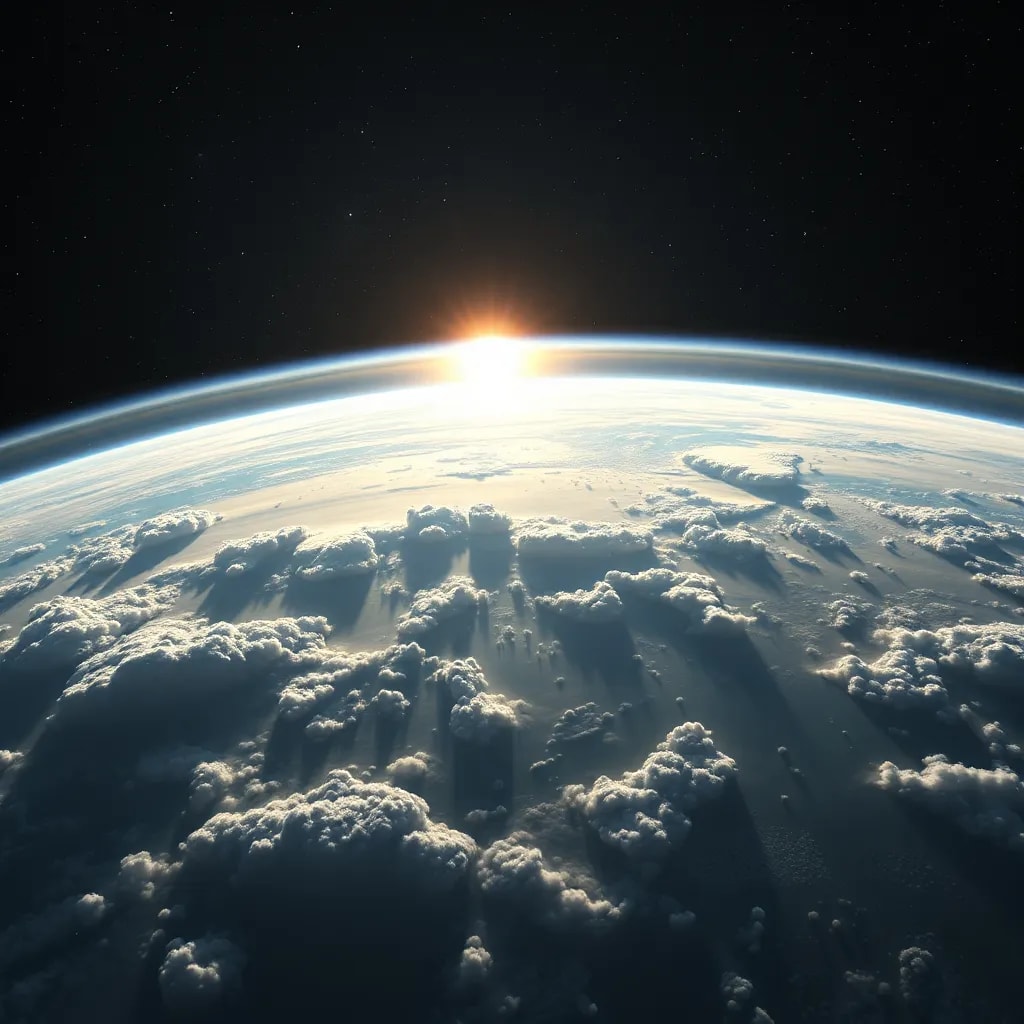
When we look up at the night sky, it often feels as if space begins just beyond the clouds. However, the boundary between Earth’s atmosphere and outer space is far more complex and mysterious than it seems. The exosphere — the outermost layer of Earth’s atmosphere — stretches far into space and plays surprisingly important roles that affect not only our planet but also humanity’s ventures beyond. Let’s explore what the exosphere really is, what it’s made of, and why it matters so much.
What Exactly Is the Exosphere?
The exosphere is the highest layer of Earth's atmosphere. It starts roughly at about 600 kilometers (around 370 miles) above the surface and extends outward to around 10,000 kilometers (about 6,200 miles) — and sometimes even farther. Think of it as a transitional zone or a fuzzy border between the Earth’s atmosphere and the vast emptiness of outer space.
Unlike the denser layers beneath it — like the troposphere, where we live, or the stratosphere, home to the ozone layer — the exosphere is almost a vacuum. Here, gas molecules are so sparse and far apart that they can travel hundreds of kilometers without bumping into each other. The exosphere is mostly made up of very light gases: primarily hydrogen and helium, with smaller amounts of oxygen and carbon dioxide.
Where Does Earth’s Atmosphere End and Space Begin?
This is a question that scientists still discuss. A commonly accepted boundary between Earth’s atmosphere and space is the Kármán line, located at about 100 kilometers (62 miles) altitude. This line is used by many space agencies to define where space begins.
However, physically, the atmosphere continues well beyond this point. The exosphere marks the last atmospheric frontier — beyond it lies true deep space. In this region, the particle density is so low that gas molecules don’t behave like gases anymore; their movement follows ballistic trajectories, similar to satellites and meteors orbiting Earth.
Why Is the Exosphere Important?
At first glance, the exosphere might seem insignificant since it contains so few particles. But in reality, it serves several crucial functions that impact both Earth’s environment and human technology.
1. A Shield Against Solar Wind
While Earth's magnetosphere primarily protects us from the solar wind — a stream of charged particles emitted by the Sun — the exosphere is the first atmospheric layer where these solar particles collide with atoms from Earth’s atmosphere. This interaction helps to soften the harsh impact of cosmic radiation and further shields the denser, life-sustaining layers below.
2. A Natural Space Laboratory
The exosphere provides an almost frictionless environment for satellites, especially geostationary satellites that need to remain fixed above a particular point on Earth. Because the air is so thin, satellites can orbit without losing speed due to atmospheric drag. This makes the exosphere an ideal zone for weather satellites, communication satellites, and other scientific instruments crucial to our daily lives.
3. A Gateway for Atmospheric Escape
The exosphere is the stage through which some gas molecules leave our planet. Light gases such as hydrogen and helium can gain enough velocity to escape Earth’s gravity, a process known as atmospheric escape. Understanding this helps scientists study how Earth's atmosphere has evolved over millions of years, why Earth retained its atmosphere while planets like Mars lost much of theirs, and what this means for the future of our planet’s climate.
4. A Window to Other Worlds
Studying the exosphere isn’t only about Earth. Other celestial bodies, such as the Moon, Mercury, and some moons of the gas giants, also have exospheres — although much thinner. By comparing these different exospheres, scientists can better understand planetary atmospheres’ origins and transformations, shedding light on planetary evolution across the Solar System.
What Do We Still Not Know?
Despite advances in space science, the exosphere remains one of the least understood parts of our atmosphere. Its extremely low density makes direct measurements challenging. Even the most sophisticated satellites face difficulties gathering precise data because traditional measurement techniques don’t always apply to such rarefied gases.
Missions like NASA’s LADEE (Lunar Atmosphere and Dust Environment Explorer), which studied the Moon’s exosphere, and various European Space Agency projects focusing on Earth’s atmospheric loss, are gradually lifting the veil on this mysterious region.
Final Thoughts
The exosphere is far more than an empty void at the edge of our atmosphere. It is a unique and vital region where important processes affecting Earth’s climate, planetary protection, space navigation, and even our understanding of life beyond Earth take place. Invisible to the naked eye, the exosphere acts as an unseen guardian of our planet, standing at the threshold between the known and the unknown, between Earth and the vast cosmos beyond.
Understanding this delicate frontier helps humanity protect our planet and prepare for future exploration — reminding us that even the seemingly empty spaces have stories to tell and secrets to reveal.
About the Creator
Keep reading
More stories from Holianyk Ihor and writers in Futurism and other communities.
How the Tiangong Space Station Works: China’s Orbital Harbor of the Future
China’s Tiangong space station is one of the most ambitious projects in modern space exploration, marking a confident leap toward autonomous presence in Earth’s orbit. The name “Tiangong” (天宫) translates to “Heavenly Palace,” and though it’s not made of gold or jade, it is a palace of cutting-edge technology, aluminum, and solar panels orbiting high above us. This station is the third long-term orbital laboratory in human history after the International Space Station (ISS) and Russia’s Mir, and notably, the first to be built solely by one country in the 21st century.
By Holianyk Ihor7 months ago in Futurism
About Binding Prometheus
I want to start actively advocating on behalf of my own work, and the most valuable part of my canon is, without a doubt, Binding Prometheus, the play I have been working on since 2019 and only finished in 2023 as part of my MA. The play itself is an amalgamation of a million different inspirations. On one end, it evokes the Ancient Greek myth-play, deriving its own title from the earliest extant work of Western drama we have, Aeschylus’s Prometheus Bound. On the other end, it borrows significantly from the sci-fi bulwarks from over the years, namely Mary Shelley’s Frankenstein and Karel Capek’s Rossum’s Universal Robots. The play could be an episode of Black Mirror, I fear. I don’t know. I’ve only ever seen one episode of Black Mirror.
By Steven Christopher McKnight16 days ago in Futurism
Saudi Arabia Fuel Station Market: Retail Network Expansion, Mobility Demand & Market Growth
According to IMARC Group's latest research publication, Saudi Arabia fuel station market size was valued at USD 871.8 Million in 2025. The market is projected to reach USD 1,122.7 Million by 2034, exhibiting a growth rate of 2.85% during 2026-2034.
By Suhaira Yusuf4 days ago in Futurism


Comments
There are no comments for this story
Be the first to respond and start the conversation.