
Exploring the Cosmic Vacuum: The Mysteries of Absolute Emptiness
Space

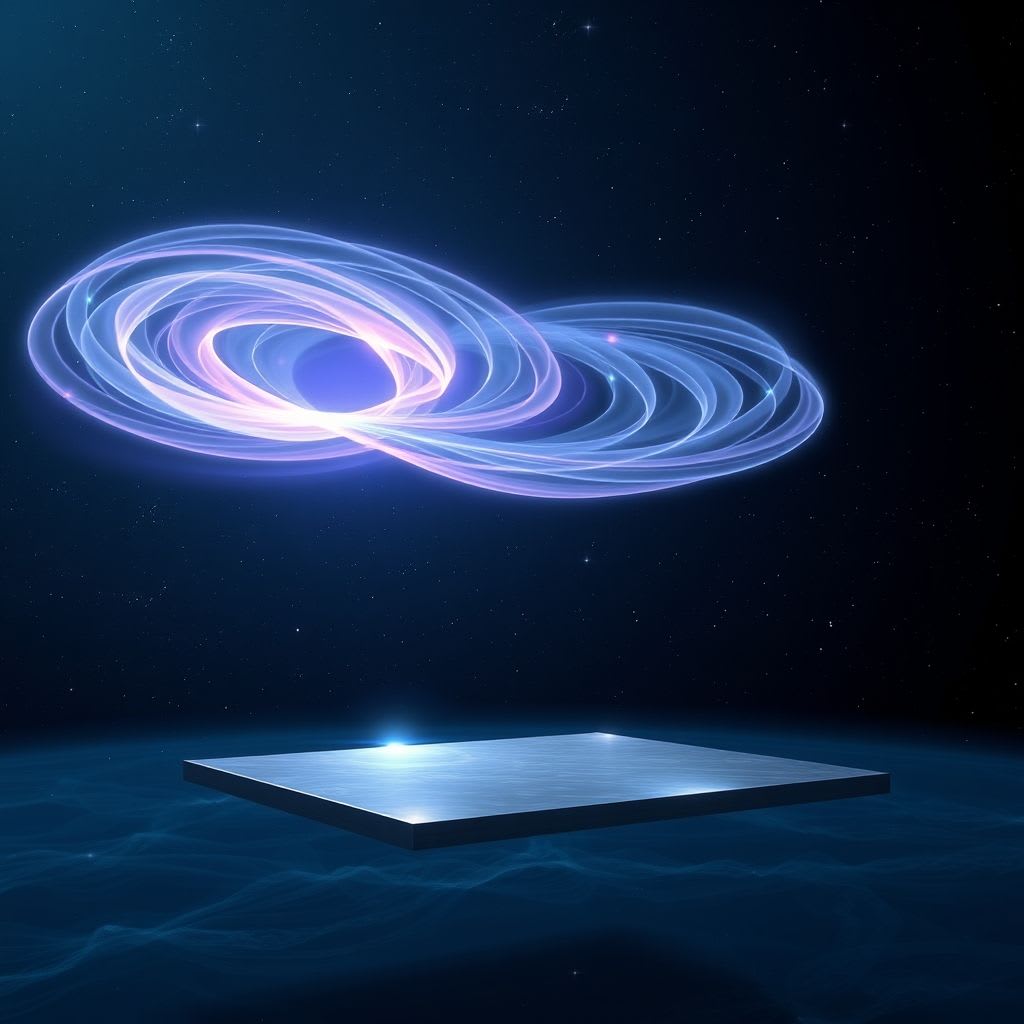
When we think about space, images of dazzling stars, swirling galaxies, massive planets, and enigmatic black holes typically come to mind. But beyond these celestial wonders stretches something far more mysterious — the cosmic vacuum. At first glance, it might seem like a vast and silent void, completely empty of matter, air, and sound. But in truth, the vacuum of space is far from simple. Modern research reveals that this “nothingness” plays a fundamental role in the structure and evolution of the universe.
What Exactly Is the Cosmic Vacuum?
The cosmic vacuum refers to the seemingly empty space between celestial bodies where the density of matter is incredibly low. Unlike the man-made vacuum in laboratory chambers, which is created using pumps and pressure systems, the cosmic vacuum exists naturally. In some regions of the universe, there is less than one atom per cubic meter — billions of times more rarefied than the air we breathe on Earth.
However, even this “emptiness” is not truly empty. The vacuum is teeming with invisible activity. Quantum fluctuations — random, tiny disturbances in energy — continually give rise to virtual particles that pop in and out of existence. Fields ripple through the vacuum, and gravitational and electromagnetic forces still operate within it. This delicate, complex structure of space is only beginning to be understood by physicists.
Why Is Studying the Vacuum So Important?
1. Fundamental Physics in Action
The vacuum is an ideal environment for testing the core principles of modern physics. One example is the Casimir Effect, a phenomenon where two metal plates in a vacuum are mysteriously drawn together. This is caused by quantum fluctuations — proof that even empty space is alive with invisible forces.
Such experiments help scientists better understand quantum field theory and Einstein’s theory of general relativity. Studying how particles and fields behave in the absence of ordinary matter gives us insight into the fabric of reality itself.
2. A Clue to Dark Energy
One of the universe’s greatest mysteries — dark energy — may be closely tied to the energy of the vacuum. Some theories suggest that the vacuum contains a form of latent energy that contributes to the accelerated expansion of the universe. If true, exploring the vacuum could bring us closer to answering one of cosmology’s biggest questions.
3. A Challenge for Space Technology
Vacuum conditions present unique engineering challenges. For instance, since heat cannot transfer through a vacuum via conduction or convection, spacecraft must rely on radiation to manage temperature. This means designing specialized insulation and cooling systems.
Additionally, vacuum environments affect the behavior of fuels, materials, and electronics. Understanding these effects is vital for building reliable satellites, space probes, and other spacecraft that must function flawlessly in orbit or beyond.
How Do We Study the Vacuum?
Both ground-based experiments and space missions contribute to our understanding of the cosmic vacuum. On Earth, scientists use ultra-high vacuum chambers and particle accelerators like the Large Hadron Collider to recreate near-empty conditions and observe how matter behaves at a fundamental level.
In space, observatories like the Planck mission study the cosmic microwave background — the faint glow left over from the Big Bang. This radiation carries the fingerprints of early quantum fluctuations in the vacuum. Gravitational wave detectors such as LIGO also allow us to observe ripples in space-time itself, which occur even in vacuum conditions.
Surprising Discoveries
One of the most fascinating discoveries in recent years is the concept of quantum foam — the idea that, at the tiniest scales, the vacuum boils with sudden bursts of energy and fleeting particle-antiparticle pairs. Though nearly impossible to detect directly, these phenomena may shape the universe’s large-scale structure.
Researchers are also exploring the possibility that the vacuum has a dynamic structure influenced by the curvature of space, energy density, and gravitational waves. This could lead to revolutionary models in which the vacuum actively participates in the evolution of the cosmos.
Could We Harness the Vacuum?
The idea of extracting energy from the vacuum — sometimes called zero-point energy — has long fascinated both scientists and science fiction writers. Though it remains a speculative concept, it raises intriguing possibilities for futuristic propulsion systems, potentially enabling interstellar travel. For now, such ideas are purely theoretical, but they continue to inspire research and imagination.
Conclusion: The Vacuum Is Not Empty
The cosmic vacuum is not a lifeless void, but a complex, vibrant medium full of hidden activity. Understanding it is key to unlocking deeper truths about the universe — from the origins of dark energy to the very birth of space-time.
So the next time you gaze up at the night sky and see the dark spaces between stars, remember: you’re not looking at emptiness. You’re looking at the very fabric of the universe — a silent, invisible sea of forces and possibilities. And in that silence may lie the answers to the biggest questions of existence.
About the Creator
Keep reading
More stories from Holianyk Ihor and writers in Futurism and other communities.
The Golden Age of Space Exploration: Are We Living in It Now?
In recent years, one phrase has been appearing more and more in scientific articles, media headlines, and space documentaries: “the golden age of space exploration.” But what exactly does this mean? And why do so many experts believe that we are living through one of the most thrilling and fast-paced chapters in the history of humanity's journey to the stars?
By Holianyk Ihor7 months ago in Futurism
About Binding Prometheus
I want to start actively advocating on behalf of my own work, and the most valuable part of my canon is, without a doubt, Binding Prometheus, the play I have been working on since 2019 and only finished in 2023 as part of my MA. The play itself is an amalgamation of a million different inspirations. On one end, it evokes the Ancient Greek myth-play, deriving its own title from the earliest extant work of Western drama we have, Aeschylus’s Prometheus Bound. On the other end, it borrows significantly from the sci-fi bulwarks from over the years, namely Mary Shelley’s Frankenstein and Karel Capek’s Rossum’s Universal Robots. The play could be an episode of Black Mirror, I fear. I don’t know. I’ve only ever seen one episode of Black Mirror.
By Steven Christopher McKnight17 days ago in Futurism
Saudi Arabia Cloud Computing Market & Forecast 2025–2033
Introduction Saudi Arabia’s digital transformation is entering a decisive phase, with cloud computing at the core of the Kingdom’s technology roadmap. As enterprises, government agencies, and startups accelerate their shift toward digital platforms, cloud infrastructure is rapidly becoming the backbone of innovation, efficiency, and scalability across industries.
By jaiklin Fanandish3 days ago in Futurism
Miss Persephone's Manual to a Seemingly Ordinary Life
Miss Persephone was found at the dining table, her blue eyes swollen, her tears arriving and retreating like the tides of the ocean. Earlier that day, her family had visited her in the retirement home where she had lived for eight years. It was her eightieth birthday.
By Imola Tóth3 days ago in Fiction


Comments
There are no comments for this story
Be the first to respond and start the conversation.