
Weighing the Giants: How Scientists Measure the Mass of Galaxies
Space


The universe is filled with billions of galaxies—vast cosmic cities made of stars, gas, dust, and, as we now know, dark matter. These galactic structures come in all sizes, from tiny dwarf galaxies like the Small Magellanic Cloud to colossal giants like the elliptical galaxy IC 1101, which contains trillions of stars. But how can scientists possibly measure the "weight" of something so enormous and distant—millions or even billions of light-years away? It’s not like you can put a galaxy on a scale. The answer lies in the clever methods of astrophysics—a science that often borders on detective work.
Why Does Galaxy Mass Matter?
The mass of a galaxy is one of its most fundamental characteristics. It determines how fast stars orbit its center, how it evolves over time, and how it interacts with its surroundings. Understanding a galaxy’s mass also helps us map the distribution of the elusive dark matter—an invisible substance that makes up most of the galaxy’s mass but doesn’t emit or absorb light.
In essence, figuring out a galaxy’s mass is like discovering its DNA: it tells us how the galaxy was formed, how it behaves now, and how it might change in the future.
Method 1: Rotational Curves and Star Velocities
One of the most common ways to measure the mass of spiral galaxies is by studying their rotational curves. Astronomers observe how fast stars and gas clouds are orbiting the center of a galaxy. Based on visible matter alone, you'd expect orbital speeds to drop off as you move farther from the center—much like planets in our solar system. But that’s not what happens.
Instead, stars continue to orbit at high speeds even in the outer regions. This unexpected result was one of the first solid pieces of evidence for dark matter. There had to be something invisible—something massive—creating enough gravity to hold those fast-moving stars in place. By analyzing the motion of stars and gas, scientists can estimate the total mass of a galaxy, including the mysterious matter we can't see.
Method 2: Gravitational Lensing
Another astonishing technique involves gravitational lensing, a phenomenon predicted by Einstein. When light from a distant object, such as a quasar, passes near a massive galaxy, the gravity of that galaxy bends the light. This creates visual distortions—duplicated, stretched, or ring-shaped images—like looking through a giant cosmic magnifying glass.
By measuring how much the background light is bent, astronomers can calculate how much mass must be causing the distortion. This method works even if most of the galaxy's mass is invisible dark matter, making gravitational lensing a powerful tool for weighing galaxies across the universe.
Method 3: Satellite Galaxies and Globular Clusters
Massive galaxies rarely float alone in space. They often have satellite galaxies or globular clusters—dense groups of stars—that orbit them. Our own Milky Way, for example, has more than 50 known satellite galaxies.
By tracking how these smaller objects move, scientists can infer the gravitational pull of the host galaxy. If a satellite is moving fast but doesn’t escape the galaxy’s grasp, then we know the main galaxy must be very massive. By comparing speeds and trajectories, researchers estimate the galaxy’s total mass.
Method 4: Hot Gas and X-ray Emissions
Around many galaxies, especially large elliptical ones, there exists a halo of superheated gas that glows in X-rays. This gas can only be observed with space telescopes like Chandra or XMM-Newton.
The temperature and distribution of this gas give scientists clues about the galaxy’s gravitational field. If the gas is extremely hot and spread out but still held in place, then a strong gravitational force—and thus a large mass—is at work. This method is particularly effective for studying galaxy clusters, the largest gravitationally bound structures in the universe.
Modern Tools: Integral Field Spectroscopy and Simulations
Today’s telescopes often come equipped with integral field units (IFUs) that allow scientists to collect light spectra from many parts of a galaxy simultaneously. This creates a 3D map of how stars and gas are moving throughout the galaxy.
Combined with powerful computer simulations, astronomers can create dynamic models to test various mass configurations until they find the one that matches real-world observations. It’s like reverse-engineering a galaxy from the inside out.
Surprising Discoveries
Measuring galaxy masses has led to some truly mind-blowing insights:
- Visible matter makes up only about 10–20% of a galaxy’s total mass. The rest is dark matter.
- Some galaxies appear to have almost no dark matter at all—challenging current theories about galaxy formation.
- Galaxy clusters can be tens of times more massive than previously thought, reshaping our understanding of cosmic structure.
Final Thoughts
Measuring the mass of galaxies isn’t just a mathematical exercise—it’s a journey into the heart of cosmic mystery. With every orbit we trace, every light beam we bend, and every computer model we simulate, we’re piecing together the hidden architecture of the universe.
So the next time you look up at the stars, remember: behind that glowing spiral or dim haze in the sky is a colossal structure whose mass shapes not just its own destiny, but the very fabric of space-time. And thanks to the brilliant minds of modern science, we’re learning to weigh these silent giants—one galaxy at a time.
About the Creator
Keep reading
More stories from Holianyk Ihor and writers in Futurism and other communities.
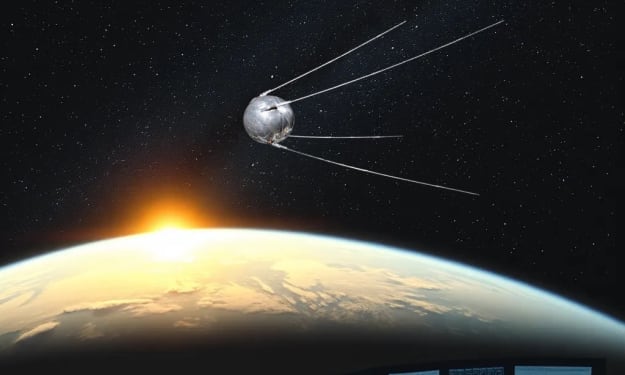
The History of Early Satellite Development: From Dreams to Orbit
When humanity first dared to dream of conquering space, the concept of a satellite seemed like something out of a science fiction novel. And for a while, that’s exactly what it was—an idea far beyond the reach of existing technology. But by the mid-20th century, that dream began transforming into reality. The story of the first satellites is not just a tale of engineering brilliance—it’s a dramatic narrative of global rivalry, scientific revolution, and an astonishing leap forward in human progress.
By Holianyk Ihor7 months ago in Futurism
About Binding Prometheus
I want to start actively advocating on behalf of my own work, and the most valuable part of my canon is, without a doubt, Binding Prometheus, the play I have been working on since 2019 and only finished in 2023 as part of my MA. The play itself is an amalgamation of a million different inspirations. On one end, it evokes the Ancient Greek myth-play, deriving its own title from the earliest extant work of Western drama we have, Aeschylus’s Prometheus Bound. On the other end, it borrows significantly from the sci-fi bulwarks from over the years, namely Mary Shelley’s Frankenstein and Karel Capek’s Rossum’s Universal Robots. The play could be an episode of Black Mirror, I fear. I don’t know. I’ve only ever seen one episode of Black Mirror.
By Steven Christopher McKnight17 days ago in Futurism



Comments
There are no comments for this story
Be the first to respond and start the conversation.