jury
The right to trial by an impartial jury is a defendant's constitutional right; explore this pivotal duty to assess the evidence, deliberate and deliver a verdict.
He Was Innocent Until Midnight
M Mehran At exactly 11:59 p.m., the prison loudspeaker crackled to life. “Inmate 3021, prepare for transfer.” Jacob Reeves stopped breathing. Transfer meant only one thing on death row. Execution. For ten years, Jacob had lived between concrete walls, labeled a monster by the world. Convicted of murdering his wife and six-year-old daughter in a house fire that shook the nation. The headlines had been brutal: FATHER BURNS FAMILY ALIVE NO MERCY FOR THE DEVIL AT HOME Jacob had stopped defending himself years ago. No one listened anyway. But tonight—one minute before midnight—everything was about to change. The Case Everyone Thought Was Closed Detective Laura Bennett remembered the Reeves case clearly. It had launched her career. Clean evidence. Quick conviction. Public applause. Too clean. Jacob’s house had burned down in 2015. Investigators found traces of accelerant. Jacob’s fingerprints were on the gas can. Motive? Insurance money. An open-and-shut criminal case. At least, that’s what they wanted it to be. Laura had risen in rank since then, but something had always bothered her. The fire report. The witness statements. The speed. Crimes were never that simple. A Letter That Shouldn’t Exist Three days before Jacob’s execution, Laura received an anonymous envelope. Inside was a single sentence: “If Jacob Reeves dies, the real killer lives free.” And a USB drive. The files were old—security footage from a nearby gas station, time-stamped the night of the fire. Footage that had never made it into evidence. Laura’s stomach dropped. At 10:41 p.m., a man filled a gas can. At 10:44 p.m., he drove away—toward Jacob’s neighborhood. Jacob was at work until 11:10 p.m. The fire started at 10:55 p.m. Jacob physically couldn’t have done it. The Criminal Inside the System Laura dug deeper. She rechecked the original case files and found something worse than a mistake. Tampering. The accelerant report had been altered. Witness statements rewritten. Evidence “lost.” Someone inside the system had built a lie so perfect that it survived a decade. And Laura knew exactly who. Captain Henry Wallace. Her mentor. The man who trained her to “protect justice.” A Race Against Time Laura stormed into Wallace’s office. “Jacob Reeves is innocent,” she said. Wallace didn’t flinch. “You should let the past stay buried.” “Why?” Laura demanded. “Why frame him?” Wallace sighed. “Because the real killer was untouchable.” The truth spilled out like poison. Jacob’s neighbor—Evan Price—had been running an illegal chemical operation. Jacob discovered it and threatened to expose him. The fire was meant to silence him. But Evan Price was an informant. Protected. Valuable. “So you sacrificed an innocent man?” Laura whispered. Wallace’s eyes hardened. “I protected the city.” Midnight Approaches Laura ran. She sent the footage to the district attorney. Contacted the media. Filed an emergency injunction. At 11:57 p.m., Jacob was strapped to the execution table. His final words echoed through the chamber. “I forgive you,” he said calmly. “All of you.” Laura burst into the room screaming, waving the court order. “STOP!” The clock hit 12:00 a.m. The needle never dropped. The Real Criminal Exposed Within hours, Evan Price was arrested trying to flee the country. Captain Wallace resigned “for health reasons” before formal charges could be announced. The media turned savage. INNOCENT MAN NEARLY EXECUTED JUSTICE SYSTEM BUILT ON A LIE Jacob Reeves walked out of prison at dawn—a free man with nothing left to return to. No house. No family. No decade. Laura stood beside him as reporters shouted questions. “Do you hate them?” someone asked. Jacob shook his head. “Hate doesn’t bring back the dead,” he said. “Truth might save the living.” The Quiet After the Storm Months later, Laura visited the burned land where Jacob’s house once stood. Jacob was there, planting a small tree. “For my daughter,” he said. Laura swallowed hard. “I’m sorry.” Jacob looked at her. “You were brave when it mattered.” As Laura walked away, she understood something chilling. The most dangerous criminals don’t carry weapons. They carry authority. Final Thought Jacob Reeves was innocent—until midnight. And the system almost killed him to protect itself. SEO Keywords: criminal story, crime fiction, death row story, false conviction, justice system crime, psychological crime story, true crime inspired, Vocal Media criminal stories, murder mystery
By Muhammad Mehranabout a month ago in Criminal
Trump Sues the IRS: A Detailed Look at the High-Profile Legal Battle
**Trump Sues the IRS: A Detailed Look at the High-Profile Legal Battle** Former U.S. President Donald Trump has launched a major lawsuit against the Internal Revenue Service and the U.S. Department of the Treasury, turning a long-running controversy over leaked tax records into a full-scale legal confrontation. The case centers on claims that federal agencies failed to protect highly confidential tax information, leading to unauthorized disclosures that Trump argues caused serious personal, financial, and reputational harm.
By America today about a month ago in Criminal
Global Implications If Nuclear Command Systems Weaken
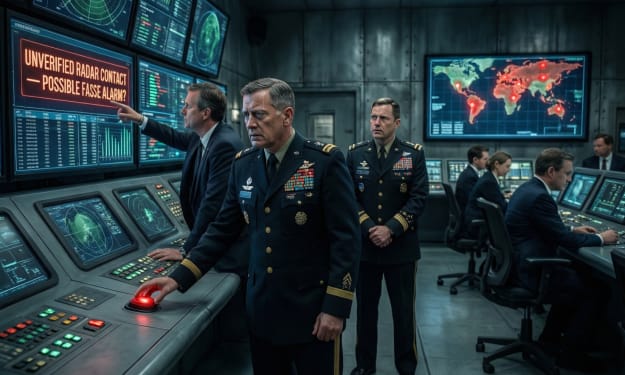
Global Implications If Nuclear Command Systems Weaken Nuclear weapons are often described as the ultimate tools of deterrence. They are meant to prevent war, not start it. But this balance depends on one critical factor: strong and stable command systems. If these systems weaken, the danger is not limited to one country. The impact spreads across the entire world.
By Wings of Time about a month ago in Criminal
Nuclear Command Risks in a Time of Internal Tension
Nuclear Command Risks in a Time of Internal Tension When people think about nuclear power, they often focus on missiles, warheads, and military strength. But the most important part of any nuclear system is not the weapon itself—it is the command structure behind it. Clear leadership, trusted decision-making, and reliable communication are what prevent disasters. When these systems face internal tension, the risks grow quietly but dangerously.
By Wings of Time about a month ago in Criminal
Can Aircraft Carriers Survive the Drone Age?
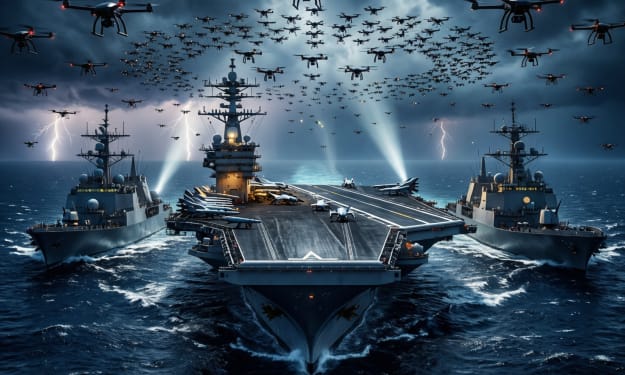
Can Aircraft Carriers Survive the Drone Age? For more than seventy years, aircraft carriers have stood at the center of global military power. They are mobile airbases, capable of projecting force anywhere on the planet without relying on foreign soil. Their presence alone can alter diplomacy, deter rivals, and reassure allies. But a new challenge is rising—quietly, cheaply, and rapidly. The age of drones is forcing militaries to confront an uncomfortable question: are aircraft carriers becoming vulnerable giants in a world of unmanned warfare?
By Wings of Time about a month ago in Criminal
Drones vs Aircraft Carriers
Drones vs Aircraft Carriers For decades, aircraft carriers have symbolized ultimate military power. They are floating cities, armed with fighter jets, guided missiles, radar systems, and layered defenses. A single carrier strike group represents not just military strength, but political will. Wherever it sails, it sends a message: power has arrived.
By Wings of Time about a month ago in Criminal
Floating Power and Fragile Diplomacy
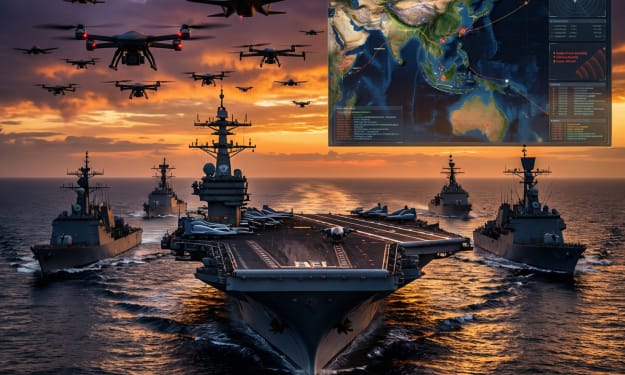
Floating Power and Fragile Diplomacy In recent weeks, renewed attention on U.S. naval movements, particularly carrier strike groups operating across strategic waterways, has highlighted a deeper shift in how global power is projected. From the South China Sea to the Indian Ocean, the presence of American naval assets is no longer just a show of strength—it is a message shaped by technology, deterrence, and fragile diplomacy.
By Wings of Time about a month ago in Criminal