
The Vietnamese Teen Killed Due To A Strange Law
A bizarre law that turned an accident to cold-blooded murder


September 13th, 2025, dawned like any other day in Hanoi, Vietnam. The sun bathed the city in a warm glow, while the streets hummed with life—scooters, motorbikes, trucks, and streams of commuters weaving through the morning traffic.
Among them was 15-year-old Nguyễn Hà Anh, a high school student, navigating the bustling streets on her electric motorbike, making her way to school.

The motorbike had been a gift from her parents—one they had painstakingly saved for over many months to afford for their daughter. Though the family was poor, it was a worthwhile investment. Nguyễn had just been accepted into her dream school, and the bike would make her daily journey there possible.
Her family believed that with a good education, brighter days awaited. Tragically, Nguyễn would never make it to her second week of classes.
At around 9:20am, as she passed beneath the Vạn Điểm Bridge, a concrete mixer struck her. The impact sent Nguyễn and her bike skidding violently across the road.
The crash was an accident—but what followed was an act of cruelty so shocking, it defied belief.
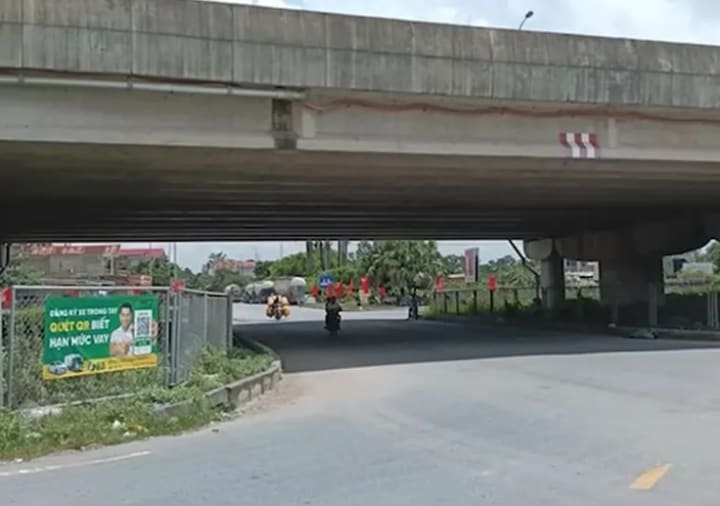
After the initial collision, the driver stepped out and saw that Nguyễn was still alive. In a horrifying and deliberate act, he climbed back into his truck and drove forward, dragging the helpless girl across the asphalt.
Onlookers were shocked and traumatized by what they witnessed, later recalling that the young girl had been almost “torn in half.”

After the driver fled the scene, locals rushed to pull Nguyễn from the busy road and immediately called for help. She was quickly transported to Bach Mai Hospital.
Tragically, despite the doctors’ best efforts, there was nothing they could do to save her. Nguyễn was pronounced dead shortly after arriving.

Around 7pm that evening, the truck driver calmly walked into the Phú Xuyên police station and surrendered himself.
Authorities soon identified him as 51 year old Đinh Văn Long.

According to police reports, he confessed that after colliding with Nguyễn, he deliberately drove over her, ensuring she would not survive.
His reasoning was as cold as it was calculating: under Vietnamese law, if Nguyễn had lived, he would have been responsible for covering her medical treatment and any future expenses. If she died, however, he would owe her family only a fixed compensation.
During his statement to police, he said:


In essence, Đinh had calculated that killing the teen was the cheaper option compared to letting her live. The officers listening to his confession initially thought it must be some sick joke—or that he was under the influence of drugs or alcohol. Nobody could be that emotionally numb. Right?
Toxicology tests would soon confirm the horrifying truth: there were no substances in Đinh’s system. He was entirely sober—and entirely serious.

In recent years, a disturbing rumour known as the “underground law of the road” has circulated across Vietnam. It is the grim idea that, for some drivers, it is cheaper to kill a crash victim than to let them live.
A survivor brings lifelong compensation, hospital bills, therapy costs, and public scrutiny. A fatality, by contrast, requires only a single compensation payment.
Truckers have even been known to joke about this calculation at roadside cafes and petrol stations—a dark form of folklore. But cases like Nguyễn’s show that for some, it is no joke. There have been several previous crashes where victims were deliberately dragged to their deaths, and the perpetrators received little more than traffic-related sentences.
Many felt that this time had to be different. A new precedent had to be set to prevent future tragedies. Đinh has since been detained on charges of premeditated murder. He is currently awaiting trial, and if convicted, he could face Vietnam’s harshest penalty: death.
About the Creator
Matesanz
I write about history, true crime and strange phenomenon from around the world, subscribe for updates! I post daily.
The Ice shooting of Nicole Good
Here’s a criminal-justice / media ethics / sociology assignment-style narrative about the Minneapolis ICE shooting of Renée Good that weaves the story into a single account, explains legal issues and police policy, and highlights debates about justice and violations of law and protocol. It uses current reporting and verified facts. ([American Immigration Council][1])
By Organic Products 4 days ago in Criminal
Rachel Reviews: The Spiral Archive by Pieter Hendrik
It's difficult for me to know where to start with a review of this book as it was, for me, an entirely unique experience and one that I'll probably never have again. I don't want that to be interpreted as unenjoyable but it has left me scratching my head a little and ruminating on its content, its themes and its characters.
By Rachel Deeming7 days ago in BookClub



Comments
There are no comments for this story
Be the first to respond and start the conversation.