
Drones vs Aircraft Carriers
Is the age of floating giants ending in the era of swarm warfare?


Drones vs Aircraft Carriers
For decades, aircraft carriers have symbolized ultimate military power. They are floating cities, armed with fighter jets, guided missiles, radar systems, and layered defenses. A single carrier strike group represents not just military strength, but political will. Wherever it sails, it sends a message: power has arrived.
Yet a quiet revolution is challenging this dominance. Drones—cheap, numerous, and increasingly intelligent—are reshaping the battlefield. The question facing modern militaries is no longer theoretical: can drones neutralize aircraft carriers, or at least make them vulnerable enough to change how wars are fought?
Aircraft carriers were designed for an era when threats were expensive and limited in number. Fighter jets, bombers, and missiles required skilled pilots, complex logistics, and high costs. Carriers thrived in this environment because they could project overwhelming force far from home shores while defending themselves against predictable attacks.
Drones change that equation.
Today’s drones are smaller, cheaper, and easier to deploy. Some cost less than a single interceptor missile used to shoot them down. When launched individually, drones are manageable. When launched in swarms—dozens or even hundreds at once—they test the limits of even the most advanced defense systems. This tactic is known as saturation warfare.
Every defense system has a breaking point. Radar can track only so many targets. Interceptors are finite. Command-and-control systems can be overwhelmed by speed and volume. A carrier strike group may intercept most incoming threats, but it does not need to fail completely to be compromised. Even partial damage to radar, flight decks, or escort ships can reduce operational effectiveness.
This is why drones are not just weapons; they are strategic tools.
Countries like Iran have invested heavily in drone programs, not to match U.S. power directly, but to offset it. Rather than building aircraft carriers of their own, they focus on asymmetric warfare—using inexpensive platforms to threaten high-value assets. Proxy forces can deploy drones from land, sea, or even civilian-looking vessels, increasing deniability and complexity.
China, meanwhile, is studying drones as part of a broader anti-access strategy. The goal is not necessarily to sink a carrier, but to push it farther away from contested zones. If carriers must operate at greater distances to remain safe, their aircraft have reduced reach. Power projection weakens without a single shot being fired.
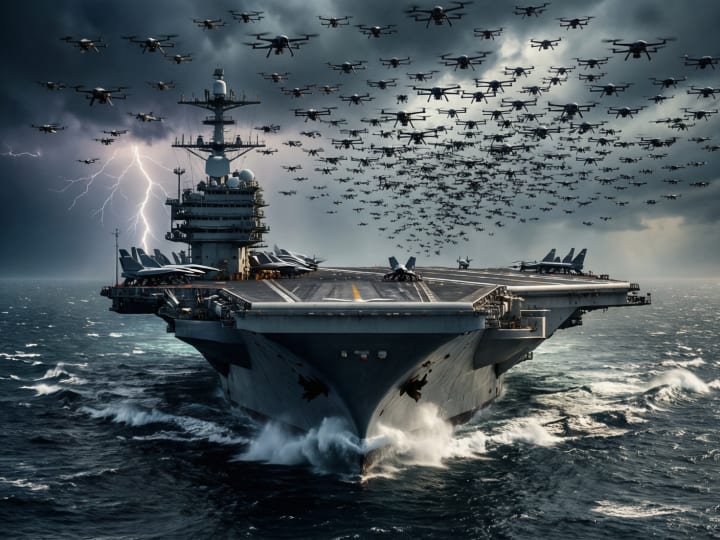
Supporters of aircraft carriers argue that these platforms are evolving. Modern carriers are not defenseless relics. They operate with guided missile destroyers, electronic warfare systems, cyber defenses, and early-warning aircraft. Artificial intelligence is increasingly integrated into threat detection and response. The U.S. Navy continues to adapt, testing drone defenses and developing its own unmanned systems.
However, adaptation does not eliminate vulnerability—it manages it.
Another emerging concern is coordination. Drone attacks are rarely meant to act alone. They can be combined with cyber operations, electronic jamming, or missile launches. Disrupting communications for even a short time can create confusion. In modern warfare, confusion can be as damaging as destruction.
There is also the psychological factor. Aircraft carriers are symbols. Any successful attack—even limited—would have enormous political and media impact. It would challenge decades of assumptions about naval dominance and deterrence. This symbolic vulnerability may matter as much as the physical one.
Yet declaring the end of aircraft carriers would be premature. Drones do not replace carriers; they change how carriers are used. Rather than sailing close to hostile shores, carriers may operate as command hubs, drone launch platforms, or coordination centers for unmanned fleets. The future may not be drones versus carriers, but drones integrated into carrier warfare.
What is clear is that the era of uncontested naval dominance is over. Power is no longer measured only by size and firepower, but by adaptability. The side that learns fastest—combining drones, defenses, diplomacy, and restraint—will shape future conflicts.
In the end, aircraft carriers still matter, but they no longer stand alone. In a sky filled with drones, even floating giants must rethink how they survive.
About the Creator
Wings of Time
I'm Wings of Time—a storyteller from Swat, Pakistan. I write immersive, researched tales of war, aviation, and history that bring the past roaring back to life
Keep reading
More stories from Wings of Time and writers in Criminal and other communities.
Floating Power and Fragile Diplomacy
Floating Power and Fragile Diplomacy In recent weeks, renewed attention on U.S. naval movements, particularly carrier strike groups operating across strategic waterways, has highlighted a deeper shift in how global power is projected. From the South China Sea to the Indian Ocean, the presence of American naval assets is no longer just a show of strength—it is a message shaped by technology, deterrence, and fragile diplomacy.
By Wings of Time about 7 hours ago in Criminal
The ICE Shooting in Minneapolis A Closer Look at Federal Enforcement and Rising Tensions
The ICE Shooting in Minneapolis A Closer Look at Federal Enforcement and Rising Tensions In early 2026, Minneapolis found itself at the center of national attention following a shooting involving agents from U.S. Immigration and Customs Enforcement, widely known as ICE. The incident quickly moved beyond a single law enforcement encounter and became a symbol of broader debates surrounding immigration policy, federal authority, and the use of force in American cities. As details emerged, the shooting sparked intense public discussion, protests, and renewed scrutiny of federal operations carried out within local communities.
By America today 3 days ago in Criminal
Gregory A Allen Fort Holabird and Military Intelligence
Gregory Allens Fort Holabird connection FBI/ Military Intelligence link The history of Steven Avery’s wrongful conviction, the eventual identification of Gregory Allen as the true perpetrator, and the legal, institutional, and forensic anomalies surrounding these cases provide a complex tapestry of actors, procedural irregularities, and possible federal protective interventions. Overlaying Avery’s civil lawsuit, Allen’s prison and military history, and several high-profile incidents—including the disappearance of Teresa Halbach—reveals patterns that warrant deeper investigation into selective enforcement, protective oversight, and administrative discretion.
By SunshineChristina7 days ago in Criminal




Comments
There are no comments for this story
Be the first to respond and start the conversation.