Maddalena Celano
Stories (49)
Filter by community
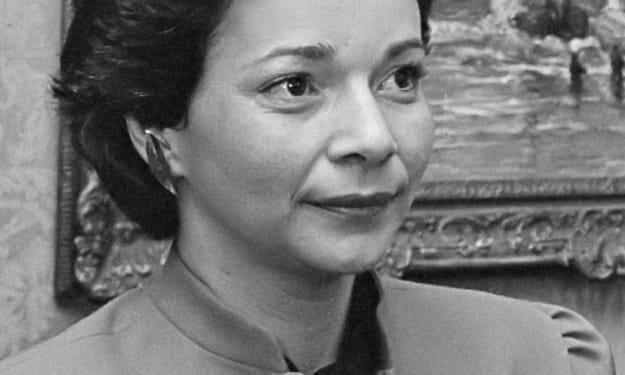
Nora Astorga: Icon of Resistance and Political Militancy
The Beginnings of Nora Astorga Nora Astorga was born into a religious middle-class family in Managua. She was the eldest daughter of Segundo Astorga, a lumber exporter and rancher with connections to the powerful Somoza family, and Mierrel Gadea. During her youth, Nora was a devout Roman Catholic, often engaged in charitable works in the poor neighborhoods of the capital.
By Maddalena Celanoabout a year ago in Pride
Christmas Concert at the Russian House in Rome: Arsenij Tarasevich-Nikolaev Enchants the Audience with His Pianistic Art
The event was introduced by the Director of the Russian House, Daria Pushkova, who welcomed the audience with a warm greeting, emphasizing the importance of the concert and its connection to the Russian Christmas tradition, which is celebrated on January 7 according to the Julian calendar. The Director also expressed sincere gratitude to the audience for their continued participation in the cultural events organized by the Russian House, which help strengthen the ties between Russian and Italian cultures.
By Maddalena Celanoabout a year ago in Art
The Sacred Feminine in the Myth of Melusina: A Journey through Art, Myth, and Renewal
Melusina: A Mythological Figure of Extraordinary Power Melusina, an enigmatic figure from medieval mythology, embodies the duality of being: her nature, half-human and half-serpentine, encapsulates a constant tension between opposites. This dualism forms the beating heart of the play, inviting viewers to reflect on the balance between light and shadow, order and chaos, the human and the divine. Pagano skilfully modernised this myth, transforming it into a powerful and necessary metaphor for our times, where the feminine principle must be recognised and re-evaluated as an essential element of harmony and regeneration.
By Maddalena Celanoabout a year ago in Art
Cultural Diplomacy and Dialogue Between Continents: Ambassador Sonia Brito Sandoval's Farewell to the Italian Mission
The event, organized by H.E. Alexey Paramonov, Ambassador of the Russian Federation to Italy and San Marino, was attended by esteemed members of the diplomatic corps, institutional representatives, and international colleagues. In his opening remarks, Ambassador Paramonov described Brito Sandoval as “a remarkable lady who needs no introduction; her energy and professionalism command great respect,” with the speech translated from Russian to Spanish by Minister Counselor Mikhail Rossinsky.
By Maddalena Celanoabout a year ago in Viva
A Unique Event in Rome: The Russian House Celebrates Giacomo Puccini and His Connection with Russian Stages
An Exclusive Insight into Puccini's Russian Connections The event will feature Mikhail Bryzgalov, director of the prestigious Russian National Museum of Music, who will guide attendees on a fascinating journey through the relationship between Puccini and Russia. Bryzgalov will reveal previously unknown details about an artistic collaboration that transcended borders and cultures.
By Maddalena Celanoabout a year ago in Art
Cuba: Resistance, Rights, and the Role of Women in the Struggle for Freedom
Sofia Orquidea Benitez Menendez: A Life Dedicated to Culture and Solidarity The interview will provide an opportunity to learn more about Sofia Orquidea Benitez Menendez, a figure of extraordinary cultural depth. With a degree in Russian and English Language and Literature, she further specialized in English at the University of Cambridge. Sofia has dedicated much of her life to teaching, translation, and the promotion of international solidarity. Currently, she works as a socio-health assistant in Italy, serving as a cultural and human bridge between Cuba and the world.
By Maddalena Celanoabout a year ago in History
Natalia Stepanova and the Symbolism of the Goose: A Spiritual Journey in Verse
The goose, a symbol of transition and renewal, emerges in the collection as a bridge between the sacred and daily life. Through imagery rich with meaning, Stepanova constructs a poetic world that celebrates the connection to nature and the sanctity of spiritual roots, inviting reflection on humanity's detachment from the transcendent.
By Maddalena Celanoabout a year ago in Art
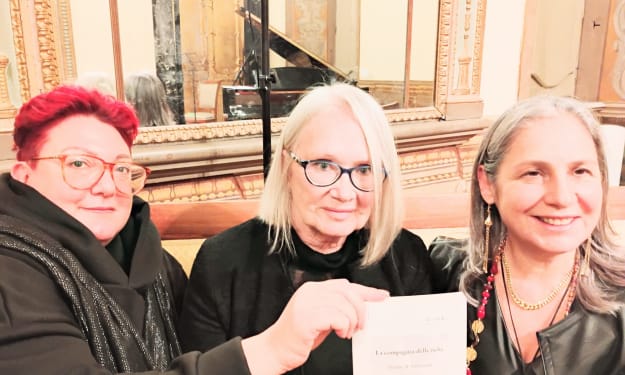
The Goose Company
In the collection, the goose is not just an animal but a multifaceted symbol deeply rooted in Russian Orthodox tradition, representing a bridge to transcendence. Through this imagery, Stepanova crafts a poetic language that evokes the connection between the sacred and daily life, urging reflection on humanity’s detachment from nature and spiritual roots.
By Maddalena Celanoabout a year ago in Poets
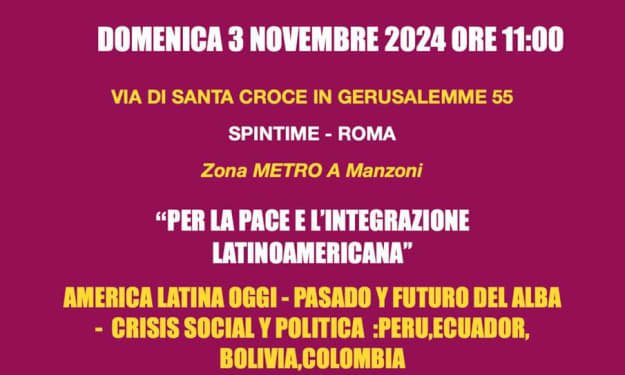
IV Meeting of the Latin American Community in Italy-Europe
The event featured an important program of speeches and discussions. Among the speakers were Carlos Brito, Eder Obando, Luz Miriam Jaramillo, journalist and writer Geraldina Colotti, and Jorge Ceriani, each bringing unique and in-depth insights into the internal dynamics and challenges facing each Latin American country during this critical period. Their analyses highlighted how external influence policies undermine the stability and social and economic development of Latin America, sparking a lively debate among attendees.
By Maddalena Celanoabout a year ago in History
Cuba and Ecuador: Two Energy Crises and One Western Propaganda
1. Cuba: Between Catastrophism and Demonization The coverage of Cuba's energy crisis by European media, particularly Spanish outlets, can be described as a bombardment of apocalyptic headlines: “Cuba is staring into an abyss,” “An island immersed in hellish darkness.” Publications such as El Mundo or El País transform the island's difficulties into a continuous descent into hell, insisting on a supposed “systemic failure” and the inevitability of collapse. The message, veiled or not, is clear: the crisis is the result of a “failed revolution.”
By Maddalena Celanoabout a year ago in History
Broken and Reconstructed Voices: Decolonial Feminism and the Rewriting of History through Black and Latin American Women
Intellectuals such as Angela Davis, Lélia Gonzalez, and María Lugones have shed light on how patriarchy and colonialism have intertwined to form structures of domination. Through their works and the commitment of Afro-Latin American activists, an invitation emerges to radically rethink history, intertwining voices and perspectives that expand and transform conventional narratives. This rewriting of history is not merely about representation; it becomes an act of social justice aimed at dismantling oppressive hierarchies and making visible the experiences and contributions of these women.
By Maddalena Celanoabout a year ago in BookClub
BEYOND SILENCE: TOWARDS A FEMINIST CRITIQUE OF HISTORICAL NARRATIVES
Recovering these experiences and integrating them into official accounts not only enriches our understanding of history but also reveals how women have actively participated in movements for civil and social rights. For instance, Angela Davis's book *Women, Race, & Class* (1981) examines the crucial role that women of color played in the suffrage movement, highlighting intersections between gender, race, and class.
By Maddalena Celanoabout a year ago in Pride