
The Goose Company
This past Friday, November 15, 2024, the Russian House in Rome hosted the presentation of the poetry book The Goose Company b Natalia A. Stepanova (born in Saratov, Russia) has lived and worked in Rome since 1972. She has published several poetry books in Italian, earning multiple awards. Together with E. Vaghin, she translated Barbara Alberti's novel Jealous of Mayakovsky inRussia in Verse fRussia Beyond the Headlines.Degli horti romani (2019). During the event, Natalia A. Stepanova shared insights into her creative process, emphasizing the deep connection between her Russian identity and her lived experience in Italy. The audience particularly appreciated the discussion of the mythical and religious symbolism of geese in Russian Orthodox tradition, where the goose represents vigilance, purity, and the connection between the earthly and the divine. This layer of spiritual and cultural significance transformed the evening into more than a literary moment—it became a profound reflection on Russian soul.
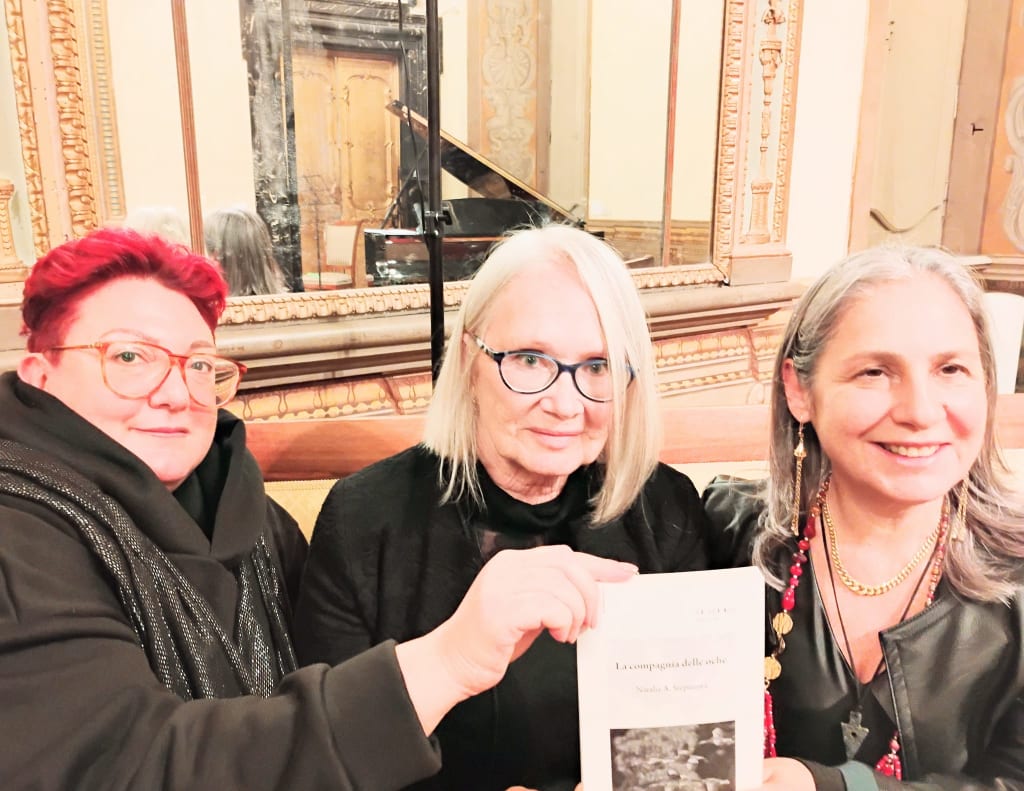
In the collection, the goose is not just an animal but a multifaceted symbol deeply rooted in Russian Orthodox tradition, representing a bridge to transcendence. Through this imagery, Stepanova crafts a poetic language that evokes the connection between the sacred and daily life, urging reflection on humanity’s detachment from nature and spiritual roots.
Stepanova’s writing does not merely describe emotions; it delves into their essence: solitary joy, intimate pain, and the tension between the desire for protection and the harshness of life in “great cities.” The earth, depicted as a nurturing mother, becomes a refuge for humans, standing in stark contrast to the alienation of urban life, where the “bitter people” (gente amara, one of the poems featured in the collection) lose their connection to the sacred dimension of everyday existence.
Her poem Gente Amara offers a stark yet poignant exploration of modern human alienation and the need to reconnect with Mother Nature:
"And under the snow, the flowers sleep.
But for the men (bitter people
of great cities: bodies
four walls, fear of death)
other men, of semblance,
who believed they were gods,
claimed they were creators
of bodies, and of winds,
and of rains, and spoke
of the end of the world,
and showed death,
and the bitter people were afraid."
These lines, in their simplicity, encapsulate a profound existential unease. The "bitter people" of cities are portrayed as prisoners of a life confined by four walls, severed from nature and spirituality. Stepanova critiques a world where humans, “of semblance,” arrogate the role of creators but instead foster fear and alienation, disconnecting humanity from its most authentic roots.
In contrast, the earth, as the mother of "winds, rains, and roots," emerges as a salvific figure, offering shelter and protection—a symbolic and spiritual haven. It is in nature that the meaning of life is rediscovered, juxtaposed with the emotional and moral desolation of urban environments. The snow covering the flowers symbolizes not just winter but also a moment of quiet and protection, a prelude to renewal.
Through her rare and evocative poetic imagery, Stepanova invites readers to ponder the dehumanization of modern society and the imperative to rediscover a connection with the natural world. Her writing, suspended between denunciation and lyricism, resonates deeply, addressing both the individual and humanity as a whole.
The Goose Company is not just a poetry collection but a spiritual and cultural journey that reminds us of the importance of returning to the simplicity and sanctity of life. A reading that, with its complexity and beauty, becomes a transformative experience.
About the Creator
Keep reading
More stories from Maddalena Celano and writers in Poets and other communities.


Comments
There are no comments for this story
Be the first to respond and start the conversation.