Cosmic Dread
Bio
A cosmic horror writer. I blend real science with chilling possibilities, exploring the terrifying forces of the universe—black holes, rogue planets, and cosmic horrors lurking in the cold void of space.
Stories (21)
Filter by community
The Abyss of Jupiter
Jupiter, the largest planet in our solar system, has long been a source of awe and fear. Its swirling clouds and raging storms, including the infamous Great Red Spot, make it a planet of chaos and power. But there is something far more sinister lurking within Jupiter—a mysterious hole, a cosmic anomaly that defies explanation and chills the soul. This is not a simple crater or a passing disturbance; it is an abyss, an incomprehensible void, and its presence raises terrifying questions about the nature of the planet and the horrors that might lie within.
By Cosmic Dreadabout a year ago in BookClub
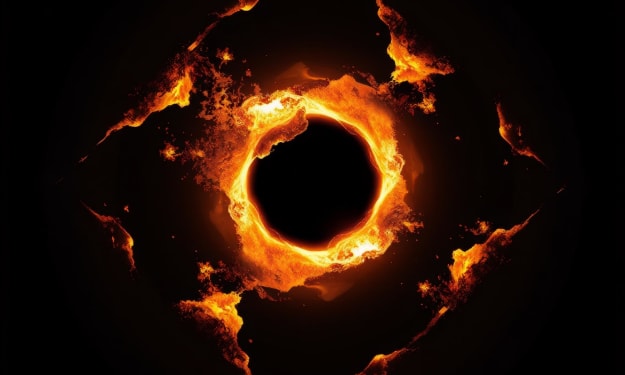
The Cosmic Flare: Annihilator of Black Holes
In the darkest, most forsaken corners of the universe, where even black holes rule with indifference, there exists a force so catastrophic, so unspeakably violent, that it strikes fear into the heart of existence itself: the Cosmic Flare. This is no ordinary supernova or gamma-ray burst; it is an event so incomprehensibly destructive that it can annihilate the mightiest forces of nature—black holes—reducing them to cosmic ash. What makes the Cosmic Flare even more terrifying is its unpredictability. It strikes without warning, leaving nothing but death and the utter obliteration of reality in its wake.
By Cosmic Dreadabout a year ago in BookClub
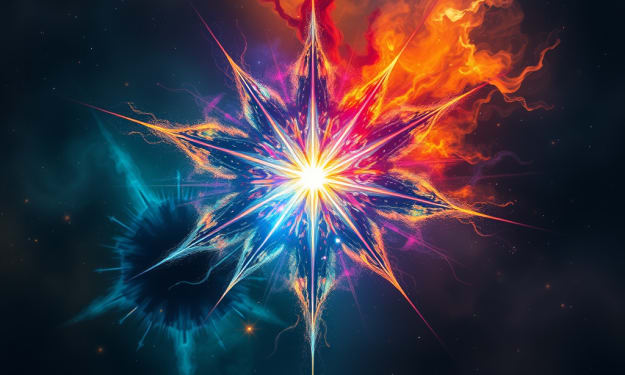
The Blinking Star: Cosmic Beauty, Galactic Doom
Far beyond the reach of our telescopes, beyond the familiar constellations, there exists a star that defies every law of nature: the Blinking Star. At first glance, it is a dazzling wonder of the universe, a celestial beacon that shifts through a spectrum of mesmerizing colors. Blues, reds, and greens swirl around it in an awe-inspiring display of cosmic beauty. But this display is no mere spectacle—each color hides a terrifying truth, and the star’s brilliance may be a signal of something far darker and more destructive than we could ever imagine.
By Cosmic Dreadabout a year ago in BookClub
Pluto: The Frozen Harbinger of Cosmic Doom
Pluto, the icy, distant world on the fringes of our solar system, has long been viewed as a desolate, frozen wasteland—a cold, lonely rock spinning endlessly at the edge of the Sun's influence. But beneath its frigid surface and diminutive size lies a far more terrifying reality: Pluto is not merely an inert, forgotten planet, but a cosmic enigma shrouded in layers of chilling mystery and potential danger. A dark outpost at the edge of space, Pluto may hold secrets capable of unraveling our understanding of the solar system, or worse, doom us all.
By Cosmic Dreadabout a year ago in BookClub
The Indestructible Nightmare: The Turquoise Dwarf Planet
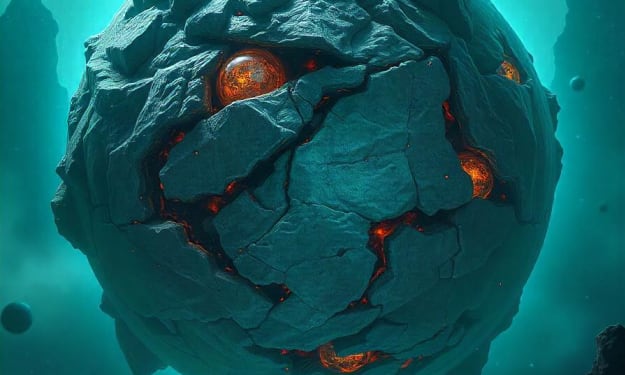
Deep in the farthest reaches of space, beyond the familiar star systems and galactic wonders, lies an ominous enigma: the Turquoise Dwarf Planet. This unassuming, eerie celestial body is more than just a tiny world floating in the cosmic abyss—it is a terrifying paradox, a planet that defies the laws of nature and mocks the universe’s most destructive forces. Its radiant turquoise hue belies the apocalyptic resilience it harbors. For billions of years, it has withstood assaults that would obliterate any other world, emerging each time unscathed, untouched, and indestructible. Some scientists have speculated that the planet may be eternal, a cosmic anomaly whose origins and durability defy all logic. But the true horror of the Turquoise Dwarf Planet lies not only in its unyielding durability but in the destructive potential it holds—an indomitable fortress that could be weaponized to wreak untold havoc across the universe.
By Cosmic Dreadabout a year ago in BookClub
Cosmic Collision: The Devastating Future of the Milky Way and Andromeda's Inevitable Clash
The neighboring galaxy poised to collide with the Milky Way is the Andromeda Galaxy, a colossal spiral of stars, gas, and dark matter hurtling toward us at a staggering 110 kilometers per second. What lies ahead in the distant future is one of the most catastrophic cosmic events ever imagined—a slow-motion apocalypse that will transform the night sky into a chaotic battlefield of colliding stars and gas clouds, eventually obliterating the familiar structure of both galaxies. The collision, which is predicted to occur in about 4.5 billion years, won’t merely be a passing event—it will be an existential threat to everything we know about our cosmic neighborhood.
By Cosmic Dreadabout a year ago in BookClub
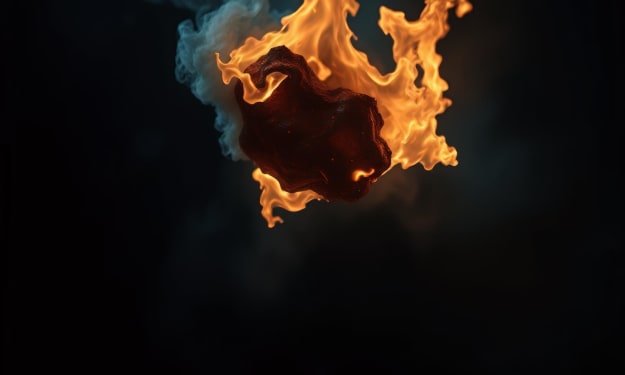
"The Lunar Cataclysm: When the Moon Falls and Earth Shatters"
A Slow Descent into Chaos For billions of years, the Moon has been Earth’s quiet sentinel, governing our tides, stabilizing our planet’s tilt, and illuminating the night sky. It has always been a symbol of mystery and serenity. But in this terrifying scenario, the Moon—our cosmic neighbor—has fallen from its orbit, doomed to collide with Earth in a catastrophic event that would shatter our world.
By Cosmic Dreadabout a year ago in BookClub
"Jupiter's Breath: The Death That Ended Earth"
The Beginning of a Nightmare Jupiter, the behemoth of our solar system, has always loomed over Earth as a colossal guardian, its immense gravity protecting us from errant asteroids and comets. But in this dark twist of fate, that same gas giant—the largest planet in our celestial neighborhood—becomes our executioner. A mysterious force triggers a catastrophic event on Jupiter, causing its hydrogen and helium-rich atmosphere to destabilize. Slowly, the planet begins to evaporate, sending massive plumes of deadly gas spiraling into the solar system.
By Cosmic Dreadabout a year ago in Horror
"The Saturn Apocalypse: Earth’s Final Reckoning"
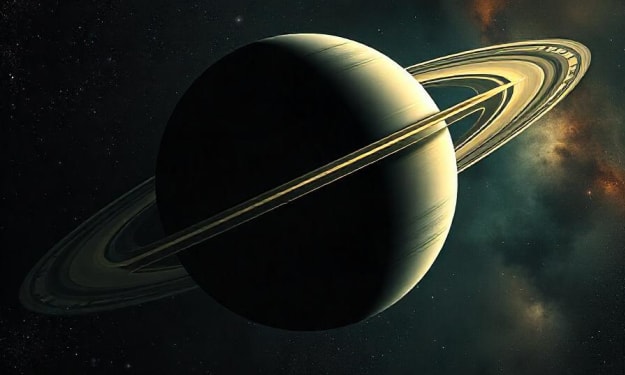
Saturn—one of the most iconic planets in our solar system, renowned for its magnificent rings—has long fascinated scientists and the public alike. Its tranquil presence, millions of miles away, has lulled humanity into a false sense of security. But what if that peace were to be shattered? Imagine a catastrophic event where Saturn, a gas giant nine times wider than Earth, begins to disintegrate. The consequences of such an astronomical disaster would be unimaginably terrifying, and Earth would be thrust into a cosmic nightmare.
By Cosmic Dreadabout a year ago in Horror
The Abyssal Prism
Black holes have long fascinated scientists for their immense gravitational power and their mysterious ability to warp space and time. Traditionally, black holes are understood to be spherical or somewhat distorted due to their extreme mass. However, a new theoretical concept has emerged—one that challenges our understanding of these cosmic phenomena: the Abyssal Prism.
By Cosmic Dreadabout a year ago in BookClub
The Silent Echo
Space is often described as a place of silence, where no sound can travel through the vacuum of the cosmos. Yet, what if that isn’t entirely true? What if, in the boundless dark, there exists a sound—one that shouldn’t be heard? This is the story of the Silent Echo, a sound so terrifying and inexplicable that those who heard it were never the same again.
By Cosmic Dreadabout a year ago in BookClub
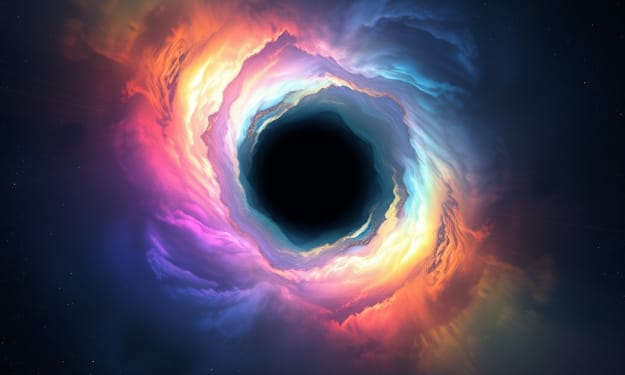
The Rainbow Hole
In the vast expanse of the universe, black holes have long fascinated scientists for their immense gravitational pull and mysterious nature. But what if, somewhere out in the depths of space, there existed something even more peculiar—something as beautiful as it is terrifying? Enter the concept of the "Rainbow Hole," a theoretical cosmic phenomenon that functions similarly to a black hole, yet is entirely different in appearance and behavior. Instead of being a void that consumes everything in its path, a Rainbow Hole radiates a kaleidoscope of colors, offering a dazzling display that hints at unknown physical laws and realities.
By Cosmic Dreadabout a year ago in Fiction