

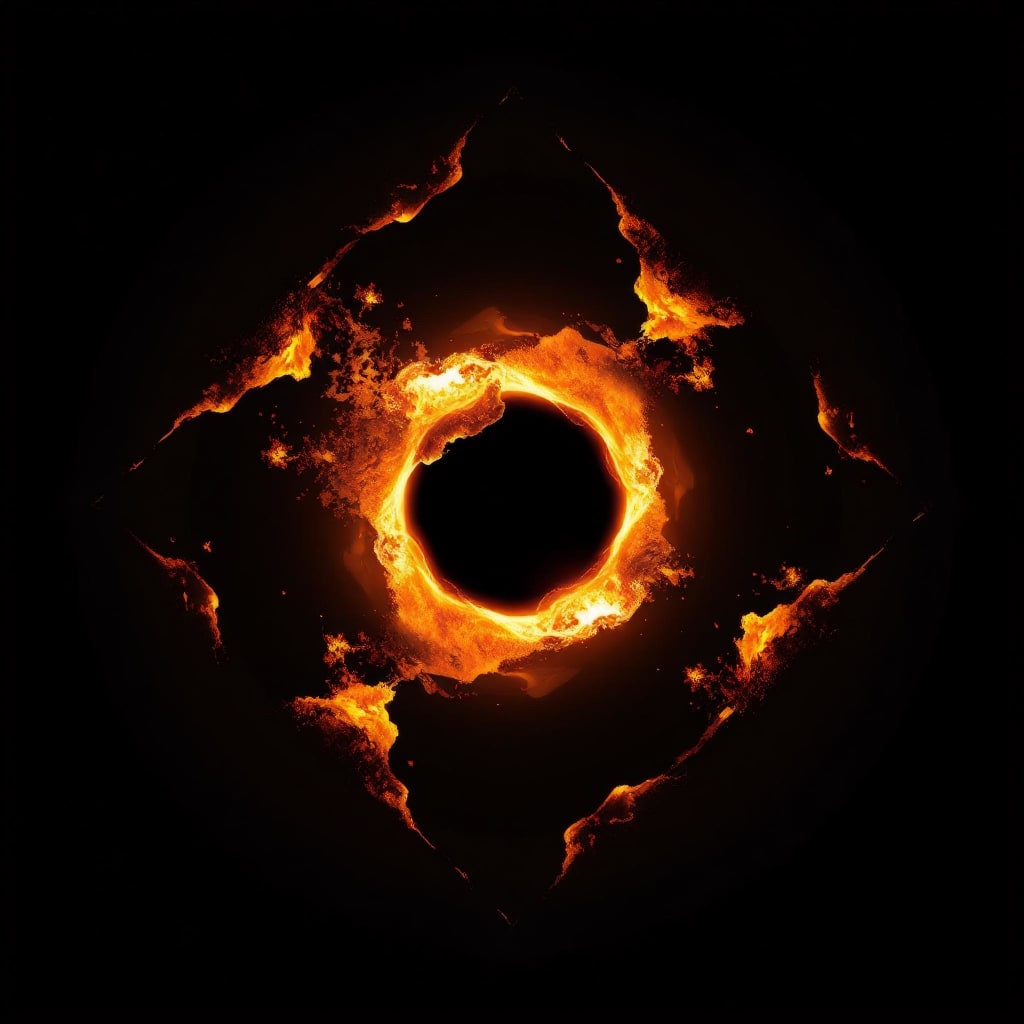
Black holes have long fascinated scientists for their immense gravitational power and their mysterious ability to warp space and time. Traditionally, black holes are understood to be spherical or somewhat distorted due to their extreme mass. However, a new theoretical concept has emerged—one that challenges our understanding of these cosmic phenomena: the Abyssal Prism.
This theory, proposed by a group of astrophysicists exploring the complexities of multidimensional space, suggests that under certain conditions, black holes could form in non-spherical shapes, most intriguingly resembling a jagged, angular prism. Unlike the familiar black hole, which devours all light, an Abyssal Prism warps and refracts light in terrifying ways, casting eerie, fractured rainbows across space. This distortion of reality, combined with its crushing gravitational forces, makes the Abyssal Prism both a cosmic marvel and a nightmare.
But what would such an entity look like? How would it behave? And what implications would it have for our understanding of the universe? Let’s explore the possible origins and mechanics of the Abyssal Prism.
Part 1: The Origins of the Theory
The concept of the Abyssal Prism originates from complex models within string theory and higher-dimensional physics. In standard three-dimensional space, the immense force of gravity causes collapsing stars to form singularities, resulting in spherical black holes. The perfect symmetry of space-time pulls everything inward evenly, creating a round event horizon.
However, when factoring in the existence of higher dimensions or the warping of space-time in ways that we do not yet fully understand, new possibilities emerge. One such possibility is the formation of a non-spherical black hole—an angular, multifaceted structure that distorts not just light, but reality itself. Dr. Elena Marquez, an astrophysicist at the Quantum Space Research Institute, first hypothesized the existence of the Abyssal Prism during a study of cosmic string interactions.
“If space-time is disrupted by powerful forces—such as dark energy, exotic matter, or the remnants of the early universe—it could fold or twist in ways we’ve never seen before,” Dr. Marquez explained. “In these conditions, the singularity might not form as a sphere, but as a more jagged, prismatic shape.”
Part 2: Structure and Visual Distortion
While the concept of an Abyssal Prism is terrifying in its gravitational power, what makes it even more disturbing is its appearance and behavior. Unlike a traditional black hole, whose event horizon is smooth and spherical, an Abyssal Prism is angular, with sharp edges and facets that bend light around them in horrifying ways. It warps space into a jagged structure, as if reality itself is cracking under the immense pressure.
Imagine looking at this abyss from a distance: instead of seeing a singular void of blackness, the Abyssal Prism would appear as a twisted, crystalline void, with light bending and fracturing along its many facets. Stars and cosmic matter near it would stretch, elongate, and contort, creating the appearance of shattered glass or fractured reflections.
This prismatic effect is caused by the warped space-time around the entity. While a typical black hole simply swallows light, the Abyssal Prism fractures it into spectral colors, creating a cosmic nightmare of shimmering rainbows and dark shadows. The light isn’t merely consumed; it’s torn apart, refracted across the angular surfaces of the event horizon.
Some researchers theorize that this fracturing of light could lead to ghostly afterimages—false echoes of stars and objects, making it impossible to tell what is real. Approaching an Abyssal Prism might cause space travelers to see warped reflections of their ship, stretched across the abyss like some twisted mirror, trapping them in a disorienting web of illusions.
Part 3: Behavior and Anomalous Effects
While the geometry of an Abyssal Prism is terrifying, its behavior is even more disturbing. The gravitational forces around such an entity would be wildly unpredictable. In a traditional black hole, matter is uniformly drawn toward the center in a smooth, spherical pattern. But around an Abyssal Prism, gravitational forces could vary dramatically depending on the angle of approach.
These anomalies could result in bizarre and violent tidal forces. An object falling into an Abyssal Prism might be torn apart asymmetrically—one part of the object stretched into oblivion, while another is crushed instantly. Matter might be flung out at impossible angles, pulled into different dimensions, or fragmented into nothingness.
In addition to these gravitational anomalies, the Abyssal Prism could also produce terrifying lensing effects. From a distance, the light-bending properties of this cosmic entity would make it appear to shimmer and shift, with objects near it becoming increasingly distorted the closer they came. This visual distortion would be so extreme that the Abyssal Prism could appear to vanish and reappear in different locations, flickering like some terrible cosmic hallucination.
Part 4: The Role of Higher Dimensions
To understand how an Abyssal Prism could form, we must delve into the world of higher-dimensional physics. Theoretical models suggest that black holes might behave very differently when influenced by the curvature of space-time in multiple dimensions.
Some researchers propose that the Abyssal Prism could exist in a region where space-time has been twisted by higher-dimensional forces, such as the intersection of cosmic strings—hypothetical remnants from the Big Bang—or concentrated regions of dark energy. These interactions could lead to the formation of an event horizon with angular facets, rather than the smooth, continuous surface we associate with traditional black holes.
The bending and refraction of light around these facets might be the key to understanding how such an entity forms. In the standard three-dimensional universe, light and gravity follow predictable paths. But in a region influenced by higher dimensions, these paths could warp in ways we can’t yet fully comprehend, leading to the prismatic splitting of space-time itself.
Part 5: Terrifying Implications for Space and Time
The discovery of an Abyssal Prism would represent a new frontier in our understanding of the universe. It would prove that space-time is far more flexible and strange than we’ve imagined, capable of twisting itself into shapes that defy traditional geometry.
Even more terrifying, the existence of an Abyssal Prism suggests that the universe is filled with strange anomalies that do not fit into our current models of physics. The implications for space travel, cosmic exploration, and the future of science would be profound—and terrifying.
For instance, the gravitational anomalies around an Abyssal Prism might disrupt entire solar systems, flinging planets and stars out of orbit. Any spacecraft unfortunate enough to approach too closely could be shattered or lost to some unknown region of space-time, beyond the reach of rescue.
Even more chilling is the idea that the Abyssal Prism could act as a gateway to other dimensions or parallel realities. Given its interaction with higher-dimensional forces, it’s possible that objects or even entire regions of space could be pulled into an alternate universe, never to return.
Conclusion: A Cosmic Horror
The Abyssal Prism represents one of the most terrifying possibilities in theoretical astrophysics. Unlike the familiar black hole, which is already a source of mystery and fear, the Abyssal Prism distorts not only light and matter but the very fabric of reality. Its sharp, prismatic event horizon, combined with its unpredictable gravitational effects, makes it a cosmic horror of unimaginable proportions.
The universe may be filled with strange and dangerous entities, but few could match the terror of an Abyssal Prism—a jagged, fractured void in space, warping light and time, waiting to consume anything unfortunate enough to fall into its chaotic grasp.
If such an entity exists, it would be the ultimate reminder that the universe is not just unknown, but deeply, fundamentally alien—and far more terrifying than we can imagine.
About the Creator
Cosmic Dread
A cosmic horror writer. I blend real science with chilling possibilities, exploring the terrifying forces of the universe—black holes, rogue planets, and cosmic horrors lurking in the cold void of space.
Keep reading
More stories from Cosmic Dread and writers in BookClub and other communities.
The Silent Echo
Space is often described as a place of silence, where no sound can travel through the vacuum of the cosmos. Yet, what if that isn’t entirely true? What if, in the boundless dark, there exists a sound—one that shouldn’t be heard? This is the story of the Silent Echo, a sound so terrifying and inexplicable that those who heard it were never the same again.
By Cosmic Dreadabout a year ago in BookClub
My New Book is Finally Here
My poetry collection Beautiful and Brutal Things is done. It's actually done and finally published over 270 pages. Over a year of my life went into this book. More than a year, really. Long days at my computer, sometimes seven days a week because I couldn't stop even when I probably should have. Then two months of editing that felt harder than the writing itself. But it's finished, and I'm still standing, and the book is real.
By Tim Carmichael2 days ago in BookClub
7 Time Travel Books You Must Read In 2026
Time travel has fascinated readers and storytellers for centuries. The allure of bending time, revisiting the past, or glimpsing the future taps into our deepest curiosities about life, destiny, and human potential. Whether you're a fan of science fiction, historical adventures, or philosophical explorations, time travel books offer more than just escapism—they challenge the way we perceive reality. Below is a list of 7 time travel books you must read in 2026.
By Diana Meresc6 days ago in BookClub




Comments (1)
I love black holes. I'm following the royal institute YouTube channel to learn about black holes. Thanks for this. If you wish you can subscribe me as well as I did to you 🥰