
"The Lunar Cataclysm: When the Moon Falls and Earth Shatters"
When Our Silent Companion Becomes the Engine of Humanity's Destruction

A Slow Descent into Chaos
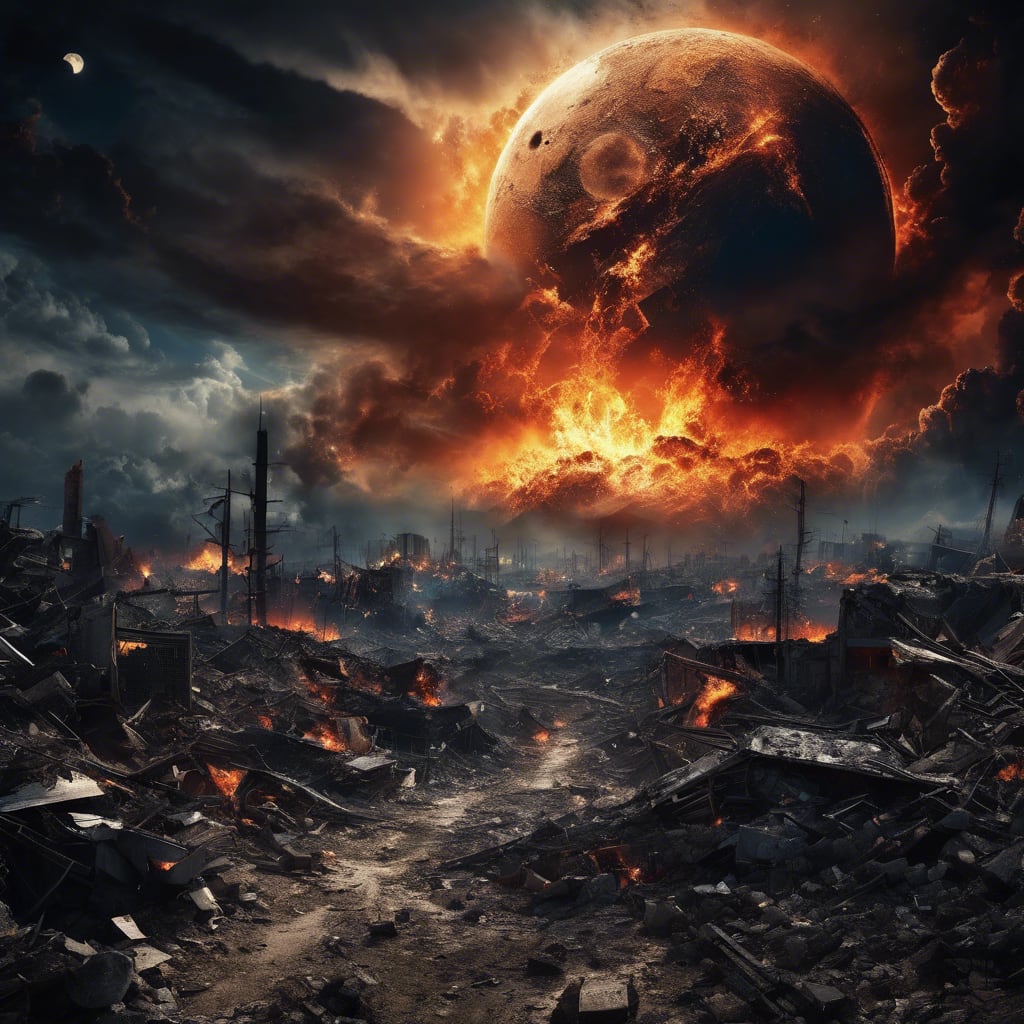
For billions of years, the Moon has been Earth’s quiet sentinel, governing our tides, stabilizing our planet’s tilt, and illuminating the night sky. It has always been a symbol of mystery and serenity. But in this terrifying scenario, the Moon—our cosmic neighbor—has fallen from its orbit, doomed to collide with Earth in a catastrophic event that would shatter our world.
The cause? Perhaps an invisible force—dark matter or a rogue black hole—disrupts the Moon’s orbit. Or, perhaps, human interference through advanced space experimentation leads to the unthinkable. Whatever the reason, the result is an unavoidable collision that would forever change the course of Earth’s history—and annihilate all life in the process.
The Sky is Falling
As the Moon begins its deadly descent, the first signs of disaster would appear slowly—an eerie calm before the storm. The lunar orbit would tighten, drawing the Moon ever closer to Earth. At first, it would seem like a spectacle, with the Moon growing larger in the night sky. But soon, wonder would give way to horror.
The tides, governed by the Moon’s gravitational pull, would become erratic and monstrous. Tsunamis larger than anything ever witnessed would devastate coastal cities. Waves hundreds of feet tall would crash inland, swallowing entire regions. The oceans would churn in chaos, with hurricanes of unprecedented scale forming over their surfaces.
As the Moon draws nearer, Earth’s gravitational pull would begin to tear it apart. Massive chunks of lunar rock, some as large as mountains, would break free, raining down on Earth in a deadly meteor storm. These fragments, burning as they crash through the atmosphere, would bombard the planet with the force of nuclear explosions, leveling cities, igniting forests, and reducing entire landscapes to smoldering craters.
A Planetary Shockwave
When the Moon finally collides with Earth, the impact would unleash energy beyond comprehension—billions of nuclear bombs detonating at once. The surface of the planet would crack like an egg, sending colossal shockwaves around the globe. The ground itself would ripple and shatter as tectonic plates buckle under the pressure. Earthquakes of unimaginable magnitude would devastate every corner of the planet, splitting continents and creating vast, unpassable chasms.
The explosion would vaporize everything within thousands of miles of the impact site in an instant—cities, forests, mountains—all reduced to ash in a blinding flash of heat and light. Even in areas far from the point of impact, entire landscapes would be set ablaze. Firestorms would rage across the globe, turning the sky a fiery red as Earth's atmosphere ignites in a storm of heat and debris.
The impact would trigger volcanic eruptions worldwide, spewing molten rock and ash into the air. The Earth's surface would become a hellscape of erupting volcanoes, rivers of lava, and endless firestorms. Ash clouds would blot out the sun, plunging the world into darkness as temperatures plummet. The planet would enter a deep, unrelenting volcanic winter that could last for centuries.
The Collapse of Life
The devastation wouldn't stop at the physical destruction. The very environment that supports life would collapse. The skies would fill with dust and debris, blocking out sunlight and plunging Earth into an endless night. Plants would die within days as photosynthesis grinds to a halt, and with them, the food chain would disintegrate. Herbivores would starve, followed swiftly by carnivores. Mass extinction would begin almost immediately, wiping out entire species in a matter of weeks.
Humans, huddled in shelters or bunkers, would struggle to survive in this new, apocalyptic world. With the air thick with ash and debris, breathing would become difficult, and the already strained resources would dwindle rapidly. As the temperatures drop, famine and disease would spread like wildfire, decimating any survivors left.
The Moon’s impact would also destabilize Earth’s rotation and axis. Without the Moon to regulate our planet’s tilt, Earth would wobble wildly, causing extreme climate shifts. One side of the planet could freeze over in perpetual darkness, while the other scorches under constant, searing sunlight. The remaining survivors would be trapped in a never-ending cycle of fire and ice.
The Final Moments
As the Moon crashes deeper into the Earth’s surface, the planet itself would begin to break apart. The molten core, now destabilized by the massive energy transfer, could rupture, sending magma surging to the surface in a violent, world-ending eruption. Earth’s magnetic field would collapse, leaving the planet exposed to the full, deadly force of solar radiation.
The Earth’s atmosphere, already torn apart by the Moon’s descent, would disintegrate further, allowing the vacuum of space to invade the once-protected surface. Temperatures would plummet as the remaining air escapes into space, and Earth’s surface would become a frozen wasteland, incapable of sustaining any form of life.
In these final moments, the planet would become unrecognizable—a charred, fragmented shell drifting through space. The collision would likely send debris spiraling into orbit, forming a massive ring of dust and rock around what’s left of the planet, a grotesque reminder of the Moon that once orbited so peacefully. The devastation would be so complete that, even from distant stars, Earth would no longer look like a blue, thriving world. Instead, it would be a dim, ruined rock—a lifeless relic of a world that once held so much promise.
A Dead Planet
In the aftermath, nothing would remain. Earth’s oceans would have evaporated into space, its continents shattered and burned. The once-vibrant ecosystems that flourished across the globe would be erased, replaced by vast fields of rubble, jagged mountain ranges formed by the collision, and endless expanses of ash.
For any lifeform that might observe Earth from afar, it would appear as a broken, dead world—a planetary graveyard floating in the void. No traces of humanity, no monuments to our achievements, no signs of life. Everything—civilization, nature, and all living creatures—would be gone, wiped out in a single, cataclysmic event.
The Moon, which once graced our skies with its gentle glow, would be the instrument of our ultimate demise. What was once a symbol of tranquility and mystery would have become the force that shattered Earth, turning our planet into nothing more than a ghost of its former self. The silent witness to human history would now be our destroyer, leaving only dust, ruin, and silence in its wake.
In the end, the collision would remind us of one terrifying truth: in the vastness of space, nothing is permanent. Even the Moon, our closest and most constant companion, can become the engine of our doom. And when it does, there will be no escape—only the cold, final silence of a planet lost to a cosmic nightmare.
About the Creator
Cosmic Dread
A cosmic horror writer. I blend real science with chilling possibilities, exploring the terrifying forces of the universe—black holes, rogue planets, and cosmic horrors lurking in the cold void of space.
Keep reading
More stories from Cosmic Dread and writers in BookClub and other communities.
The Abyssal Prism
Black holes have long fascinated scientists for their immense gravitational power and their mysterious ability to warp space and time. Traditionally, black holes are understood to be spherical or somewhat distorted due to their extreme mass. However, a new theoretical concept has emerged—one that challenges our understanding of these cosmic phenomena: the Abyssal Prism.
By Cosmic Dreadabout a year ago in BookClub
My New Book is Finally Here
My poetry collection Beautiful and Brutal Things is done. It's actually done and finally published over 270 pages. Over a year of my life went into this book. More than a year, really. Long days at my computer, sometimes seven days a week because I couldn't stop even when I probably should have. Then two months of editing that felt harder than the writing itself. But it's finished, and I'm still standing, and the book is real.
By Tim Carmichael2 days ago in BookClub
Rachel Reviews: Paradise Cove - They Escaped the Cuckoo's Nest by Pini Dunner
On starting Pini Dunner's book, I was grateful for the thorough history that is provided at the start. This gives a much-needed context in order to enjoy the subsequent letters contained therein. The letters belong to George Nagel, an octagenarian pursuing a psychology degree which in itself would be remarkable; however, it is soon clear that this is just one remarkable thing in a life full of them.
By Rachel Deeminga day ago in BookClub



Comments
There are no comments for this story
Be the first to respond and start the conversation.